
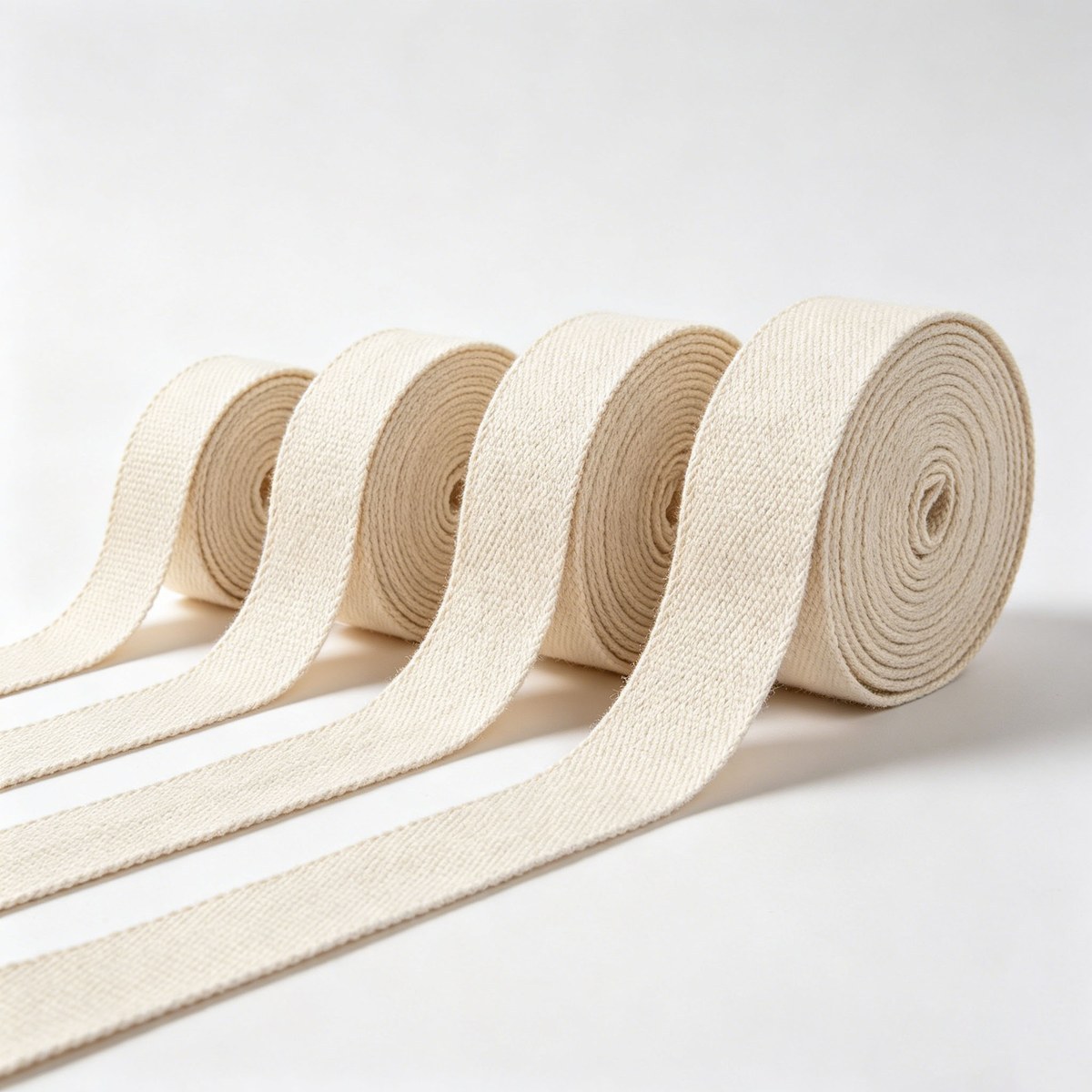
Cotton Webbing vs Nylon Webbing: Which Material Is Better for Your Application?
Cotton webbing vs nylon webbing is a decision most product teams meet twice: once when a range moves between natural and technical positioning, and once when a band that looked right on the sample comes back from the wash a size smaller or a shade lighter. The two fibers are specified against the same four requirements — load, surface comfort, wash behavior and appearance — and they answer them in almost opposite ways.
Cotton is a spun staple fiber: matte, absorbent, low-stretch, comfortable, and the one that moves in the wash. Nylon is a continuous filament: high tensile, elastic under load, low absorbency, and the one that needs a coating or a weave decision to feel good against skin. Neither fiber is the better webbing in the abstract. Each is the better band for a specific set of conditions, and the conditions are written down before the fiber is chosen.
For a sourcing team the practical risk is choosing on hand feel alone, because hand feel at delivery is the property that changes fastest in service. This guide compares cotton webbing vs nylon webbing on strength, stretch, moisture behavior, comfort and color, sets out which application each fiber fits, and closes with five questions that settle the choice for a specific product.
Cotton Webbing vs Nylon Webbing at a Glance
The differences cluster into six properties, and each row of the table is a decision the specification has to make explicitly rather than inherit.
| Property | Cotton webbing | Nylon webbing |
|---|---|---|
| Tensile at same width | Lower; drops further when wet | Higher and stable when wet |
| Stretch under load | Very low; no elastic recovery | Noticeable; recovers after the load |
| Moisture behavior | Absorbs; dries slowly; shrinks on washing | Low absorbency; dries fast; dimensionally stable |
| Surface against skin | Cool, matte, no coating needed | Slick unless woven or coated for grip |
| Color and appearance | Yarn-dyed matte shades; jacquard-friendly | Deep saturated dyes; slight sheen |
| Edge behavior | Staple yarns fray; sew or bind the ends | Melts sealed when hot-cut |
Two of those rows usually decide the outcome. Moisture behavior decides anything that will be washed repeatedly or used wet, and stretch decides anything where the band sets the length of the product. The other rows are adjustments; those two are the fork.
Strength and Stretch: Nylon Webbing Pulls Ahead of Cotton Webbing
Nylon webbing carries more load at the same width and thickness, and it keeps that rating when wet, which is why it is the default for harnesses, tie-downs and anything with a safety function. It also stretches under load and returns, which is an advantage in a rescue sling and a defect in a belt: a nylon belt grows with the wearer, and the buckle has to be re-set through the day.
Cotton webbing holds its length under load, and that dimensional stability is why belts, apron ties and bag handles read as well-fitted months later. What it gives up is load margin: the same width in cotton rates lower in tensile, and the wet figure drops further, so any cotton band in a load path needs its rating verified at the finished width rather than assumed from the synthetic equivalent. Neither behavior is better; they suit different load paths, and the drawing should say which one the product is in.
Moisture Behavior: Where Cotton Webbing and Nylon Webbing Split
A cotton band absorbs water into the staple yarn itself. It dries slowly, loses part of its wet strength while wet, and shrinks on the first wash unless it was pre-shrunk at the mill. On a product that is washed weekly — a bib, an apron, a tote that follows groceries — shrinkage is the property that decides whether the band still sits flat against the panel it was sewn into.
Nylon absorbs very little, dries quickly and holds its dimensions through the same cycles, which is why it dominates wash-heavy and outdoor products. Its cost is elsewhere: a wet nylon band stays slick, and dye migration and UV aging behave differently than on cotton. Where a product sits between the two — a pet collar in a natural-tone range, a handle on a canvas tote — the usual answer is cotton for the surface and a shorter wash cycle, or a cotton-face construction over a stronger core, rather than one fiber pretending to be the other.
How Cotton and Nylon Webbing Age in Service
The two fibers age differently, and the aging pattern is often what the buyer is actually choosing between. Cotton webbing ages toward softness: the staple surface breaks in, the dye lightens slightly at high-wear points, and a band that was stiff at delivery reads as worn-in by month three. Its failure modes are shrinkage around a panel, color loss at the rub points, and edge fray where a slit edge meets a buckle — all visible, all slow, and all caught by a wash test before bulk.
Nylon webbing ages toward its surface. The fiber keeps its strength for years, so what ages is the finish: a coating wears at the contact points, the sheen dulls, and UV exposure works on the filament at the edges. A nylon band that looks tired is usually still at its rated tensile, while a cotton band that looks tired may have lost real strength at a rub point. That asymmetry is worth carrying into any inspection routine: cotton bands are checked visually at stress points, nylon bands are checked for coating integrity and edge melt quality. Both checks are cheap on a sample and expensive on a returned carton, which is the whole argument for running them before bulk.
Comfort and Color: Where Cotton Webbing Wins
Cotton needs no coating to feel right against skin or a coat. The staple surface absorbs the moisture that would otherwise sit between skin and band, which is why handles, belts and collar edges in cotton read as softer after a month, not before. That comfort survives wear in a way coatings do not: a coated nylon handle is softest on delivery, and the coating is what abrades first.
On color, the fibers differ in kind rather than rank. Cotton takes yarn dyeing and jacquard lettering cleanly, with a matte depth that suits natural and heritage ranges, and it is the band that disappears into a garment or a canvas bag instead of standing out of it. Nylon takes deeper, more saturated shades and keeps a slight sheen that reads as technical. Polyester webbing sits between them: synthetic strength and moisture behavior with a better matte option than nylon, which is why three-fiber comparisons usually end with polyester rather than with a winner between two.
Which Material Fits Which Application: Cotton Webbing or Nylon Webbing
The application table is the fastest way to a decision, because most products sit clearly in one column.
| Application | Fits cotton webbing | Fits nylon webbing |
|---|---|---|
| Bag and tote handles | Yes — comfort and matte finish | Only if coated or woven for grip |
| Apparel belts and ties | Yes — length stays true | No — grows under body load |
| Harnesses and tie-downs | No — wet strength drops | Yes — the default choice |
| Pet collars, natural ranges | Yes — soft edge, jacquard | Where strength leads the brief |
| Outdoor and wash-heavy straps | No — slow drying, shrinkage | Yes — stable through cycles |
| Binding on natural-fiber goods | Yes — matches fabric hand | Sheen works against the panel |
Read the table by column rather than by row: a product family that lives in the left column buys cotton across the range and manages shrinkage once, while a family that straddles both columns is usually two products rather than one, and specifying them separately is cheaper than finding a fiber that does neither job well.
What Drives the Cost Difference Between the Two
Cotton webbing and nylon webbing are priced by different drivers, which is why a like-for-like comparison has to hold width, weave density and finish constant. Cotton cost follows the staple yarn market and the dye route: yarn-dyed jacquard sits at the top of the cotton range because the color is in the yarn, while piece-dyed plain weave sits lower. Shrinkage control adds a finishing step, and that step is where most of the premium in a wash-stable cotton band lives.
Nylon cost follows filament supply and finishing: a coated or specially woven band costs more than a plain weave at the same width, and jacquard or heavy denier constructions add from there. The comparison that matters to a product is not the per-meter figure but the cost of the failure each fiber avoids: a cotton band specified without shrinkage control fails after the first wash, and a nylon handle specified without grip fails in the hand on the first hot day. Specifying against the actual failure mode is cheaper than either premium.
When Neither Fiber Fits: Hybrid Constructions
A third answer exists between the two, and it is worth naming because it solves the exact case where the comparison stalls: a product that needs a cotton surface and a nylon load path. A cotton-face construction — cotton woven as the visible surface over a stronger core — keeps the hand and the matte color where the customer touches, and puts the tensile where the load runs. It is a common resolution for natural-range pet collars and premium bag handles.
Blended yarns are the other middle path, trading some absorbency and matte depth for dimensional stability, and polyester webbing remains the single-fiber compromise: synthetic strength and wash stability with a better matte option than nylon. Sampling all three — cotton, nylon and the hybrid — on the same product is cheaper than committing to one fiber and redesigning after the first wash test, and it closes the argument with a wash result instead of a preference. The hybrid usually wins wherever the brief carries both a comfort line and a load line, and it fails only where the wash cycle is long enough to find the seam between the two fibers.
Five Questions That Settle a Cotton Webbing vs Nylon Webbing Choice
Asked in order, five questions close the cotton webbing vs nylon webbing decision for a specific product.
- Will the band be washed repeatedly? If yes and the product is light-colored, shrinkage and colorfastness push toward nylon or pre-shrunk cotton, and the care label cycle has to be written into the spec.
- Does the band set a length? Belts, ties and fitted straps need dimensional stability, which favors cotton; slings and adjustable paths tolerate or need stretch, which favors nylon.
- Is the band a load path? Any safety-relevant load moves to nylon, with tensile verified at the finished width and the wet figure included.
- What touches the band? Hands, coats and cheeks favor cotton uncoated; hardware and ground contact favor nylon or polyester.
- What does the range look like? Natural, matte, heritage: cotton. Technical, saturated, sport: nylon. The fiber is part of the positioning, not just the construction.
A brief that answers those five can be quoted without a discovery round, and the sample can be approved against the same list. The testing page carries the reports behind both fibers, and comparing them is fastest when both bands are tested at the same finished width.
FAQ: Cotton Webbing vs Nylon Webbing
Is cotton webbing or nylon webbing stronger?
Nylon webbing is stronger at the same width and thickness, and it keeps that rating when wet. Cotton is adequate for handles, belts and collars where the load is modest, provided tensile is verified at the finished width rather than assumed.
Does cotton webbing shrink more than nylon?
Yes. Untreated cotton shrinks visibly on the first wash; nylon is dimensionally stable through wash cycles. Pre-shrinking closes most of the gap, and a shrinkage limit in the specification closes the rest.
Which one feels better against skin?
Cotton, without a coating: the staple surface absorbs moisture and stays matte. Nylon needs a weave or coating decision to reach the same hand, and coatings are the first thing to wear.
Can cotton webbing replace nylon in a harness?
It should not. A harness is a safety-relevant load path, and the wet-strength loss plus the lack of elastic recovery make cotton the wrong fiber there, whatever the appearance brief says.
What about polyester webbing in this comparison?
Polyester takes the moisture stability of nylon and a more matte surface, at a tensile between the two. Where a product needs synthetic behavior with a natural look, polyester is usually the third answer worth sampling.
Why Buyers Compare Cotton and Nylon Webbing with Xinxiangrui
Cotton webbing vs nylon webbing is decided by wash cycle, load path and surface, in that order. A brief that answers those three lets both fibers be quoted on the same terms, and the sample approval settles the choice with reports rather than opinions.
Xinxiangrui Webbing has woven webbing in Dongguan since 2011, supplying cotton webbing and nylon webbing in the same widths, with tensile, shrinkage and colorfastness tested in-house. Sampling both fibers at the finished width is the fastest way to close the decision, and approved dips keep the shade repeatable whichever fiber the range lands on.