
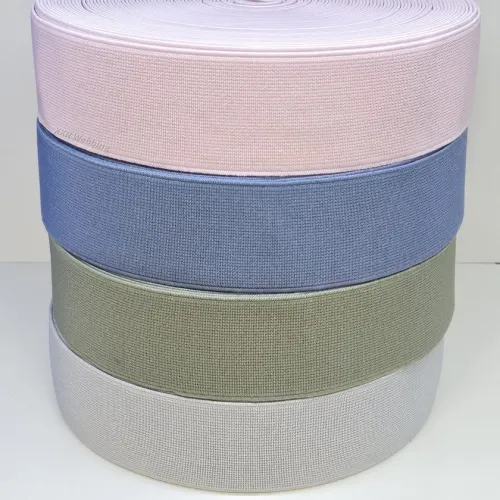
Features
Why Choose Xinxiangrui Webbing?
Source Factory
Direct wholesale production from our own plant in Dongguan, not a trading desk. Weaving, dyeing, printing, hardware assembly and packing all run in house, with no middleman margin in the price.
Full Customization
OEM and ODM work starts from your drawing: width, weave, colour, hardware and retail packaging. We match Pantone, send a physical sample before bulk, and keep every change on one work order.
Strict QA & ISO Standards
Every batch is checked for width, thickness, break strength and colour fastness before it ships, and the plant runs to ISO 9001 and ISO 14001. Test reports for your batch travel with the goods.
Proven Track Record
Fifteen years of narrow fabric since 2011, 200+ active partners and shipments to 50+ markets. Long-run programmes are what this factory is built for, which is why most customers reorder.

We Have The Best Solutions for Your Business
Xinxiangrui has made narrow fabric in Dongguan, China since 2011. Our 8,000 m² plant weaves, dyes, prints, cuts and sews under one roof, supplying 200+ active partners in 50+ markets. We produce polyester, nylon, cotton, elastic, reflective and bio-based webbing, ribbon, lanyards, pet leashes, bags and luggage components, from yarn and reflective tape to finished straps and handles.
Because every step stays in one plant, a widening range does not cost tolerance. Our laboratory tests to 2000N+ break strength, 50,000+ Martindale cycles and 1,000+ hours of UV exposure, and every batch carries its own figures rather than a catalogue sample. We work to OEKO-TEX, CPSIA, REACH, RoHS, ISO 9001, ISO 14001 and GRS. Send us your spec sheet and target quantity, and we will recommend the construction that fits.
Elastic Webbing: Three Constructions
The three families below look similar on a sample card and behave nothing alike in use, which is why the choice belongs at the start of a brief rather than at the end.
| Construction | Surface | Behaviour | Typical use |
|---|---|---|---|
| Woven elastic | Ribbed, firm, holds a shape | Moderate stretch, good recovery, stable width | Waistbands, suspenders, furniture trim |
| Knitted elastic | Soft, matte, slightly bulky | High stretch, gentler compression, softer edge | Garment trims, masks, soft goods |
| Jacquard buttonhole | Patterned, slotted, decorative | Adjustable, visible, less durable at the slots | Adjustable straps, braces, maternity bands |
A figure that is not the same as strength: a 25 mm elastic band is not a 2000N article and should not be specified as one. That load figure belongs to a rigid polyester substrate of the same width, where the filament carries tension without moving. An elastic band is judged on how much it extends, how completely it returns and how long it holds that behaviour, which are three numbers no strength test describes.
Stretch, Recovery and the Difference Between Them
Stretch ratio, which is easy to measure
Stretch ratio is how far a band extends before it stops behaving elastically, expressed as a percentage of its relaxed length. A band quoted at 120 per cent doubles in length before it locks. The measurement is simple, which is why it is the only figure most catalogues print, and it says nothing about what happens afterwards. Two bands with the same ratio can differ by a factor of three in how much length they lose in the first month.
Recovery, which is not
Recovery is how close a band returns to its original length after being held at a stated extension for a stated time. It is measured after a rest period, because an elastic band keeps creeping back for minutes after the load is removed. A band with excellent stretch and poor recovery becomes visibly longer by the end of a season, and the product it holds becomes loose. Recovery is the property that decides whether the band is still doing its job in year two, and it is the one to ask for by name.
Permanent set, the number behind both
Permanent set is the length a band never gives back. It accumulates with every cycle, and it is accelerated by heat, by chlorine and by being stored stretched. A band left under tension on a roll in a warm warehouse will arrive with a measurable set before it has been used at all. That is why storage instructions belong in the specification, and why a sample pulled from the outside of a roll is not always representative of the roll.
What Heat Setting Does and Does Not Fix
Heat setting passes the band through a heated chamber under controlled tension, which relaxes the stresses left by weaving and stabilises the width. Done properly, it improves dimensional stability, reduces curling at the edges and makes the band predictable in a sewing room. Done badly, it does the opposite: too much heat makes the elastane brittle, too little leaves the band with the loom's memory still in it.
What heat setting cannot do is add elastane. A band that has too little elastic content for the job will still be too weak after any finishing route, and a programme that tries to fix a recovery problem by increasing the setting temperature will simply make the band fail sooner. The content belongs in the construction; the setting only decides whether the construction performs as designed.
One more property belongs in the same conversation, because it explains most of the complaints that arrive after a month of wear. An elastic band narrows as it stretches, and the amount it narrows depends on the weave rather than on the elastane content. A band that is 25 mm relaxed may be 17 mm at its working extension, and if a fitting was chosen from the relaxed width, the band will roll inside it. The measurement is simple: stretch the band to the extension the product uses and measure across it there. That single second number prevents a whole category of returns, and almost no specification sheet carries it.
Six Lines an Elastic Webbing Brief Should Carry
- The construction — woven, knitted or jacquard, because the three do not share a stretch curve or an edge.
- The relaxed width and the width at working extension — two numbers, since a band narrows as it stretches and the fitting has to accept both.
- The stretch ratio and the recovery figure — quoted together, with the test extension and the rest period stated.
- The temperature it will meet — in washing, in drying, in storage, because heat is what turns recovery into set.
- The chlorine and salt exposure — a band used in swimwear or in a coastal market ages differently from one used indoors.
- The storage and packing format — coiled loose or wound under tension, since the second choice sets a permanent length before the product is used.
Four Checks Before a Bulk Order
- Cycle a sample fifty times, then measure. Not one pull: fifty. Recovery is a cumulative property and a single extension tells you nothing about a season.
- Leave one stretched overnight. Stretch a band to its working extension, leave it under load until morning and measure the set. That is the condition a product sits in on a shelf.
- Wash one at the stated temperature twice. The second wash is where a heat-sensitive elastane declares itself, and one wash is not enough to see it.
- Sew it at the stretch you will use in production. A band sewn relaxed and a band sewn stretched produce the same garment on a table and two different products after a week.
The elastic webbing range runs on the same looms as the rigid cotton webbing beside it, which is the honest way to compare them: same width, same finishing route, one with elastane in the warp and one without. Products that need an elastic band usually need a closure too, and a hook and loop fastener sewn on the same line lets the two be matched in colour and stretch before either is cut.
Two Mistakes That Make a Band Loose
Stretch specified without recovery
A brief that says the band must stretch to a given percentage has described half a product. Suppliers answer it with a construction that extends easily and returns poorly, because that is the cheapest way to hit the number. Adding a recovery figure and a rest period to the same line changes which constructions can be offered, and it costs nothing to write.
Stored stretched before it ships
A roll wound tightly and left in a warm container for a month arrives with a permanent set already in it, and the first customer to open the pack is the one who discovers it. Loose coiling, a cool store and a shorter dwell time all reduce the effect, and the packing specification is the place to say so.
Elastic webbing is bought for what it gives back, not for what it gives. Specify stretch and recovery together, treat heat as the property that decides both, and test fifty cycles rather than one. The band that returns is the band that keeps the product in use.
Why Xinxiangrui for Elastic Webbing
Recovery is decided at the loom and again in the heat-setting chamber, and both are in one plant in Dongguan, so tuning a stretch curve is a single routing decision rather than a conversation across three suppliers. This site has woven narrow fabric since 2011 and keeps a cycled sample from each approved lot, which means a recovery question is answered with a measured band rather than a memory. Send the stretch you need and the cycles it has to survive, and a matched band comes back to you.
Featured Products
Collection about Xinxiangrui Webbing

User Reviews
What users say about Xinxiangrui Webbing
Frequently Asked Question
Do you have any question?
A narrow band containing rubber or an elastane yarn in the warp, so it extends under a pull and returns when the pull is released. The second half of that sentence is the engineering: a band that stretches is easy to make, and a band that comes back without taking a permanent set is not.
Stretch is how far a band extends before it stops behaving elastically. Recovery is how close it returns to its original length after being held at a stated extension for a stated time. A band with excellent stretch and poor recovery gets longer over a season and the product it holds goes loose.
Because an elastic band keeps creeping back for minutes after the load is removed. A reading taken immediately understates the recovery and flatters the band. The figure only means something with the test extension and the rest period stated beside it.
It passes the band through a heated chamber under controlled tension, relaxing the stresses left by weaving and stabilising the width. Done properly it reduces curling and makes the band predictable in a sewing room. It cannot add elastane, so it cannot rescue a construction that was too light for the job.