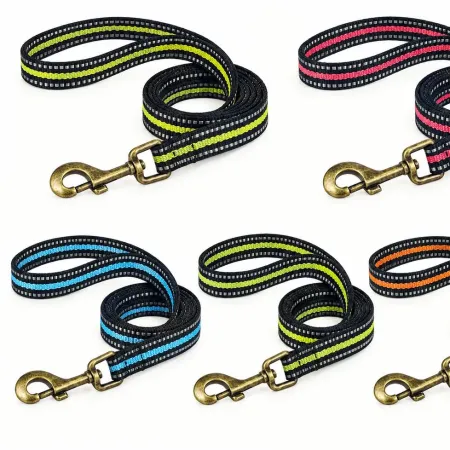
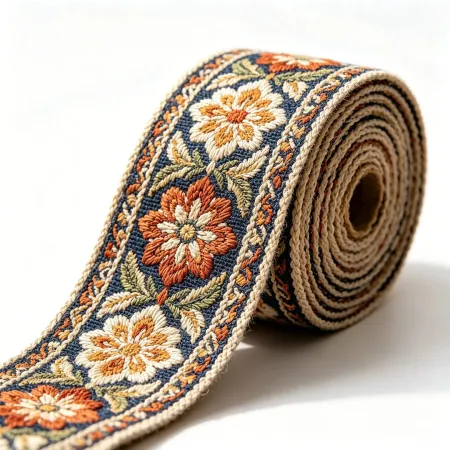
Polyester Pet Reflective Webbing: Why the Base Decides
A reflective band is a film on a fabric, and most of what happens to the film is decided by the fabric. Polyester pet reflective webbing dominates this category for reasons that have nothing to do with brightness: the base holds its dimensions through a wash, it resists ultraviolet, and it gives a binder something consistent to grip. A brighter coating on an unstable base loses its brightness faster than a modest coating on a stable one, which is why the base is the first decision and the optical layer the second.
This guide covers how the base constrains the coating, why shrinkage matters more than strength in a reflective product, how polyester and nylon differ in ways a customer eventually notices, six lines a polyester brief should carry, and the two figures a new-sample report never contains.
Polyester Pet Reflective Webbing: The Base Under the Film
The optical layer is thin, and it moves with whatever is beneath it. Every property that matters to a finished reflective product is therefore a property of the pair, and the base contributes to three of them directly.
- Dimensional stability — a base that shrinks in a hot wash pulls the coating with it, and a film that cannot stretch cracks into fine lines that scatter light.
- Surface for bonding — a binder grips a yarn crown mechanically, and the regularity of the weave decides how even that grip is across the width.
- Ultraviolet resistance — sunlight attacks the base as well as the coating, and a base that embrittles takes the film with it.
| Property | Polyester base | Nylon base |
|---|---|---|
| Shrinkage in a hot wash | Low and predictable, which keeps the coating intact | Higher and more variable, and the film has to follow |
| Softness and drape | Firmer, and it holds a fold rather than flowing | Softer and more supple on a neck or a wrist |
| Water uptake | Very low, so a wet band dries without changing size | Higher, so a soaked band swells slightly and dries back |
| Ultraviolet | Holds its strength well over a season outdoors | Degrades sooner unless it is stabilised for the purpose |
The first row is the one that shows up as a reflective failure. A coating is a continuous film with almost no give; a base that contracts two per cent in a warm wash asks the film to contract with it, and the film answers with a network of hairline cracks too fine to see in daylight and wide enough to scatter a beam. The band still looks silver and reads noticeably weaker, which is the hardest kind of fault to argue about because nothing appears broken.
Strength is the easy part
A 25 mm polyester base band clears 2000N, and so does a nylon one, so the tensile figure rarely separates the two materials in this application. What separates them is what happens at forty degrees in a washing machine, which is not a strength question at all and is the one most reflective failures turn out to be.
Three Tests That Reveal the Pair
Dimensional change after washing
Measure a 300 mm length, wash it at the temperature the label will recommend, dry it flat and measure again. The number of millimetres lost is the amount the coating had to absorb, and a band that moves more than a fraction of a per cent is a band whose reflective face is under strain from its first wash. The test costs one sample and one afternoon and predicts a failure that otherwise appears in customer reviews eighteen months later.
Adhesion by tape or by rub
A simple adhesion check tells you whether the binder has gripped the yarn or is sitting on top of it. Press a strip of adhesive tape across the face, smooth it down, pull it off and look at what came away: a few loose beads are normal, a patch of film is not. It is a crude test next to a laboratory method and it catches the difference between a coating applied to a prepared surface and one applied to a dusty or contaminated one.
Light exposure over a season
Ultraviolet attacks the base and the binder at once, and the visible result is a band that keeps its colour and loses its return. Where a product is sold into a sunny market, a season on a windowsill beside an unstressed sample gives a rough but honest comparison. A polyester base usually holds better than a nylon one here, which is one of the reasons this material dominates a category that spends its life outdoors.
Six Lines for a Polyester Brief
- The yarn and its count — because two polyester bands of the same width can differ in how much they move after a wash.
- The weave — plain, twill or a denser structure, since the surface it presents decides how a binder grips.
- The width and thickness — with tolerances, and with the finished thickness after coating rather than before it.
- The dimensional allowance — the shrinkage the finished product may show after the recommended wash, stated as a percentage.
- The adhesion requirement — a method rather than an adjective, so that a later argument has a procedure behind it.
- The exposure expected — indoor, outdoor or a sunny market, since ultraviolet resistance is a choice of yarn as much as of coating.
The fourth line is the one that turns a vague worry into a specification. Shrinkage of a fraction of a per cent is normal and harmless; two per cent is a different product. Writing the allowance down means the band can be woven to suit it, and it also means a buyer who receives a band that moves three per cent has a number to point at rather than an impression to describe.
- Heat-set before coating — so the base has already done most of its shrinking before the film arrives.
- A test on the pair — not on the base alone, because the film is what cracks.
- A stated wash temperature — since the label and the test need to describe the same conditions.
- A retained washed strip — one sample put through the cycle and kept, as the reference for the next lot.
The base is a polyester webbing woven to a stated count and heat-set before the optical layer goes on, and the coating runs on the pet reflective webbing line in the same plant. Because the loom and the coating line are on one site, a change of weave or count can be coated and washed in the same week, and the laboratory record covers the pair rather than the fabric alone.
Two Figures a New-Sample Report Never Has
The coefficient after five washes
Every report gives a figure for new material, and customers experience the product after a year. The gap between those two numbers is the useful information, and it is produced by washing a strip five times and measuring it again rather than by any new instrument. A supplier who has that figure for a construction is describing the product a customer will own; one who does not is describing a sample.
The width after the same treatment
A band that shrinks in length usually narrows as well, and a narrow band that has lost two per cent of its width has lost two per cent of the area that returns light. Since the fitting was sized on the original width, the same wash also makes the band looser in a buckle. Neither effect is dramatic on its own, and together they explain a collar that fits differently in its second season than in its first week.
FAQ: Polyester Pet Reflective Webbing
Why polyester rather than nylon?
Because the coating survives washing and sunlight better on a base that does not move or absorb water. Nylon is softer and more supple, and it asks more of the film.
Does shrinkage really affect the reflection?
It can. A film that cannot follow a shrinking base develops hairline cracks that scatter light, so the band stays silver and reads weaker. It is invisible in daylight.
Is a heavier band better?
Not automatically. A heavier band is stronger and stiffer, and a stiff band stands away from a small neck. The right weight follows the product rather than the other way round.
Can polyester be heat-set before coating?
Yes, and it should be. Heat setting does most of the shrinking before the film arrives, which leaves less movement for the coating to absorb later.
How do I check adhesion at home?
Press adhesive tape across the face and pull it off. Loose beads are normal; a patch of film coming away means the binder did not grip the yarn.
Polyester pet reflective webbing is chosen for what the base does to the film, not for the film itself. Ask for the dimensional allowance and the coefficient after five washes, and the product on the roll will match the product in use.
Why Xinxiangrui for Polyester Reflective Webbing
The base and the film are made and tested in one place here, which is what makes a shrinkage figure meaningful: the polyester pet reflective webbing comes off a loom that can be re-set and a coating line that can be re-run within the same week, and the pair is washed and measured in the laboratory before the lot is released. A 25 mm band clears 2000N on the way through. Share your details with us and we come back with a matched sample and its washed figures.