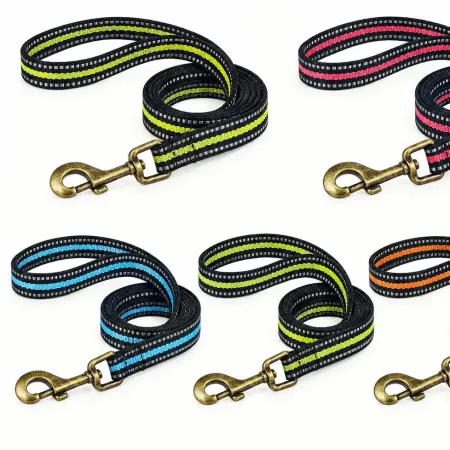
Retractable Pet Leashes: The Part a Loom Actually Makes
Retractable pet leashes are sold as a mechanism, and the mechanism is not made of fabric. A housing, a spring, a brake and a reel belong to an injection moulding and assembly trade; what a narrow fabric mill contributes is the cord, the reflective yarn inside it, the connector that joins it to the collar and the webbing handle on the outside. Understanding that boundary is what makes a conversation with a mill useful rather than confusing.
This guide covers the four parts of a retractable that a mill can supply, why the interface between tape and housing is where the product fails, why a tape is not a rope, six lines a component brief should carry, and the two mistakes buyers make when they bring a webbing specification to a retractable product.
Retractable Pet Leashes: Four Parts a Mill Can Supply
The woven content of a retractable is smaller than the product, and each piece has its own specification.
- The tape or cord — a flat woven tape or a round braided cord that winds onto the reel, and the choice changes how the product retracts.
- The reflective element — a yarn or a stripe woven in rather than printed on, because a retractable is dragged across the ground and a print would not last.
- The end connector — the loop, the swivel and the clip that join the tape to a collar, which is the joint that takes every shock.
- The handle webbing — the band on the outside of the housing, which is the only part a customer grips and the only part that is a conventional webbing product.
| Part | Made by | What decides its quality |
|---|---|---|
| Tape | A narrow fabric mill | Edge stability, thickness and how it coils |
| Reflective yarn | The mill, at weaving | Whether it stays in the weave after abrasion |
| Connector | Hardware assembly | The swage, the swivel and the loop |
| Handle webbing | The mill | Hand feel, colour and resistance to sweat |
Two constructions, two numbers
The handle on the outside of the housing is a 25 mm webbing band that clears 2000N, and it is a conventional product. The tape on the reel is a different construction with a different figure, and it should be quoted and tested on its own. Taking one number and applying it to the other part is the most common error in this category.
Three Things That Decide a Retractable
The interface is where it fails
A retractable does not usually break in the middle of the tape. It breaks where the tape leaves the housing, where the connector is attached, or at the point that rubs the guide on every extension. Those three places are all interfaces, and an interface is a design collaboration between two trades: the mill controls the tape's edge and thickness, the moulder controls the aperture. A tape with a soft or fraying edge will cut itself on a sharp guide within a season.
Width is a function of the housing
The tape width is not chosen for appearance; it is chosen for the reel it must coil onto and the aperture it must pass through. A wider tape holds more and retracts less smoothly, and a tape that is slightly too wide for the reel will bind after a few hundred cycles. This is why a webbing supplier needs the housing dimensions before quoting a retractable tape, and why the question "what width do you want" is the wrong one to begin with.
A tape is not a rope
A flat tape retracts onto a narrow reel with less build-up than a round cord, and it lies flatter when extended, which makes it less likely to cut into a leg. A round braided cord is stronger per gram and tends to kink less when twisted, and it is thicker on the reel. Choosing between them changes the housing as well as the cord, so it is the first decision rather than a detail at the end.
Reel load is worth a sentence, because it explains why a tape is harder to make than its width suggests. A five-metre tape winds on in layers, and the outer layer travels a longer path than the inner one, so the tape has to be thin enough to coil and stiff enough not to crease where it turns. Those two requirements pull against each other, and the resolution is in the weave rather than in a cheaper yarn.
Six Lines for a Component Brief
- The housing dimensions — reel width, aperture and the radius the tape must turn, which decide the tape more than any aesthetic preference.
- The tape type and width — flat tape or round cord, given as a pair with the thickness, since a width alone does not describe a reel load.
- The reflective treatment — woven yarn rather than printed, with the position across the tape and the coverage stated.
- The connector — swaged or sewn, with the swivel specified, since this is the joint that receives every lunge.
- The handle webbing — the one conventional part, specified for hand feel, colour and sweat resistance rather than for load.
- The cycle expectation — how many extensions the tape should survive against the guide, which is the only figure that describes this product's real life.
The sixth line is the one that distinguishes a retractable from every other lead in a catalogue. A conventional lead is loaded in tension and occasionally; a retractable tape is flexed and dragged thousands of times, and it fails by wear at a guide rather than by breaking in the middle. A brief that names the cycle expectation gives the mill something to test against, and gives the buyer a number to compare between two tape suppliers.
The tape is woven from a nylon webbing or polyester webbing construction in narrow widths with tightly controlled edges, and the handle on the housing is a conventional 25 mm band. A reflective webbing version carries the visibility element in the weave rather than on the surface. Abrasion and colour fastness results come from the in-house laboratory, and the development route can quote a tape against a supplied housing drawing rather than against a nominal width.
Two Mistakes Buyers Make
Asking for a webbing specification
A buyer who has sourced conventional leads arrives with a familiar set of requirements: a width, a thickness and a tensile figure. Applied to a retractable tape, those three lines produce a product that will not coil. The specification that matters is the reel it must wind onto, the guide it must pass through and the cycles it must survive, and a mill can only answer those if it is given the housing rather than the habit.
Expecting one supplier to cover both trades
A mill makes tape and handle; it does not make a spring, a brake or a moulded housing. A buyer who asks one supplier to deliver a whole retractable will be passed to a trading company, and the tape inside will be someone else's. The efficient arrangement is to specify the woven parts with the mill and the mechanism with the moulder, and to make sure both are working from the same drawing of the interface.
FAQ: Retractable Pet Leashes
Can a mill supply a complete retractable?
No. A mill supplies the tape, the reflective yarn, the handle and the connector. The housing, spring, brake and reel belong to a moulding and assembly trade.
Tape or cord?
A tape lies flatter and coils tighter; a cord is stronger per gram and kinks less. The housing has to be chosen with the answer, not after it.
Where do retractables usually break?
At an interface: the guide where the tape leaves the housing, the swage at the connector, or the loop where the tape is folded back on itself.
Should the reflective element be printed?
Not on a retractable. A tape is dragged and flexed, and a film lifts. A woven yarn stays in the structure.
What figure describes a retractable tape?
A cycle count against a guide, plus an abrasion result. A tensile figure describes a moment, and this product is worn out over thousands of them.
Retractable pet leashes are a mechanism plus a woven component, and a mill's part is the component. Specify the tape against the housing, the reflective yarn into the weave and the connector at the joint, and the two trades can meet at one drawing.
Why Xinxiangrui for Retractable Pet Leashes
The woven half of a retractable is tape, reflective yarn, connector and handle, and all four sit inside one product family here. Three production lines across 17 product categories and 65 items mean a narrow tape for a reel draws on the same constructions as a lead, a collar and a bag strap, so a mechanism project does not need a new mill. Give us the application and the load it must carry, and the construction follows.