Cotton Webbing for Garment: The Trim Has to Shrink Like the Garment
Cotton webbing for garment is a trim, and a trim fails differently from a strap. Nobody pulls a garment trim to breaking; the failures are a waistband that ripples after the first wash, a drawcord channel that stiffens and will not gather, a colour that bleeds onto a pale shell, and a seam that perforates along the needle line. Four problems, four tests, none of them about tensile.
This guide covers what a garment trim has to match, why shrinkage is the number that decides whether the product survives its first laundry cycle, and how a base cloth developed for bag straps can serve apparel without a new development — with the finish and the width changed rather than the weave.
The Trim Has to Shrink Like the Garment
A garment is washed as a whole. If the shell moves three per cent and the trim moves six, the difference appears as a wave along the seam, and it appears after the customer has already bought the product.
- Shrinkage has to be measured, not assumed — the figure depends on yarn, sett, finish and the wash cycle. Two per cent along the length and a different figure across the width is normal, and both matter on a trim.
- The wash cycle has to be the garment's — a trim tested at 30 degrees and sewn into a garment washed at 60 is tested against the wrong condition. Name the cycle in the specification.
- Pre-shrinking is a decision — a pre-shrunk trim moves less in the wash and costs more at the roll. On a garment that will be washed hot, the trade is usually worth taking.
- The care label follows the trim — if the trim cannot take the wash the shell needs, the label has to describe the trim's limit, and that is a product decision rather than a technical one.
The table pairs the common garment uses with the property that decides whether the trim works, which is rarely the same property twice.
| Use | Property that decides it |
|---|---|
| Waistband or cuff trim | Shrinkage matching, then stiffness |
| Drawcord or channel | Hand feel and resistance to stiffening |
| Decorative strap or tab | Colour fastness and edge softness |
| Apron or workwear tie | Repeated washing and bleaching |
Where Garment Trim Fails
Needle cutting along the seam
A fine needle through a dense webbing can cut warp ends rather than push between them. The damage is invisible at the machine and appears as a line of small holes when the garment is worn. A smaller needle, a ball-point for knits and a slightly looser stitch prevent it.
The trim stiffens after washing
A finish that is applied to make a strap crisp makes a drawcord channel unpleasant against the skin. On apparel the finish has to be soft from the start, because washing will not soften a heavily finished cotton — it will merely redistribute the finish unevenly. If a finish is unavoidable, ask for it to be applied before the final wash rather than after, so that what remains on the cloth is what survived the process the garment will repeat.
Colour bleeds onto the shell
A deep trim against a pale shell is the classic bleed scenario, and it shows after the first wash rather than at the fitting. Wash fastness of the trim in contact with the shell, at the garment's cycle, is the only test that predicts it.
The trim fights the seam allowance
A 20 mm trim folded into a waistband sits under several layers, and the bulk at the fold is what makes a garment uncomfortable rather than the trim's weight. Thickness at the fold is the figure to discuss, not thickness on the roll, and it is the reason a 1.2 mm trim often outperforms a 1.6 mm one in the same application. Turning the ends under rather than cutting them raw adds a further layer, so the finishing method belongs in the same conversation as the thickness.
One Base Cloth, Several Categories: Cotton Webbing for Garment
Three product lines, 17 categories and 65 finished items sit under one roof, and the practical effect on apparel is that a cotton webbing for garment use rarely starts from nothing. The same 2/2 twill base that runs as a 25 mm bag handle can be woven at 20 mm with a softer finish and used as a waistband trim, because the weave and the yarn are already qualified.
- The weave stays — plain for a soft trim, twill for a firmer waistband, herringbone where the pattern is the point.
- The width narrows — 20 to 25 mm covers most apparel uses, and a narrower strip needs a different edge treatment to stay flat.
- The finish softens — this is the real change, and it is a finishing decision rather than a weaving one.
- The tests change — tensile matters less; shrinkage, wash fastness and hand feel matter more. A 2000N figure that decides a bag strap is irrelevant to a waistband, and quoting it would be answering a question the buyer did not ask.
Reusing a base cloth also reuses its test history. Abrasion, colour fastness and dimensional change results attach to the cloth, so a trim taken from a qualified base arrives with data rather than with a promise, and only the finish and the width are genuinely new. For an apparel programme that is the difference between one sampling round and three, and it is why the same weaver supplying bag straps can supply trims that match them in shade.
Wash the sample with the garment before approving it
A trim approved dry tells you nothing about the product. Sew a length into an offcut of the actual shell, wash it at the temperature on the care label, dry it the way the label says, and then look at the seam. Most trim complaints are visible in that one sample and nowhere else.
Five Lines for a Garment Trim Order
- The garment's wash cycle — temperature, detergent type and drying method, because all three change the shrinkage figure.
- A shrinkage target — matched to the shell, expressed as a range in both directions.
- Wash and perspiration fastness — grades rather than a word, with the shell's colour named so bleeding can be judged.
- Hand-feel target — described against a trim the buyer already has, since "soft" is not measurable across a supply chain.
- Skin-contact class — the OEKO-TEX class matching the garment, and where the trim sits against the body.
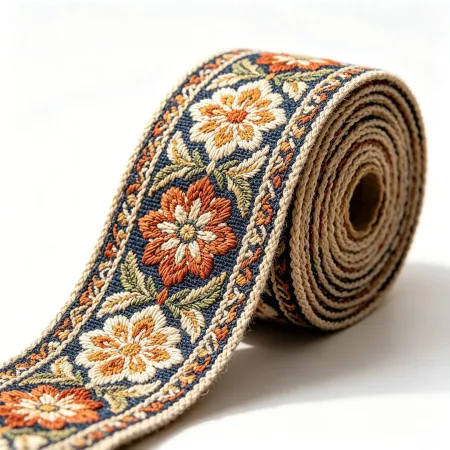
The plain woven cotton webbing is the base for most soft trims, the jacquard cotton strap covers the patterned end of the category, and the cotton webbing range holds both.
FAQ: Cotton Webbing for Garment
What width is garment webbing usually?
Twenty to twenty-five millimetres covers most waistbands, drawcords and decorative straps. Narrower than 15 mm the edge becomes the dominant part of the strip and the finish has to be softer to compensate.
Does garment webbing need to be pre-shrunk?
If the garment will be washed hot or tumble dried, yes, or the shrinkage target has to be matched closely to the shell. A pre-shrunk trim costs more per metre and saves a seam that ripples after the first wash.
Can a bag strap construction be used as a trim?
The weave can, and often is, but the finish has to change. A construction that feels correct as a handle feels boardy at a waistband, and a handle's 2000N rating tells a garment buyer nothing useful.
Why does the trim bleed onto the garment?
Usually because the trim's wash fastness was never tested against the shell at the garment's cycle. A deep shade on cotton moves more than a pale one, and contact with a lighter fabric during a wet wash is the condition that shows it.
Which certificate class applies to a trim?
The class that matches how the garment is worn. A trim at a waistband sits against skin for hours, which is a stricter class than a decorative strap on an outer layer. Match the certificate to the position rather than to the product category.
A garment trim is judged after the first wash, by a customer who has no interest in grammes per metre. Shrinkage, hand feel and wash fastness are the three numbers that decide it, and all three are settled before the roll is woven.
Why Xinxiangrui for Cotton Webbing in Garment Trim
Cotton webbing for garment trim has to shrink like the garment, not like a strap, and at Xinxiangrui Webbing the shrinkage, wash fastness and hand feel are agreed against the garment's own cycle before a length is cut. Three product lines and 17 categories mean the base cloth is often already qualified, so the development is a finish change rather than a new weave. Send us the drawing, the width and the garment wash — we reply with a construction that survives it.