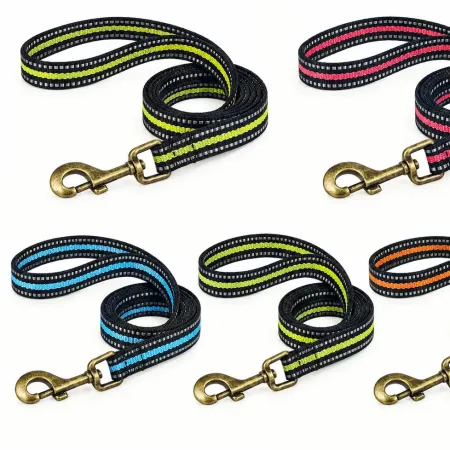
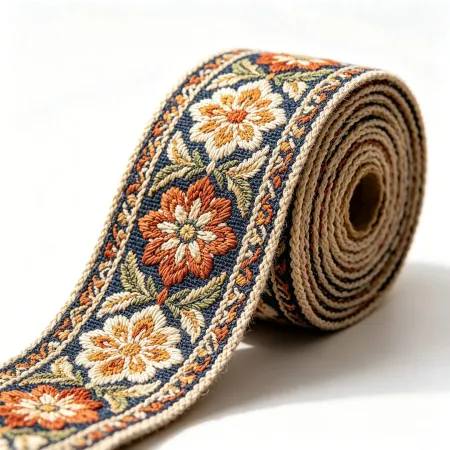
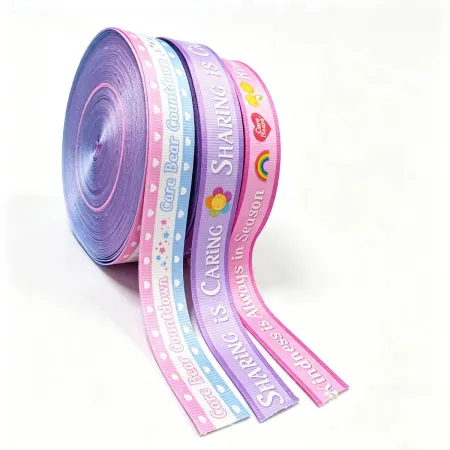
Heat Transfer Pet Reflective Webbing: The Press It Runs On
A heat transfer band is judged twice: once for how bright it is, and once for whether it stays on. Heat transfer pet reflective webbing is made by pressing an optical film from a carrier onto a woven base, so the reflective face is a transferred layer rather than a woven thread or a poured coating. That route buys design freedom, because a film can carry almost any pattern, and it borrows its durability from a bond that is only as good as three settings on a press.
This guide covers what actually transfers during a press cycle, why temperature, pressure and dwell are one decision rather than three, where the film route stops being the right answer, how the base fabric constrains the process, six lines a transfer brief should carry, and the two defects that only appear after washing.
Heat Transfer Pet Reflective Webbing: What Moves in the Press
The film arrives on a carrier with the optical layer facing out and a heat-activated adhesive facing the fabric. Under heat and pressure the adhesive softens, flows into the weave, and grips the yarns mechanically; when the carrier is peeled away the optics stay behind. Nothing melts into the fabric and nothing is dyed. The bond is adhesive plus mechanical key, which is why the surface it grips decides how well the result survives.
Three settings, one window
Temperature, pressure and dwell trade against each other. More heat with less time can give the same bond as less heat with more time, up to the point where the extra heat damages the base or the film. A press operator who adjusts one setting to fix a peel problem usually creates another, which is why a transfer specification is a window rather than three independent numbers.
| Setting | Too little | Too much |
|---|---|---|
| Temperature | The adhesive stays tacky and the film lifts at the first wash | The base glazes, the weave flattens and the hand turns stiff |
| Pressure | The adhesive bridges the weave instead of entering it | The film is squeezed thin and the optics are pressed flat |
| Dwell | The adhesive never reaches full flow and the edge releases first | Heat travels through to a coated back and marks it |
The fourth variable is not on the panel: cooling. A transferred film should be peeled after it has cooled enough for the adhesive to set, and a band pulled from the platen into a stacking tray while still warm will have its carrier lifted too early in the operator's hands or, worse, will hold the film in a stretched state that shows as a wavy edge once it relaxes. Where the press and the cutting table are in the same building, the distance between them is part of the process rather than a detail of layout.
Three Things That Decide Whether It Stays
The base has to tolerate the press
A woven band is not a flat surface at the scale the adhesive cares about. A plain weave presents a regular grid of yarn crowns; a twill presents a diagonal ridge that the film has to bridge; a base with a stiff coating presents a film on top of a film, and the adhesive has to grip the coating rather than the yarn. Polyester tolerates a hotter press than a thin nylon, a heavy band tolerates more pressure than a light one, and neither tolerates a platen that is not level. The base is therefore chosen with the press in mind, not only with the finished hand, and the strength the base already had is not part of the calculation: a 25 mm band clears 2000N before any film touches it, and the press adds visibility without adding or removing load capacity.
The pattern decides the edge length
A full-face transfer has two edges, both at the selvedge. A striped or dotted pattern has an edge around every shape, and every edge is a place where a peel can start. This is the hidden arithmetic of a printed reflective design: a dotted line across a 25 mm band can have four times the perimeter of a solid stripe, so the same film and the same press produce a product that fails sooner because it has more places to fail. A pattern with generous shapes and clear spacing lasts longer than a fine one, and the difference is visible in the drawing rather than in the sample.
The film has to be able to leave
The carrier is peeled away and discarded, and a carrier that releases too easily drops the film before it has bonded, while one that holds too tightly pulls optics back off the fabric. That balance is a property of the film as supplied, and it is one more reason a transfer project is a conversation with the material maker rather than only with the press operator. A change of film supplier mid-order can shift the press window enough that a previously stable job starts peeling at the corner.
Where the Film Route Stops Being Right
There are three ways to put reflection on a band, and they are not interchangeable. Naming the route in the brief prevents a quotation that answers a different question.
- Transferred film — any pattern, applied after weaving, and limited by the bond at the edges of each shape.
- Coated face — a continuous layer with no internal edges, duller in design freedom and stronger against wear.
- Woven-in yarn — the optics are part of the structure, permanent and confined to straight bands along the warp.
A product that will be dragged, chewed or washed weekly belongs in the second or third column. A product that needs a brand mark, a paw print or a fine stripe belongs in the first, with the understanding that the design is what limits the life. Choosing the film for a hard-wearing collar and then complaining about peeling is a specification error rather than a manufacturing one, and it is worth saying so before the order rather than after.
Six Lines for a Transfer Brief
- The design at final size — artwork scaled to the finished band, since a motif drawn at 50 mm and applied at 25 mm changes its edge length and its legibility.
- The base — weave, weight and finish, because a film grips a yarn crown and slides on a smooth coated face.
- The coverage — the share of the face the film occupies, since that figure drives both the appearance and how much edge exists to peel.
- The wash condition — temperature and detergent, because the bond is the product and a hot cycle is its hardest test.
- The pattern tolerance — how far a repeat may drift across a roll, which is a press-alignment question rather than a design one.
- The peel test — agreed as a method, so that "it lifted" and "it did not" are settled by a procedure instead of a fingernail.
The fifth line is easy to overlook and easy to measure. A repeat that drifts a millimetre per metre is invisible on a 300 mm sample and obvious on a 100 m roll, where the pattern has walked nearly a full repeat by the end. Setting a tolerance per metre, rather than per piece, is what keeps a long order consistent, and it is a number the press can actually hold.
A transferred band is a build of three parts: the woven base from a polyester webbing or nylon webbing beam, the optical film, and the press that joins them. Here the loom, the dye line, the transfer press and the cutting bench are inside one plant, so a base that glazes at the required temperature can be re-woven and re-pressed in the same week rather than re-sourced. The pet reflective webbing range includes both coated and transferred constructions, and the development file records which one a given design was approved on.
Two Defects That Appear After Washing
The half-bonded pattern
A transfer can be complete in the middle of a shape and incomplete at its edge, where the adhesive had less pressure because the platen met a thicker yarn crown. In the hand the shape looks whole; after two washes the border lifts and the motif appears to have shrunk. The inspection that finds it is a low-angle light on the finished band, looking for a dull rim inside each shape, and it is worth doing on the first metre of every roll rather than on a sample from the middle.
The shadow where a fold was pressed
A band pressed flat and then folded for packing carries a crease through the transferred area, and the crease is a line where the adhesive was never fully engaged. It survives a season and then opens along the fold, which on a collar is exactly where the band passes through the buckle. Whether the transfer is applied before or after folding is a process decision, and it should be settled at the quotation, because pressing a folded band means a platen that cannot reach into the crease.
FAQ: Heat Transfer Pet Reflective Webbing
Is a transferred band as durable as a coated one?
A continuous coating has no internal edges and generally outlasts a pattern. A transferred solid stripe sits between a coating and a print, and a fine motif is the least durable of the three.
Can any pattern be transferred?
Most can, within the width of the band. Fine detail below about a millimetre is difficult to hold, and a shape smaller than that has more edge than face.
Why does the pattern peel at the corners?
A corner concentrates stress, and it is where the adhesive had the least contact with the weave. Rounding a corner, or leaving more space between shapes, removes the problem at the drawing stage.
Does the base colour matter?
It matters for the unlit appearance and for what shows through any gap in the film. A dark base behind a transferred stripe makes the edges read harder.
Can it go through a domestic wash?
Yes, at a cool setting and inside a bag. Heat and strong detergent attack the adhesive long before they attack the optics, which is why the care line belongs with the product.
Heat transfer pet reflective webbing trades permanence for design freedom, and the trade is settled at the press rather than in the artwork. Name the base, the coverage and the wash condition, and the pattern that arrives still has its edges after a season.
Why Xinxiangrui for Heat Transfer Pet Reflective Webbing
A transfer project needs the base and the press in the same conversation, and here they are in the same building: weaving, dyeing, transfer pressing and hardware assembly run inside an 8,000+ m² site in Dongguan. When a base glazes at the temperature a film needs, the weave is adjusted and re-run rather than blamed on the film supplier, and the press window is recorded per lot. Share your details with us and we come back with a matched sample and its press settings.