Jacquard Cotton Webbing: What the Loom Allows Before the Design Does
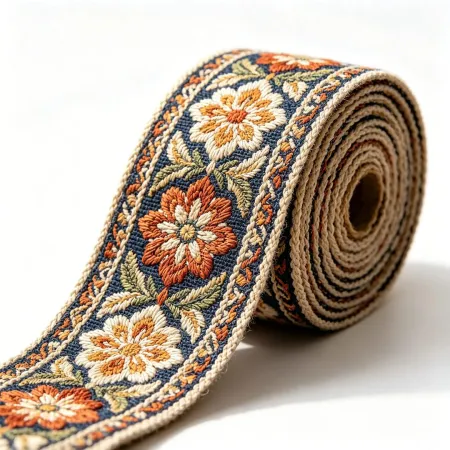
Jacquard cotton webbing is the only decoration route where the pattern cannot wear off, because the pattern is the cloth. That advantage comes with a set of constraints that have nothing to do with design taste: a repeat measured in ends, a colour count limited by what the loom can carry, a minimum width below which a logo becomes a smudge, and a warp setup that has to be paid for before the first metre exists.
This guide covers what a jacquard machine can and cannot do at narrow widths, how repeat and colour interact, and why a jacquard base is worth developing once and reusing across categories rather than commissioning per product. It ends with the three failures that appear in a jacquard that looked correct on a screen.
What the Jacquard Machine Actually Allows
A dobby loom can only raise groups of ends in a fixed sequence, which limits it to simple geometric weaves. A jacquard controls individual ends, which is what makes letters, logos and fine motifs possible — and what makes the setup expensive.
- Every end is a decision — the pattern is stored as which ends lift on which pick. At 25 mm and a normal sett that is a few hundred ends; at 50 mm it is twice that, and the design file grows with it.
- The repeat is fixed in ends and picks — a motif that fits twice across a 50 mm strip fits once across 25 mm, or not at all. Width does not scale a jacquard; it crops it.
- Colour comes from yarn, not ink — each colour in the pattern is a warp or weft position. Four colours is a different machine setup from two, and the difference is a cost rather than a tweak.
- The back carries the floats — where a colour is not used on the face it travels behind, and those floats are the reason a jacquard strap has a face and a back rather than two faces.
The table sets the practical envelope at three widths, which is the conversation to have before artwork is drawn.
| Width | Detail that survives | Colours that work |
|---|---|---|
| 20–25 mm | Bold letters, simple marks, 2 mm lines | Two, occasionally three |
| 38 mm | Fine type, small devices, 1.2 mm lines | Three |
| 50 mm and above | Detailed motifs, serif type, 0.8 mm lines | Four, at a cost |
Repeat and Width Interact in One Direction Only
A design can be made to fit a narrower width, but it cannot be made to look the same. Shrinking a repeat means fewer ends per element, and below a threshold the element stops being an element.
- Letters need height before width — a capital 8 mm tall on a 25 mm strip is legible; the same letter 5 mm tall is a mark. Set the minimum from the width, not from the artwork.
- Edges consume design space — a tucked edge takes several ends on each side, and those ends are not available to the pattern. A design that reaches the edge loses its outer elements.
- Weft colour changes the repeat height — a horizontal band is a number of picks, and the number is a whole number. A band specified as 3.4 mm becomes whatever the loom can produce in whole picks.
- A repeat that does not divide the width leaves a seam — where the pattern meets itself, a partial element appears. The design should close on a whole repeat, or the join becomes a feature.
Approve a woven proof, never a rendering
A screen rendering shows a pattern at whatever size the monitor happens to be; a woven proof shows what the loom can do with the ends available. Ask for a proof woven at the production width, in the production colours, on the production sett — and look at the back of it as well as the face.
One Warp, Several Categories: Jacquard Cotton Webbing
Three product lines, 17 categories and 65 finished items sit under one roof, and the economics of jacquard make that breadth useful in a specific way: the expensive part is the warp setup, so a design that can serve more than one product amortises that setup across categories that would otherwise each pay for it.
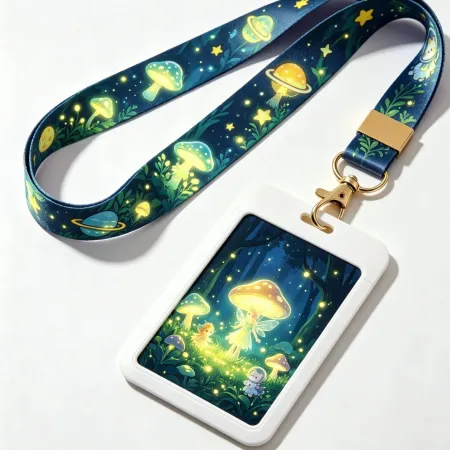
- Lanyard and keychain — the same 20 mm jacquard, cut short and fitted with different hardware.
- Bag strap and tote handle — the same design at 38 mm, where the repeat either gains a column or the motif is re-proportioned.
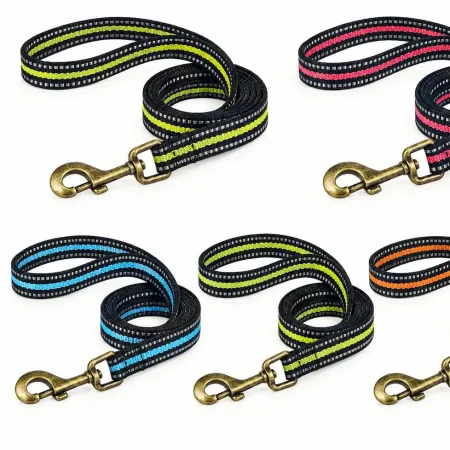
- Pet and luggage straps — the same cloth with a firmer finish and heavier hardware.
Reuse does not mean the same file at every width. It means the design is developed once with the narrowest product in mind, so the widest gains columns rather than losing detail. Planning in that direction is the difference between one development and three, and it is a decision taken before the first proof rather than after the third.
Three Jacquard Failures
The floats catch on hardware
Long floats on the back of a jacquard snag on a slider, a ring or a buckle edge, and a snagged float pulls a loop to the face. Float length is a design parameter: keeping the longest float short, or binding it at intervals, removes the failure before the hardware is chosen.
The motif disappears at the fold
A design centred on the strip disappears into a fold at a handle or a keychain join. The repeat has to be positioned against the finished product's folds, not against the width of the roll, and that means the fold position belongs on the artwork.
The back is visible and ugly
On an open-ended strap the reverse of a jacquard shows the floats and a duller version of the pattern. On a lanyard or a keychain the back is seen constantly. A lining, a folded construction or a design that is nearly reversible solves it, and it is a construction decision rather than a design one.
Five Lines for a Jacquard Order
- Production width first — the narrowest product in the range sets the detail budget for the design.
- Colour count and positions — how many yarns, in warp or weft, and which one carries the ground.
- Repeat size in finished millimetres — the figure the cutting table can work with, not the pixel dimensions of a file.
- Fold and hardware positions — so the motif clears or deliberately crosses them.
- Float limit — the longest float the hardware will tolerate, stated as a number.
A jacquard strip is still a load-bearing strap underneath the pattern: a sound 25 mm construction clears 2000N, and the decoration should not be allowed to compromise the sett that achieves it. The jacquard cotton strap page shows what the loom produces at working width, the double-sided jacquard is the answer when the back will be seen, and the cotton webbing range sets both beside the plain weaves.
FAQ: Jacquard Cotton Webbing
How small can a logo be woven into webbing?
On a 25 mm strip, letters about 8 mm tall are the practical floor; on 38 mm, around 6 mm. Below that the ends available per letter are too few and the mark reads as texture rather than as a logo.
How many colours can a jacquard webbing carry?
Two or three at narrow widths, four at 50 mm and above. Each additional colour is another yarn position and another setup, so the count is an economic decision as much as a design one.
Why does the back of a jacquard look different?
Because unused colours travel behind the cloth as floats. That back is structurally necessary to the pattern, and on a product where it will be seen the answer is a double-sided weave or a folded construction rather than a flatter pattern.
Is jacquard more durable than print?
Substantially, because the pattern is yarn rather than ink on the surface. A print abrades at the points of contact; a jacquard wears like the cloth it is, which is why it suits handles, keychains and straps that are rubbed constantly.
Can one design run at two widths?
Yes, if it is designed for the narrower one first. At the wider width the repeat gains a column rather than losing detail; designed the other way round, the narrow version has to drop elements and stops being the same design.
A jacquard is a design decision and a machine decision at once. The ends available, the colours carried and the floats tolerated set the limits, and the best time to learn them is before the artwork is finished rather than after the first proof.
Why Xinxiangrui for Jacquard Cotton Webbing
A jacquard cotton webbing costs what its warp costs before a single pick is woven, so the design is developed once against the narrowest product in the range and then reused across lanyards, handles and straps under one roof. A woven proof at production width and colour is what gets approved, with the back inspected as well as the face. Share your jacquard details with us and we will come back with a matched sample.