Bio-Based Webbing for Pet Products: What Outdoor Service Does to a Green Claim
Bio-based webbing for pet products has a harder life than most apparel trim and a shorter tolerance for excuses. A collar sits in sun, rain, salt water and mud, rubs against a dog's coat and a metal D-ring, gets chewed at the edge during play, and is expected to still read correctly on the label after a year of that.
This guide looks at the four service conditions that actually degrade pet webbing, explains which bio-based routes survive them and which do not, and sets out the specification lines that keep a sustainability story intact once the product leaves the packaging.
Four Service Conditions That Decide Whether the Claim Survives
Pet gear is not washed on a gentle cycle and hung to dry. It works outdoors in a way that stresses materials differently from any bag or garment strap.
- Solar exposure combined with moisture — UV alone weakens a polymer slowly, and UV with water in the fibre breaks it down much faster. A strap that holds its colour in a dry climate can chalk and stiffen in a humid one within a single season.
- Biological soiling — urine, saliva and pond water leave residues that feed mildew on cellulose fibres. Cotton-rich pet webbing that stays damp develops a smell the owner cannot wash out, and a smell is a return.
- Abrasion from teeth and hardware — play chewing attacks the edge first, and a metal D-ring or snap hook polishes the same few millimetres at the fold. These are the two places pet straps fail, and neither is the flat face.
- Repeated washing at home — many owners machine wash harnesses. Heat, detergent and tumble drying attack prints, coatings and reflective films far more aggressively than the woven structure underneath.
The table maps the main pet product types to the failure that generates returns, and to the material and test that address it.
| Product | Return driver | Bio-based route that suits it |
|---|---|---|
| Everyday collar | Colour fading, edge fraying at the buckle, a stiff strap after getting wet | Partially bio-based polyester, sealed edge, UV stabilised, dyed to a lightfast recipe |
| Padded harness | Strap cutting into the coat, binding in the adjuster, seam pull-out under load | Soft-hand bio-based polyester at a controlled thickness, tested as a sewn assembly |
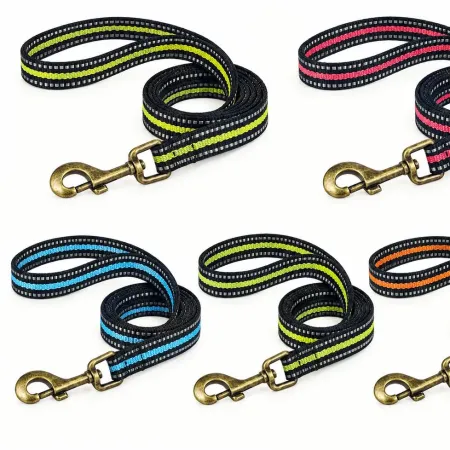
| Fixed-length leash | Handle wear, colour transfer onto hands, stretch over time | Higher-tenacity bio-based polyester with heat setting to limit creep |
| Retractable lead | Webbing jamming in the spool, edge wear against the housing, twist memory | Thin, dense, low-friction construction with a tightly controlled thickness band |
| Reflective gear | Reflective film lifting after washing, brightness dropping at the fold | Bio-based substrate checked for film adhesion before the reflective layer is applied |
| Toy and accessory straps | Chewing at the edge, print wearing off, hardware separation | Dense sett and a fully tucked edge; print specified with a rub-fastness grade |
Which Bio-Based Route Survives a Dog's Week
The bio-based label covers several different materials, and they behave nothing alike outdoors. Choosing the wrong one is how a good idea becomes a return rate.
Partially bio-based polyester is the safe default
It is chemically the same polymer as conventional polyester, so it does not absorb water, does not feed mildew and does not rot. For collars and leashes that get wet and stay wet, that combination matters more than any feedstock percentage. The material story changes; the field behaviour does not.
Cotton-rich bio-based straps need a different design brief
Cotton is genuinely bio-based and genuinely pleasant in the hand, which is why it appears in premium collars. It is also cellulose, so it holds moisture and supports mildew, and it abrades by fuzzing rather than glazing. A cotton strap works outdoors when it is dense, correctly finished and expected to be washed and dried rather than left damp. It is the wrong choice for a retractable lead that lives inside a housing.
Reflective layers are the real weak point
On reflective pet gear, the woven substrate is rarely what fails first — the film or the heat-transfer layer does. A bio-based substrate can have slightly different surface energy after finishing, and adhesion is checked on the finished strap rather than assumed from the greige. If the reflective layer lifts after five washes, the sustainability claim is irrelevant to the customer holding the product.
Test the wash cycle the owner will actually use
A 40 °C machine wash with detergent, followed by tumble drying, is far harsher than the gentle laboratory wash many trim specifications assume. Run the reflective adhesion and print rub tests after that cycle, not before it, and record the grade. It is the single most predictive test in pet gear and one of the least often requested.
Specification Lines That Keep the Claim Honest
Four parameters do most of the work, and each one can be written into an order without ambiguity.
- Measured bio-carbon share, per yarn — stated as a figure with the method named. A product name is not a specification, and a category average is not a claim you can defend item by item.
- UV ageing with a colour threshold — hours of exposure plus a maximum permitted shade shift. Production webbing is qualified beyond 1,000 hours with the shift held under a visible threshold, which is more useful than a bare hours figure.
- Tensile on the assembled article — a leash rated at 2000N+ break strength tells you about the webbing, not about the seam at the handle. Both figures belong in the file.
- Wash and rub fastness after the real cycle — graded, on the production shade, on the printed or reflective version of the strap rather than the plain one.
Six Questions to Ask a Pet Webbing Supplier
These are the questions that separate a supplier who understands pet gear from one who has adapted a bag strap specification.
- What is the thickness band on this construction? — retractable leads and padded harnesses both live or die on thickness consistency, and a nominal figure without a band is not a specification.
- Is the edge tucked, sealed or welded? — edge construction determines how a collar behaves under a chewing dog and how it feels against a coat.
- Which reflective method is used? — woven reflective yarn, heat-transfer film and sewn tape age differently, and only one of them survives the owner's wash cycle reliably.
- Does the mill print and assemble in-house? — print registration, hardware fitting and webbing production in one plant removes the coordination gap where most pet gear defects originate.
- What does the bio-based document actually cover? — the yarn, the strap or the whole article. A statement covering a yarn does not automatically cover a printed, coated, hardware-fitted product.
- Can you show a batch record from a previous pet programme? — evidence of repetition beats evidence of capability.
Why a Three-Line Mill Suits Pet Programmes
Pet gear rarely ships as webbing alone. A collar programme usually needs matching leashes, a harness in the same shade and a reflective variant for the autumn line, and the value of a single source is that all of it shares one substrate.
- One substrate, several finished products — the same woven base serves a collar, a leash and a harness strap, so the shade and hand feel stay consistent across a range instead of drifting between suppliers.
- Printing and hardware in the same plant — jacquard, dye-sublimation and hardware assembly sit alongside the looms, so a printed logo and a fitted D-ring do not travel between three companies before they reach a carton.
- Testing that covers the finished article — tensile to 2000N+ break strength, Martindale abrasion past 50,000 cycles, UV ageing beyond 1,000 hours and colourfastness to wash and rub, all reported against the roll that ships.
The pet side of the range sits in pet harness constructions, leash webbing and reflective pet webbing, with the lower-fossil routes collected in the bio-based webbing range and a retractable-lead example in the reflective retractable lead webbing.
FAQ: Bio-Based Webbing for Pet Products
Will a bio-based collar smell after it gets wet?
Not if the yarn is polyester-based, because polyester does not absorb water or support mildew. A cotton-rich strap that stays damp can develop a smell, so a cellulose option belongs on products that are washed and dried rather than left wet in a car or a kennel.
Does bio-based webbing fade faster in sunlight?
Fading is a dye and stabiliser question more than a feedstock question. Production webbing is qualified beyond 1,000 hours of UV exposure with the shade shift held under a visible threshold, and a lightfast dye recipe matters more than the origin of the polymer.
Can reflective webbing also be bio-based?
Yes, and the reflective layer is the part to test. A bio-based substrate can finish with slightly different surface energy, which affects film adhesion. Check reflective brightness and adhesion after repeated washing rather than on the day it is made.
Is a bio-based leash as strong as a conventional one?
When the polymer family is the same, strength is comparable, and load-bearing constructions are qualified to 2000N+ break strength. What changes more often is the seam at the handle, which is why the assembled article should carry its own tensile figure.
Should the whole pet range switch at once?
No. Start with the product where the material story is easiest to verify and the service conditions are mildest, prove it through a season, and expand from there. A range-wide switch made before the first wash-cycle results are in is the fastest way to generate a batch of returns with a green claim attached.
Pet gear punishes optimism. The label has to survive sun, water, teeth and a washing machine before it earns the right to describe the feedstock, and every one of those four is testable in advance. Specify the band, test the finished article, and keep the bio-based figure honest — that is what makes bio-based webbing for pet products a commercial advantage rather than a claim waiting to be challenged.
Why Xinxiangrui for Bio-Based Webbing for Pet Products
Collars, leashes and harnesses can share one substrate at Xinxiangrui Webbing, because raw webbing, pet gear and finished accessories are three product lines from a single Dongguan site across 17 categories and 65 product pages. Jacquard weaving, dye-sublimation printing and hardware assembly sit in the same plant as the looms and the test lab. Give us the application and the load it must carry, and the construction follows.