Polyester Grosgrain Ribbon: The Rib Is a Weft Decision
A polyester grosgrain ribbon is recognised by its ribs, and those ribs are made by the weft. They are not embossed, not calendered and not printed; they exist because a heavier pick is inserted at regular intervals, lifting the cloth into a line that runs across the width. Change how often that pick appears and you have a different ribbon with the same yarn, the same width and the same colour.
This guide covers what a rib actually is in the weave, why the pitch decides more about the product than the width does, how the corded edge is formed, six lines a brief should carry, and the two places where a ribbed construction behaves differently from a flat one.
Polyester Grosgrain Ribbon: What a Rib Is
The ribs are formed in the loom shed. A heavier weft is introduced at intervals, the warp is held at a different tension across that pick, and the result is a raised line that survives dyeing and finishing because it is structural rather than applied. Four variables define the finished surface.
| Variable | Effect on the ribbon | Where it shows |
|---|---|---|
| Rib pitch | How many ribs per centimetre, and therefore how fine the surface reads | At a distance, where a coarse pitch reads as texture and a fine one as sheen |
| Rib height | How far each line stands proud of the ground | In the hand, and where the ribbon is pressed or stacked |
| Corded edge | A heavier, rounded selvedge that resists curling | On a bow, where a flat edge curls and a corded one lies down |
| Weft colour | Whether the ribs read as a tone or as a second colour | Close up, and in photographs where a two-tone rib catches the light |
A coarse pitch on a narrow width produces a ribbon that reads as rustic at two metres. The same pitch on 38 mm reads as heavy and deliberate. A fine pitch on the same width reads as a dull satin from a distance and only reveals its ribs when someone picks it up, which is why two grosgrains can be sold into the same market with completely different results.
A pitch change is a loom change, and it is not a small one
Ribs are made by the sequence of picks, so altering the pitch means re-setting the loom rather than adjusting a finishing roll. A plant that weaves several pitches keeps several set-ups; a plant that buys finished grosgrain can offer whatever its supplier already runs. Asking for a pitch nobody has on the machine is a request for a new set-up, and it is worth knowing that before the sample round.
Three Places One Site Makes a Difference
Dye penetration at the rib
A raised line is denser than the ground it sits on, and dye reaches a dense area more slowly. On a deep shade the difference is invisible; on a pale or a bright one the ribs can come out a fraction lighter than the field between them, which reads as a subtle stripe in a colour that was specified as solid. Running the loom, the dye line and the finishing in one plant means the pitch and the dye cycle can be adjusted against each other rather than negotiated between two companies.
The edge is formed before it is finished
A corded edge is woven, not sewn on, so it is fixed at the loom and cannot be added later without a second process. That matters because the corded edge is what stops a grosgrain from curling in a bow, and curling is the single most common complaint about cheap ribbed ribbon. A supplier who can change the edge on the loom can fix the complaint; one who cannot will offer a heavier body instead, which changes the whole hand of the product.
Printing over a rib tests the registration twice
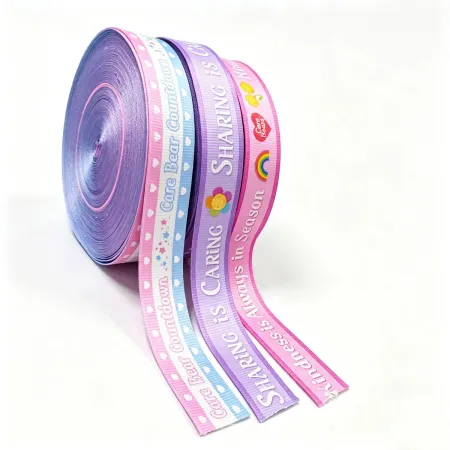
A design printed across a ribbed surface lands on two different heights, and ink behaves differently on each: it sits proud on the rib and keys into the ground. A fine line crossing the ribs therefore varies in apparent weight along its length, which is a property of the construction rather than a fault in the print. Designs drawn for grosgrain usually work with the ribs, placing motifs between them or using the rhythm deliberately, and that decision is easier when the printer and the loom are in the same building.
Six Lines for a Grosgrain Brief
- The pitch, in ribs per centimetre — the number that defines the surface, and the one a catalogue never prints.
- The width and the edge type — corded or flat, because the edge decides whether a bow curls.
- Whether the ribs may show as a tone — a pale shade on a dense rib is where dye penetration becomes visible.
- The hand wanted — a grosgrain is firmer than a satin at the same weight, and a bow built for satin will look stiff in it.
- The print, if any — and whether the design is drawn to sit between the ribs or across them.
- The put-up and the cut end — rolled rather than folded, and hot cut so the ribs at the end do not release.
The first line is the one that changes the answer to everything else. A buyer who asks for grosgrain in a colour and a width has described a family; a buyer who adds a pitch has described a product. Since a pitch change is a set-up, knowing it before the sample round saves a cycle, and knowing it before the artwork is drawn saves a second one.
- Count the ribs — over a measured centimetre, on the sample, with a pin if the pitch is fine.
- Look along the edge — a corded selvedge has a rounded profile that a flat one does not.
- Press a fold and release it — ribbed cloth takes a crease across the ribs and shows it longer than a satin does.
- Hold it against the light — a pitch that is too coarse for the width lets light through at the ribs and looks open.
The pitch, the edge and the dye cycle are three settings on one line of machines, and here they sit in one 8,000+ m² plant in Dongguan beside the polyester webbing looms that supply the webbing lanyards and the rest of the polyester ribbon range. A 25 mm webbing base clears 2000N; a grosgrain is judged on whether its ribs run straight and its edge lies down.
Two Places a Rib Behaves Differently
It takes a crease across the ribs
Bend a ribbed ribbon sharply and the ribs on the outside of the bend are stretched while those on the inside are compressed against each other. Release it and the ground recovers before the ribs do, because a raised line has further to travel and less support. The visible result is a fold line that stays readable at an angle even after the ribbon looks flat, and it is why a grosgrain shipped folded in a bag arrives looking older than a satin shipped the same way.
It grips where a satin slides
The ribs give a tied knot somewhere to sit. A satin bow loosens because the surfaces slide against each other; a grosgrain bow holds because the ribs interlock, and the difference is obvious in a knot tied once and left for a week. This is also why a grosgrain is used to back a satin bow or to bind an edge that must not shift, and why the two are often specified together in the same product.
FAQ: Polyester Grosgrain Ribbon
What is the difference between grosgrain and satin?
Grosgrain has raised ribs across its width and a matte surface; satin has a smooth face made by floats and a high shine. The hand and the knot behave differently too.
Why does cheap grosgrain curl at the edge?
Usually a flat selvedge rather than a corded one. The cord gives the edge weight and a rounded profile, and without it the ribbon rolls in a bow.
Can the pitch be changed without a new loom?
The loom can be re-set, which is a change of set-up rather than of machine. Whether it is worth doing depends on the run length.
Does grosgrain print well?
It prints, with the ribs making a thin line look heavier where it crosses them. Designs that work with the rib rhythm print better than designs that ignore it.
Is a heavier grosgrain always stiffer?
Usually, but the pitch matters as much. A close pitch on a light band can feel firmer than a coarse pitch on a heavy one, because the ribs are doing the work.
A polyester grosgrain ribbon is a weft pattern with a width attached. Specify the pitch and the edge, expect the ribs to grip where satin slides, and the rest of the specification follows.
Why Xinxiangrui for Grosgrain
A polyester grosgrain ribbon is a pick sequence and a selvedge, both fixed at the loom, and here the loom, the dye line and the cutting bench are in one 8,000+ m² plant in Dongguan. A pitch change is a set-up someone can make and measure rather than a request to a third party. Tell us the rib pitch and the width, and a matched construction comes back to you.