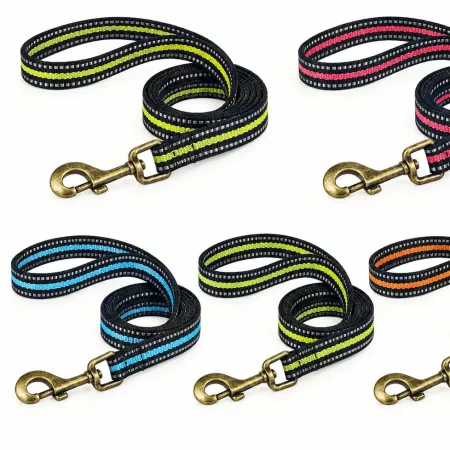
Custom Pet Reflective Webbing: The Sample You Can Actually Judge
Colour can be approved on a card; direction cannot. Custom pet reflective webbing fails its first approval more often than any other narrow fabric, and the reason is structural: the property being bought is not a shade that a card can carry but a return of light that only appears when something shines on it. A buyer holding a Pantone chip and a swatch of reflective band is comparing two things measured in different units, and the approval that follows from that comparison is a guess dressed as a decision.
This guide covers why a reflective sample has to be judged differently from a coloured one, what the three sampling rounds each decide, which details belong in the drawing before the first round starts, six lines a custom brief should carry, and the two things no sample can settle.
Custom Pet Reflective Webbing: Why a Swatch Is Not Enough
A dyed band is judged by comparing two surfaces under the same light, and the judgement holds wherever the band is later used. A reflective band is judged by pointing a light at it and standing where the customer will stand, so the result depends on geometry: the angle of the lamp, the angle of the eye and the distance between them. Change any of the three and the same sample reads differently.
This is why a reflective approval has to happen in a room that can be darkened, with a torch, at a stated distance. It sounds crude next to a laboratory report, and it answers a different question. The report says what the material can do; the darkened room says what the customer will see.
There is no Pantone number for a retroreflector
A colour standard describes a surface under reflected light. A retroreflective surface sends light back towards its source, which is a directional property rather than a colour, so the closest a colour system can get is the appearance of the unlit face. What substitutes for a Pantone number is a grade plus the angles it was measured at, and a physical sample pair lit side by side.
What Each Sampling Round Decides
A custom reflective band is developed in three rounds, and each round answers a question the previous one could not. Running them in this order is what keeps the second round from being wasted on a base that will change.
| Round | Decides | How it is judged |
|---|---|---|
| First | The base: weave, width, thickness and shade under the coating | Hand, drape, a caliper and a light table |
| Second | The optical route and the pattern: full face, edge stripe or print | A torch in a dark room and a photograph at a stated distance |
| Third | The assembly: stitching, folding, the fitting and the finished length | A finished piece worn by a person or fitted to a dog |
The order matters because of what each round can destroy. Approving a pattern on a base that later changes width means the pattern has to be re-scaled. Approving an assembly before the coating is fixed means the seam allowance is set against a thickness that will not hold. Buyers who ask for everything at once usually receive a sample that settles nothing, because three variables moved together and nobody can say which one caused the result.
Three Details to Settle Before Round One
The width the fitting allows
The brief usually says 25 mm because 25 mm is the standard collar width. What the plant needs is the slot the band has to pass through, since coating adds a fraction and folding doubles it. A drawing that gives the nominal width and the measured slot lets the first round come back with a band that threads on the first attempt, which is one whole round saved.
The shade under the optics
A reflective layer is not opaque. The base shows through the gaps between beads or prisms, so a silver-grey base lifts the return and a black base dulls it. If the design calls for a black band with a reflective stripe, say so in round one, because the same stripe on a black base and on a grey one are two different products with two different results under a beam.
The radius it will bend to
A collar turns around a neck at a radius of a few centimetres; a harness strap on a chest runs flatter; a lead hangs and bends only at the handle. A coating stiff enough for a flat strap can craze at a tight collar radius, and the cracking appears after a month of use rather than in the sample. Giving the radius at the start lets the binder be chosen for it instead of being discovered by the customer. The radius is an optical decision and never a structural one, since a 25 mm base band clears 2000N whether the coating on it is soft or stiff.
Six Lines for a Custom Brief
- The use — collar, harness, lead or trim, since each bends differently and each exposes a different face to traffic.
- The width and the slot — nominal width plus the measured opening of the fitting it must pass through.
- The base and its shade — because the shade under the optics sets how bright the finished band can look.
- The pattern and the repeat — a stripe, a dotted line or a printed motif, with the repeat measured rather than sketched.
- The assembly — stitching, bartack positions and the hardware, since a seam through coated fabric behaves unlike a seam through plain.
- The approval condition — the distance and the light under which the sample will be judged, agreed in advance so the judgement is a comparison rather than an opinion.
The sixth line is unusual in a textile brief and it is the one that makes a reflective project work. Two people can look at the same sample in the same room and reach opposite conclusions if one is standing beside the lamp and the other is three metres away. Writing down the distance, the lamp and the darkness turns that into a test both sides can repeat.
- A fixed lamp — the same torch at the same power for every sample, so the comparison is between materials rather than batteries.
- A stated distance — commonly ten metres for a collar and thirty for a lead, measured rather than paced out.
- A camera at eye height — because the photograph is what gets forwarded internally, and it should match what a person sees.
- One uncontrolled sample — a piece of the band the buyer already sells, as a reference point for what "good" meant last season.
Custom work here starts from production settings rather than a bench, so the first sample already carries the stitch density, the coating weight and the base that a repeat order would use. The band can be built on a polyester webbing or nylon webbing base, with the optical layer applied on the pet reflective webbing line, and the development process describes what a drawing has to contain before round one opens.
Two Things No Sample Can Settle
The second season
A sample is new, and a collar is judged in its second winter. Sun, detergent and the rubbing of a daily walk all act on the binder before the customer forms an opinion, and none of that can be compressed into a courier parcel. What can be done is to keep a strip from the approved lot, wash it repeatedly and put it beside an untouched one, then photograph the pair. That photograph is the only honest forecast available at approval time.
The way it is worn
A lead on a shelf hangs straight; on a walk it swings, drags on the ground at a sniff and wraps around a leg. A collar sits still and rotates slowly, so one face spends most of its life towards the ground. The reflective pattern that photographs best on a flat sample is not always the one that stays visible in use, and that is a question about the animal rather than about the material. Asking how the product is worn, and by what size of dog, is more useful at sampling than another photograph.
FAQ: Custom Pet Reflective Webbing
Can I match a Pantone colour on a reflective band?
The unlit face can be matched to a colour, and the reflective performance cannot. Those are two approvals, and treating them as one is how a project ends up with a band that matches the brand and does not show up at night.
How many sampling rounds does a custom band need?
Three is usual: base, optics, assembly. A project that tries to settle all three at once often needs a fourth, because nothing in the first sample can be attributed to a single change.
Can the pattern be printed rather than woven in?
Both routes exist. Printing puts the optical material exactly where the design wants it and relies on the print layer staying put; a woven-in stripe is more durable and confines the pattern to straight lines.
Is a black band with a reflective stripe possible?
Yes, and the stripe will read dimmer than the same stripe on a pale base, because the dark fabric absorbs the light that passes between the optics. Expect a grey band by day and a silver line at night.
Does a sample cost anything?
Development samples are supplied without charge in most projects; the cost that matters is time, and the three-round order is the fastest route through it.
Custom pet reflective webbing is approved in a dark room, not on a colour card. Fix the base, the pattern and the assembly in that order, agree the distance and the lamp, and the sample that comes back can be judged instead of merely looked at.
Why Xinxiangrui for Custom Pet Reflective Webbing
A custom reflective band moves between four processes, and here they share one 8,000+ m² site in Dongguan: the loom that sets the base, the dye line that fixes the shade underneath, the coating or print line that adds the optics and the bench that stitches the fitting. Because the first sample is built on production settings, an approved piece can be repeated rather than redeveloped. Give us the application, the width and the dog it is for, and the construction follows.