
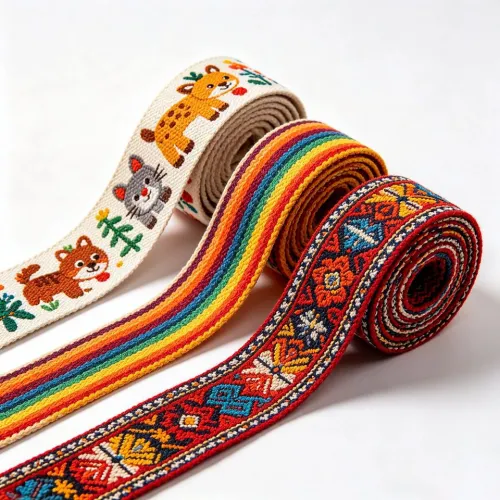
Features
Why Choose Xinxiangrui Webbing?
Source Factory
Direct wholesale production from our own plant in Dongguan, not a trading desk. Weaving, dyeing, printing, hardware assembly and packing all run in house, with no middleman margin in the price.
Full Customization
OEM and ODM work starts from your drawing: width, weave, colour, hardware and retail packaging. We match Pantone, send a physical sample before bulk, and keep every change on one work order.
Strict QA & ISO Standards
Every batch is checked for width, thickness, break strength and colour fastness before it ships, and the plant runs to ISO 9001 and ISO 14001. Test reports for your batch travel with the goods.
Proven Track Record
Fifteen years of narrow fabric since 2011, 200+ active partners and shipments to 50+ markets. Long-run programmes are what this factory is built for, which is why most customers reorder.

We Have The Best Solutions for Your Business
Xinxiangrui has made narrow fabric in Dongguan, China since 2011. Our 8,000 m² plant weaves, dyes, prints, cuts and sews under one roof, supplying 200+ active partners in 50+ markets. We produce polyester, nylon, cotton, elastic, reflective and bio-based webbing, ribbon, lanyards, pet leashes, bags and luggage components, from yarn and reflective tape to finished straps and handles.
Because every step stays in one plant, a widening range does not cost tolerance. Our laboratory tests to 2000N+ break strength, 50,000+ Martindale cycles and 1,000+ hours of UV exposure, and every batch carries its own figures rather than a catalogue sample. We work to OEKO-TEX, CPSIA, REACH, RoHS, ISO 9001, ISO 14001 and GRS. Send us your spec sheet and target quantity, and we will recommend the construction that fits.
Cotton Webbing: Three Weaves and What They Signal
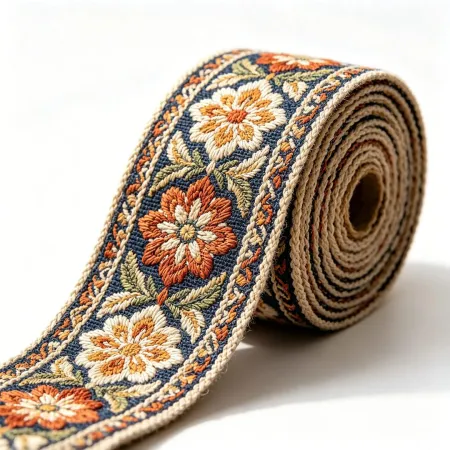
The weave is visible from a metre away and decides most of the properties a buyer cares about. The table below is the version worth carrying into a meeting.
| Weave | Surface | Behaviour | Typical use |
|---|---|---|---|
| Plain | Flat, even, matte | Equal strength both faces, prints cleanly | Bag handles, aprons, ties |
| Twill | Diagonal rib across the face | Denser, stiffer, hides soil better | Belts, tool straps, workwear trim |
| Herringbone | Broken diagonal that reverses direction | Softer hand, decorative, less abrasion resistance | Trim, garment detailing, gift packaging |
A property of cotton worth stating plainly: a 25 mm cotton band is not the article that carries a 2000N figure. That number belongs to the polyester substrate of the same width, where the filament does the work. Cotton earns its place on hand, on dye depth and on a natural fibre story, and it should be specified against those rather than against a load figure it was never designed to reach.
Weight, Yarn and the Gap Between Them
A cotton band is described by its width and its weight per metre, and those two numbers do not fix the cloth. Two bands at the same weight can be built from a coarse yarn at a low pick count or a fine yarn at a high one, and the second is denser, smoother, stronger at the edge and slower to weave. That is why a sample that matches the weight but not the yarn feels wrong in a way the buyer cannot immediately name.
Cover factor is the term for how much of the surface is occupied by yarn rather than air, and it is the number that predicts whether a print will sit on top of the cloth or sink into it. A high cover factor gives a smooth ground that takes a fine screen; a low one gives a textured ground that swallows ink and looks mottled after a wash. Neither is better. They suit different products, and the brief should say which one the design assumes.
There is also a finishing question that belongs with dyeing because it is decided at the same stage. A cotton band can be calendered to flatten its surface, mercerised to strengthen the fibre and deepen the shade, or left as woven for a matte and slightly rustic look. Mercerising costs a step and changes three things at once: the lustre rises, the tensile strength rises, and the dye uptake improves so a given shade is reached with less dye. It is the reason two bands described as the same colour can differ in depth by a visible margin, and the reason the process route belongs in the brief beside the colour reference rather than in a separate conversation.
Dyeing Cotton Is a Different Problem
Reactive dye, the route that lasts
A reactive dye forms a chemical bond with the cellulose, so the colour becomes part of the fibre rather than a layer on it. That is why a reactively dyed cotton band keeps its shade through washing and rubbing while a surface-dyed one fades at the fold. The cost is a longer process with more water and more control, and the reward is a band that can be sold on fastness rather than on appearance alone.
Pigment dye, the route that sits on top
A pigment is held on the surface by a binder, which makes it cheap to apply, easy to match and vulnerable to abrasion. On a band that rubs against a buckle, a shoulder or a bag edge, pigment wears away at the high points first and the band develops a pale halo along its ridge. Pigment is the right answer for a decorative trim that is never loaded and the wrong one for anything that is handled daily.
The shade that cannot be repeated
Cotton is a natural fibre with a natural colour, and that base shade varies by bale. A pale dye over a variable base produces a variable result, which is why ecru and pale grey are the two shades most likely to arrive slightly different from the approved standard. Deep shades hide the variation because they cover the base; pale ones reveal it. Where a programme needs a pale shade held tightly, the base has to be bleached to a stated whiteness before dyeing, and that step belongs in the brief.
Six Lines a Cotton Webbing Brief Should Carry
- The weave — plain, twill or herringbone, because the surface and the behaviour come from this choice before any other.
- The width and weight per metre — both, with tolerances, since one without the other leaves the yarn count unconstrained.
- The base whiteness — stated for pale shades, because an unbleached base makes a pale dye unpredictable.
- The dye class — reactive or pigment, named rather than implied, since the two are indistinguishable in a photograph and different in a wash.
- The shrinkage limit and the wash cycle used to reach it — a percentage with no method attached is a number nobody can check.
- The edge treatment — woven selvedge or cut and finished, because the two look alike on a roll and feel nothing alike on a wrist.
Four Checks Before a Bulk Order
- Measure a metre, wash it, measure it again. Warp shrinkage is what shortens a band and weft shrinkage is what narrows it, and a cotton band rarely moves the same amount in both directions.
- Rub a wet white cloth along the face and the edge. The edge is denser and carries more dye; if it releases, a collar will find out.
- Fold the band and press it. Cotton takes a crease and keeps it. A band that creases sharply at the fold is telling you how it will look after a season of being folded on a shelf.
- Sew it with the thread you intend to use. Cotton against a polyester thread behaves differently from cotton against cotton, and a seam that puckers on the sample will pucker on every piece.
The cotton webbing range is woven on the same looms as the polyester webbing beside it, which is the practical way to compare the two: same width, same weave, different fibre, and the difference in hand becomes obvious in a way a catalogue cannot convey. The figures behind each lot, including shrinkage and fastness, sit in the test record rather than in a general statement.
Two Mistakes That Cost a Season
Shrinkage discovered after cutting
A cut length is decided on unwashed cloth, and a cotton band can lose several per cent of its length in the first wash. A programme that cuts to the finished length and washes later discovers the error in the customer's hands, not in the factory. The fix is unglamorous: wash a sample first, measure the change, and either cut oversize or buy the band pre-shrunk. Both work, and neither is expensive compared with reworking a season.
A pale shade agreed on a screen
Natural cotton is not white, and a pale shade approved from a digital image has been approved against a rendering rather than a cloth. The two pale shades that cause the most trouble are the ones that look identical on a monitor and slightly different on a bench. Approve pale shades on a physical swatch under daylight, and keep that swatch: it is the only object that can settle a dispute six months later.
Cotton webbing rewards a buyer who names the weave, the base whiteness and the shrinkage method, and punishes one who leaves them to the factory's default. None of the three is difficult to specify, and all three are difficult to correct after the cloth has been cut.
Why Xinxiangrui for Cotton Webbing
Cotton webbing is decided at the loom and again at the dyehouse, and both sit in the same plant in Dongguan, so a pale shade that needs a bleached base is a routing decision rather than a delay. This site has woven narrow fabric since 2011 and keeps a retained swatch from every approved lot, which is what settles a shade question a year after the order. Send the weave, the width and the wash routine, and a matched band comes back to you.
Featured Products
Collection about Xinxiangrui Webbing

User Reviews
What users say about Xinxiangrui Webbing
Frequently Asked Question
Do you have any question?
Bag handles, aprons, belts, ties, garment trim and packaging. It is chosen for hand, dye depth and a natural fibre story rather than for load, and it is the material most often compared directly with polyester webbing at the same width.
Plain for a flat matte face that prints cleanly, twill for a denser and stiffer band that hides soil, herringbone for a softer decorative trim. The weave is visible from a metre away and decides most of the properties a buyer cares about.
Because the fibre beneath the dye varies by bale. A pale shade over a variable base produces a variable result, which is why ecru and pale grey are the two shades most likely to differ from the approved standard. Deep shades hide the variation; pale ones reveal it.
A reactive dye bonds chemically with the cellulose, so the colour becomes part of the fibre and survives washing and rubbing. A pigment sits on the surface held by a binder, which is cheaper and easier to match and wears away at the high points first. The two are indistinguishable in a photograph.