Custom ID Holder Lanyard: A Card, a Slot and a Hang Point
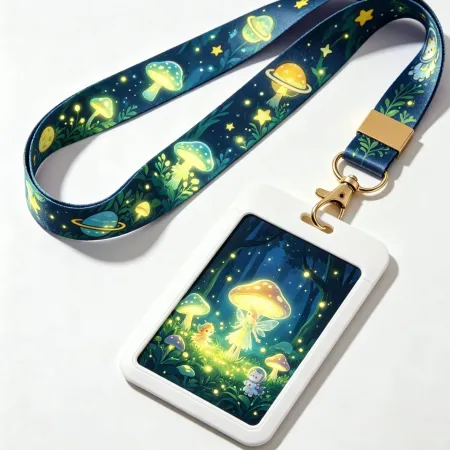
A custom ID holder lanyard is two products sold as one, and most of the problems in the category come from treating them separately. The holder is dimensioned around a card, the strap is dimensioned around a neck, and the only place they meet is a slot, an eyelet or a snap — a joint that has to survive being pulled, twisted and sat on. Get the interface right and the rest is colour and print.
This guide covers the card sizes that dictate everything, the holder formats that exist and where each one belongs, the three ways a holder attaches to a strap, and the colour and print decisions that keep the pair looking like one product rather than two purchases.
The Card Sets the Dimensions
Almost every access card, employee badge and event pass is the same size, and that single fact decides the holder.
- The standard card — 85.6 by 54 mm, the ID-1 format used by bank cards. A holder built for it needs a couple of millimetres of clearance on each side or the card bows and jams.
- The portrait card — the same format rotated. Vertical holders read better on a chest and are the default for staff badges.
- The oversized pass — event passes and visitor badges often run larger, and a holder has to be built to the actual print size rather than to the standard.
- The multi-card holder — two or three pockets for a staff card, a door card and a travel pass. Each added pocket adds thickness and changes how the holder hangs.
The table lines up the common holder formats against the situations they suit, because the wrong format is usually obvious within a week of use.
| Holder format | Loading | Best for | Watch point |
|---|---|---|---|
| Soft PVC, vertical | Top load | Staff badges and conference passes on a tight budget | The slot creeps in warm conditions; a card left in a car curls |
| Rigid polycarbonate | Slide-in with a thumb notch | Site access, visitor management, any scheme that recycles holders | Scratches show on clear plastic and dull a printed card |
| PU leather, side load | Horizontal | Corporate and hospitality programmes where the holder is part of the uniform | Edge paint wears at the corner nearest the clip |
| Expandable, multi-card | Side load, concertina | Staff with a door card, a canteen card and a travel pass | Weight pulls the strap forward; needs a wider band |
Custom ID Holder Lanyard: The Joint That Carries the Load
Three interfaces connect the holder to the strap, and each one distributes force in a different place. On a strap that clears 2000N, the interface is almost always the weakest element in the product.
- Punched slot in the holder — cheapest and most common. All the load passes through a narrow bridge of PVC, which stretches in heat and tears outward over months.
- Metal eyelet through the holder — a brass or nickel eyelet spreads the load around a ring and multiplies the life of the joint several times over. It also stops the card window from distorting.
- Clip-on or snap interface — the holder carries its own clip or a press stud, and the strap simply loops through it. Best for programmes that swap holders between events.
Match the hang, not just the colour
Two holders in the same colour can hang completely differently because of where the slot sits. A slot near the top edge lets the card sit flat; a slot punched 10 mm lower tips the holder forward so the card faces the floor. On a staff badge that difference is noticed immediately and blamed on the strap, so the specimen should be assembled and worn before the print is approved.
Making Two Parts Look Like One Product
A strap and a holder made from different materials will never match exactly, and the goal is not an exact match — it is a pair that reads as intentional.
Colour across two substrates
Woven polyester, soft PVC and PU leather each render the same reference differently. The practical approach is to approve the strap first, then match the holder to the strap rather than to the Pantone book, because the strap is the larger area and the eye reads it as the reference. Where the holder is transparent, the card inside becomes part of the colour story and should be considered at the same time.
Print continuity at the joint
A logo that appears on both the strap and the holder has to keep its size and its optical weight across two surfaces. A 15 mm mark on a 20 mm strap looks heavy; the same mark printed on a 65 mm holder looks lost. Adjust the scale per component and keep the proportion, rather than copying coordinates from one artwork to the other.
Reading through the window
Where the holder is clear, whatever sits behind the card is visible through it. A busy print on the reverse of the strap shows through a thin holder and makes the card harder to read at a barrier. A plain reverse, or a coloured backing card behind the ID, solves it at almost no cost.
Six Decisions Before the First Sample
These are the questions that turn a vague request into a product that can be sampled once rather than three times.
- Card size and orientation — measured from the actual card, including any laminate or print bleed.
- Interface type — slot, eyelet or clip-on, chosen against how long the holder has to last and whether it will be reused.
- Strap width against holder weight — a multi-card holder on a 15 mm band hangs forward; 20 mm holds it flat.
- Closure — breakaway where there is a snag risk, sewn loop where there is not.
- Colour sequence — which part is matched to which, and what the retained approved pieces are.
- Packing unit — assembled and bagged, or flat-packed as two components for local assembly.
The advantage of buying both parts from one place is that the strap and the holder can be developed as a pair. The custom lanyard range covers straps, closures and short wristlets, and because holders, clips and straps sit in the same catalogue the base cloth is often already qualified for the colour you need. Testing runs through the in-house laboratory, and new holders are developed through OEM and ODM development.
FAQ: Custom ID Holder Lanyard
Should the holder be vertical or horizontal?
Vertical for staff badges, because a portrait card sits flat against the chest and reads from the front. Horizontal for visitor passes and event cards that carry a wide logo along the top. The choice also changes where the slot goes, so decide it before the holder drawing rather than after.
Is an eyelet worth the extra step?
On a holder that has to last more than a few months, yes. The eyelet turns a point load into a ring load, which is the difference between a slot that creeps and a joint that holds its shape. On a single-event pass that is thrown away at the gate, the plain slot is the sensible choice.
Can the holder be printed as well as the strap?
Yes, and it is usually the cheapest place to put the full company details, because a holder has more flat area than a 20 mm strap. Keep the mark proportionate to the surface, and remember that print on a soft holder flexes at the corners — artwork that relies on a hairline border will show wear there first.
Will a clear holder turn yellow?
Soft PVC can yellow with UV exposure and with contact with some plastics, and the effect is faster in a sunny reception than in an office. Polycarbonate holds clarity far longer at a higher unit cost. If the holder is a long-term staff item, the material question matters more than the print on it.
How do I keep two production lots consistent?
Keep a retained piece of both the strap and the holder from the approved lot, and reference them on the purchase order. Colour drift across lots is normal on dyed webbing and on moulded plastic, and a physical reference settles any argument faster than a photograph or a number in an email.
A custom ID holder lanyard is really an exercise in dimensions: a card of 85.6 by 54 mm, a slot or eyelet that survives being pulled, and a strap wide enough to keep the whole assembly hanging flat. Settle those three and the product behaves; settle only the colour and it will be replaced within a year.
Why Xinxiangrui for Custom ID Holder Lanyard
Holders, clips, straps and short wristlets are catalogued together, so a custom ID holder lanyard is developed as one product rather than as two purchases that meet at a slot. The base cloth behind the strap is often already qualified for the shade, which turns a colour match into a sampling round instead of a new dye programme. Share your custom ID holder lanyard details with us and we will come back with a matched sample.