1 Inch Cotton Webbing: The Four Numbers Behind a 25.4 mm Strip
1 inch cotton webbing is the most widely bought width in the narrow fabric trade, and the most loosely specified. Buyers order it by name, receive a strip that measures somewhere between 24.5 and 26 mm, and then discover that the buckle they chose for a one-inch strap closes on some rolls and not on others.
The reason is simple: an inch is 25.4 mm, a loom reed is built in whole and half millimetres, and a cotton strip shrinks in the dye bath by a figure nobody writes down. Four numbers — ends per inch, yarn count, finished thickness and shrink allowance — decide what actually arrives. This guide sets out each one, the test that proves it, and the failures that follow when it is left to the mill.
Why a 1 Inch Strap Rarely Measures an Inch
Three separate tolerances stack on top of each other before the strip is measured, and each one is defensible on its own.
- Reed setting — the width is woven in the reed, and reeds come in fixed increments. A mill set up for 25 mm will not change the reed for a 25.4 mm order unless the order justifies it.
- Weave take-up — cotton crimps as it interlaces, so a strip off the loom is wider than the same strip after finishing. Plain weave takes up more than twill at the same sett.
- Dye shrinkage — a cotton strip dyed on a continuous line relaxes and draws in. Two to four per cent is ordinary; the figure depends on the yarn, the tension and the colour depth.
The table shows how those tolerances add up in practice, and which part of a finished product feels each one.
| Measured width | Where it comes from | What it breaks downstream |
|---|---|---|
| 24.5–25.0 mm | Metric reed plus dye shrinkage with no allowance added | A one-inch slider rattles and will not hold adjustment under load |
| 25.4 mm | A reed built to the imperial figure, or an allowance added at greige | Nothing — this is the figure the hardware was designed around |
| 26.0 mm and over | A 26 mm reed used because it was already on the beam | The strap will not pass through the buckle at all after the first wash |
The Four Numbers a Specification Has to Carry
Width alone identifies nothing. Two strips at 25.4 mm can differ by a factor of two in strength and by a wide margin in hand feel, because width does not say how much yarn is inside it.
- Ends per inch — the count of warp threads across the width. At one inch, going from 40 ends to 56 ends changes both density and strength, and it changes the hand from soft to boardy.
- Yarn count — spec cotton by the English count, written as 20/2 or 16/3. Two plies twisted together resist abrasion far better than a single yarn of the same total thickness, at the same nominal weight.
- Finished thickness — usually 1.2 to 2.0 mm at this width. Thickness is what hardware feels, and it is the figure most often missing from an enquiry.
- Weave and edge — plain weave is flat and stable; twill is denser and softer. A tucked edge holds fibre in; a cut edge on cotton will fray from the first cut end unless it is sewn or tipped.
Measure the hardware, then the webbing
Take the buckle or slider you intend to use and measure its internal slot with a calliper. That slot is the real width requirement — not the nominal inch. A slot of 26.2 mm takes a 25.4 mm strip comfortably and a 25.0 mm strip badly, because a loose strap in an adjuster slides under load. Write the slot figure into the enquiry and the width argument ends before it starts.
What a Test Report for 1 Inch Cotton Webbing Should Show
A report written against the yarn rather than the finished strip answers a question nobody asked. Four results matter, and each one should name the specimen, the method and the direction of test.
- Tensile to break — quoted in newtons for the full strip, with the gauge length and the pull rate. Constructions in this width routinely reach 2000N and beyond; what matters is whether the figure was measured on a sample or on the production roll.
- Abrasion — Martindale cycles to a defined end point. A strip that survives 50,000 cycles is a different product from one that fails at 15,000, even when both are labelled 25 mm cotton.
- Colour fastness — to rubbing, wet and dry, and to washing. A deep shade on cotton moves more than a pale one, and a strap that crocks onto a white shirt is a return.
- Dimensional change — length and width after a stated wash cycle. This is the figure that tells you whether the strap still fits its buckle after the customer's first laundry load.
Light ageing belongs on the same page for anything that lives outdoors. A thousand hours of UV exposure with a colour shift under five Delta-E is a working target for a dyed cotton strip, and it is worth asking for because sunlight on a bag strap is relentless in a way that a shop test never is.
Where a One Inch Strap Fails in Use
Field failures on this width are repetitive enough to rank, and none of them is a mystery once the construction is known.
The buckle edge cuts the webbing
A die-cast buckle with a sharp internal corner acts as a blade on a woven strip, and the failure starts as a single broken end that unravels the edge. The cure is either a radiused buckle or a thicker, denser strip that spreads the load. Asking for a 25.4 mm strip at 1.8 mm thickness instead of 1.4 mm solves more of these than any change of yarn.
The stitch line is stronger than the cloth
When a strap is sewn to a bag with a box-X, a coarse thread at a short stitch length will perforate the webbing and tear along the needle line before the thread breaks. Cotton is more forgiving here than a coated synthetic, but the stitch density still needs a limit. Eight to ten stitches per inch with a size 90 needle is a workable band for this weight.
The strip stretches where it is gripped
A plain weave at low sett elongates under sustained load. On a shoulder strap that shows up as permanent growth of several millimetres over a season, and the bag starts to hang unevenly. Twill at a higher sett resists it, and a two-ply yarn resists it further.
Six Lines to Put in the Enquiry
- Width with a tolerance — 25.4 mm plus or minus 0.5 mm, measured flat under a stated pressure.
- Thickness band — a range, not a point, and the instrument used to check it.
- Ends per inch and yarn count — these two numbers carry the strength, and they cost nothing to state.
- Weave and colour reference — plain or twill, with a Pantone number plus a retained physical piece once approved.
- Edge treatment — tucked, tipped or cut, and whether the end will be sewn into a seam.
- Put-up — metres on a roll or cut lengths, and the roll length the cutting table can use without waste.
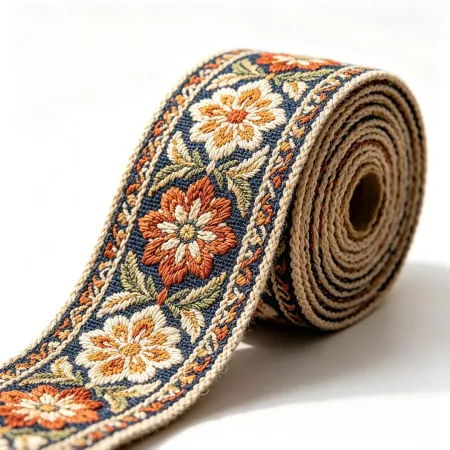
The strip itself is a simple product. The plain woven natural cotton webbing and the heavier twill version built for tote handles are the same width and behave differently, which is why the numbers above decide more than the name does. The wider cotton webbing range covers the neighbouring widths, and sampling is handled through OEM and ODM development.
FAQ: 1 Inch Cotton Webbing
Is 1 inch webbing exactly 25.4 mm?
Only if the reed was built to the imperial figure. Most mills weave 25 mm and finish near 25.0 to 25.4 mm depending on the dye shrinkage. If your hardware was designed for a true inch, say so in the enquiry and ask for the greige width that lands at 25.4 mm after finishing rather than assuming the name covers it.
What weight is 1 inch cotton webbing?
A plain weave in this width commonly runs 110 to 160 grams per metre, and a twill or a denser sett runs higher. Weight is a consequence of yarn count, ends per inch and picks per inch rather than an independent choice, so specify those three and let the weight be reported back.
Will a cotton strap shrink after washing?
It will, and the amount depends on whether the yarn was pre-shrunk and how the strip was finished. Two to four per cent in length is ordinary after a warm wash. For a bag handle that number is invisible; for an adjustable strap it changes the usable length, so ask for the dimensional change figure on the report.
Can the ends be heat sealed?
Not cleanly on pure cotton. Heat sealing relies on melting a thermoplastic fibre, and cotton chars instead. The practical options are a tucked edge woven in, a sewn and turned end, or an ultrasonic cut with a sealed resin tip. Each adds a step and each shows differently on the finished strap.
Do I need a certificate for a cotton strap?
If it touches skin or goes into a product for children, yes. OEKO-TEX, REACH and CPSIA documentation is usually requested for the yarn and dye recipe actually used, not for the mill in general. Ask which certificate numbers cover your order and check that the scope names the yarn and the dye house.
Width is the number a buyer can see and the least informative one on the page. Ends per inch, yarn count, finished thickness and shrink allowance are the four that decide whether a 1 inch cotton webbing strap survives a buckle, a wash and a season of carrying something heavy.
Why Xinxiangrui for 1 Inch Cotton Webbing
Tensile, Martindale and UV results for 1 inch cotton webbing come off the roll that ships, not from a catalogue sample kept for show, and the report names the yarn count, the sett and the dye recipe behind it. Width tolerance, thickness band and dimensional change are recorded per order, so a repeat run follows the last one instead of drifting. Give us the application and the load it must carry, and the construction follows.