Double-Sided Reflective Pet Webbing: Both Faces, One Limit
A band that twists is the reason double-sided exists, and twisting is the one thing a flat sample never does. Double-sided reflective pet webbing is bought for the moment a lead spirals in a hand or a collar rotates until its reflective face points at the pavement, and in that moment a single-sided band stops working entirely. The product answers a real problem, and it also carries a misconception that survives most briefs: that two reflective faces return twice the light.
This guide covers the three ways a band can be made reflective on both faces, why only one face ever works at a time, what doubles and what does not, how the extra layer changes stitching and edge finishing, six lines a double-sided brief should carry, and the two things a flat swatch will never reveal.
Double-Sided Reflective Pet Webbing: Three Ways to Get There
The phrase covers three constructions that look alike in a photograph and behave differently in a hand. Which one is being bought should be settled before anything else in the brief.
| Construction | How it is made | What it costs in return |
|---|---|---|
| Coated both faces | The optical layer is applied to the front and the back in two passes | Stiffer hand, two surfaces that can age differently |
| Two bands laminated | Two single-sided bands bonded face to face, optics outward | Double thickness, and a bond line that must survive flexing |
| Single band, folded | One reflective band folded along its length, optics out and a plain spine | A visible plain edge, and half the width per face |
The first two are what most buyers mean. The third is what a buyer sometimes receives, because folding one band is cheaper than coating two faces, and the difference is only obvious when someone looks at the edge. A folded band also has a spine that is plain fabric, which reads as a dark line down the middle of a reflective strip under a beam.
Two faces, one working at a time
A retroreflector returns light towards its source, so a band can only work on the face that is turned towards the lamp. What a second face buys is coverage, not brightness: the same band now works in twice as many orientations. A double-sided band at a given grade is not twice as visible from any one position, and it is visible from twice as many.
Three Things That Change When a Second Face Arrives
The hand of the band
A coated face is a film, and a film on both sides makes the band behave like a strip of card rather than a strip of cloth. That matters where the band has to turn: a collar around a small neck, a lead looped through a handle, a harness that follows a chest. A stiff double-sided band stands away from the neck instead of lying on it, and the gap it leaves is exactly where a light can pass without touching the reflective face. Choosing a thinner base for a double-sided construction is the usual answer, and it has to be chosen at the start rather than at the sample stage.
The way it stitches
On a single-sided band a seam can be planned to run down the plain back, where a needle mark does not matter. On a double-sided band every stitch passes through one optical face, so the seam line becomes a permanent dull stripe. The usual solution is to sew through the edge and keep the seam within a couple of millimetres of the border, where the coating is already compromised by the selvedge and the eye is not looking. That is a design decision, and it has to be drawn before the third sampling round rather than corrected after it.
The two edges
A single-sided band has one coated face and one plain back, so a raw edge shows a fabric cross-section. A double-sided band has optics on both faces meeting at the selvedge, and that border is the place where the coating has the least support and the most exposure. It is also where a band handled daily wears first. Ask how the edge is finished, whether the coating wraps the ridge or stops short of it, and whether the answer is the same on both sides.
What Doubles and What Does Not
- Coverage doubles — the band now works from either side, which is the whole point on a lead that spirals or a collar that rotates.
- Brightness does not — the coefficient of the face turned towards the light is unchanged by what is on the other side.
- Thickness doubles — and with it the clearance a fitting needs, so a slot that passed a single-sided band may not pass this one.
- Strength does not — the load path is the weave, and a 25 mm base band still clears 2000N; the second coating adds visibility rather than tensile capacity.
The third point catches more orders than the others. A double-sided band is thicker at the fold, thicker under a buckle and thicker where two pieces overlap for a bartack, so the fitting that was specified from a single-sided sample can bind. Measuring the slot against the finished thickness, rather than against the nominal width, is the check that prevents a delivery of band nobody can thread.
Six Lines for a Double-Sided Brief
- Which construction — two coatings, two laminated bands or a folded single, named explicitly because the three look alike in a photo.
- The width per face — on a folded band the total width is not the reflective width, and the difference is a plain spine.
- The finished thickness — a number in millimetres, since it decides which fittings the band can pass through.
- The seam position — how close to the border the stitching runs, because every stitch crosses a reflective face.
- The base shade between the faces — on a laminated band the middle is invisible until the edges are cut, and then it is not.
- The care instruction — two coated faces age at the same rate only if the band is washed as one piece rather than scoured on one side.
The fifth line is the one nobody thinks to ask. A laminated band is two bands bonded, and the bond line sits at the centre of the cross-section, invisible until a cut or a worn edge exposes it. If the two bands came from different dye lots the join shows as a faint line along the border, and on a product whose whole appeal is a clean reflective stripe that line is a fault even though nothing has failed.
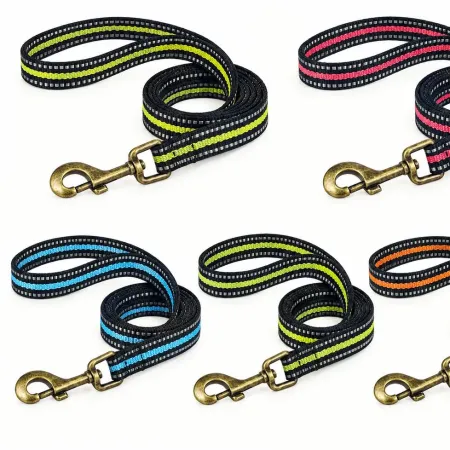
The construction starts from a base that is chosen for bend rather than for weight, usually a polyester webbing in a lighter count, with the optical layer applied on both faces on the pet reflective webbing line. Where the finished piece is a lead rather than a band, the pet leashes page shows how a double-sided band is joined to a handle, and the test record should say which face the coefficient was measured on.
Two Things a Swatch Will Not Reveal
How much of the band twists
A hand-held strip stays flat because a hand keeps it flat. On a lead the band turns as the dog moves, and the proportion of time it spends face-on is what the second coating is buying. That proportion depends on the weave, the thickness and how the lead is held, and it can be estimated by hanging a two-metre length from a rail and watching which way it settles. A band that prefers to lie flat gains less from a second face than one that rolls.
What happens at a fold
Every lead folds where it passes through a handle, and every collar folds at the buckle. At that crease two coated faces are bent against each other, and the compression is on the inside of the curve. A thin binder takes it; a thick one takes a set and later cracks along the crease, which shows as a pale line across the reflective face at exactly the point a customer looks at when the product is worn out. Folding a sample in half and leaving it under a book for a week is a crude test that finds this before a customer does.
FAQ: Double-Sided Reflective Pet Webbing
Is double-sided twice as bright?
No. Each face returns light when it faces the source, so brightness from one position is unchanged. What doubles is the number of orientations the band works in.
Does it fit the same buckles?
Not always. Two coatings and, in a laminated version, two bands add thickness, so the slot has to be checked against the finished thickness rather than the nominal width.
Where should the stitching go?
Close to the border. Every stitch crosses a reflective face, so the seam becomes a dull line wherever it runs; near the edge it falls where the coating is already thinnest and least noticed.
Can the two faces differ in colour?
They can, and it is worth asking whether they do. A band reflective on one face and merely coloured on the other is sold as double-faced in some catalogues, and the difference only shows at night.
Is a folded band acceptable?
It works, and it has a plain spine down the middle that reads as a dark line under a beam. If the design wants an unbroken stripe, the folded route will not give it.
Double-sided reflective pet webbing doubles coverage, thickness and the number of ways a seam can spoil a face. Name the construction, the width per face and the finished thickness, and the second side adds visibility rather than problems.
Why Xinxiangrui for Double-Sided Reflective Pet Webbing
A double-sided band is a lamination problem rather than a weaving one, and here the loom, the dye line, the coating line and the laminating bench sit inside one 8,000+ m² plant in Dongguan. Two passes, two dye lots and one bond line are all handled under the same roof, so a shade that has to match across both faces is matched before the bands meet rather than after. Tell us your double-sided spec and a matched construction comes back to you.