Abrasion Resistant Reflective Pet Webbing: What Actually Wears Away
The word abrasion on a roll of abrasion resistant reflective pet webbing describes a test result, and that result is almost never printed on the same page as the reflection figure. A band can survive twenty thousand rubs and still lose half its return, because the test counts cycles while the customer counts visible brightness. Abrasion resistant reflective pet webbing is therefore two claims wearing one label, and a brief that asks for only one of them leaves the other to chance.
This guide covers what abrasion actually removes from a reflective band, why a cycle count and a coefficient belong in the same sentence, how the four common test methods differ in what they punish, six lines a wear-resistant brief should carry, and the two things a test certificate will not tell you.
Abrasion Resistant Reflective Pet Webbing: Two Numbers, One Sentence
A reflective band returns light because a layer of glass beads or microprisms sits in a binder on the surface. Abrasion does not slowly polish that layer away; it breaks the binder that holds the optics in place, and the optics leave. Once a bead is gone there is a hole in the array, and the light that reaches that hole is absorbed by the base band instead of being sent back. The damage is discrete rather than gradual, which is why a band can look uniformly scuffed and still read at a distance, or look intact and read poorly because a band of beads has shed along a fold line.
The sentence to ask for
Abrasion resistance is only meaningful as a pair: a stated number of cycles, a stated method, and the coefficient measured before and after. A report that gives the cycle count alone answers how long the band survived, not what it still does at the end of that time, and those are different questions for a product whose whole job is to be seen.
| Method | What it punishes | What it misses |
|---|---|---|
| Rubbing, weighted | Gradual loss of binder across the whole face | Edge wear, which is where a collar actually fails |
| Abrasive wheels | Sharp local cutting of the optical layer | Soft soiling, which dulls a band with no material loss |
| Repeated washing | Binder swelling, then loss at folds and seams | Dry abrasion against fur and ground |
| Flexing to a radius | Cracking of a stiff coating where the band bends | Straight-line wear on a flat, unloaded band |
No single method covers a real collar, and that is the honest summary. A collar bends around a neck, rubs against a coat, drags on the ground when a dog lies down and goes through a washing machine twice a month. A test that subjects the same sample to one of those actions describes one quarter of its life, and a buyer comparing two suppliers who each chose a different method is comparing two unrelated numbers. What none of the methods changes is the structural figure underneath: a 25 mm base band clears 2000N, and the optical layer rests on that strength rather than adding to it.
Three Ways a Reflective Band Loses Its Return
The optics leave the binder
This is the loss most people mean by wear, and it happens fastest at a fold, a seam and a selvedge, because those are the places where the binder is already under strain. A bead that sits in a relaxed film is held by the whole depth of the layer; a bead near a fold is held by a film that is being pulled away from the fabric. That is why a band worn as a collar loses its reflection in a ring around the sewn joint rather than evenly across its length.
The surface fills with dirt
A reflective band is a retroreflector, which means the light has to enter the optics and come back out through the same face. Anything sitting on that face reduces both directions at once: mud, oil from a hand, sunscreen, the plasticiser that migrates out of some coated fabrics. This loss is reversible with a soft brush and water, and it is the most common reason a band is judged worn out when nothing has actually worn. The test for it is a wipe, not a microscope.
The carrier film crazes
Where the optical layer arrives as a transfer film rather than as a coating, the polymer carrying the optics can craze under repeated flexing, and fine cracks scatter light before it reaches the prisms. The band still looks silvery in daylight and reads noticeably dimmer under a beam. This failure is invisible in a hand-held inspection and obvious in a night photograph, which is one reason a photograph belongs in the approval file beside the numbers.
Six Lines for a Wear-Resistant Brief
- The starting coefficient — the figure on a new sample, with the angles it was measured at, because everything else is a percentage of this.
- The cycle count and the method — named together, since ten thousand rubs by one method and by another are not the same ten thousand.
- The coefficient after the cycles — the number that turns a survival claim into a performance claim.
- Where the sample was tested — flat face, folded edge or seam, because the answer differs by a wide margin between them.
- The cleaning instruction — whether the band can be brushed wet, since a reversible soil loss should not be counted as wear.
- The acceptance floor — the value below which a lot is rejected, agreed before the first roll is run rather than after the third.
The sixth line is what separates a specification from a hope. A floor is a number both sides wrote down, and it settles the argument that otherwise arrives with a photograph and two opinions. It also forces the earlier lines to be specific, because a floor cannot be applied to a method that was never named.
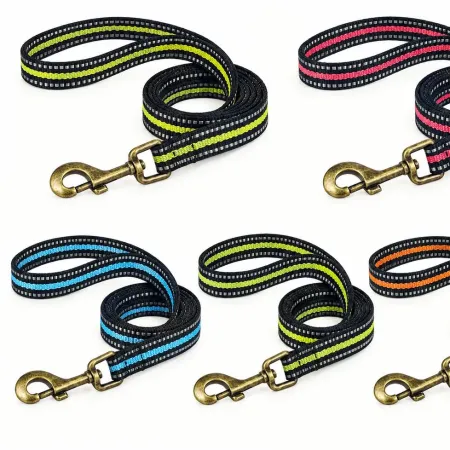
Wear resistance is built on the base as much as on the coating: a tightly woven polyester webbing holds a binder steadier than a loose one, because the film has less movement underneath it. The pet reflective webbing range is quoted with both the width and the wear result, and the laboratory record for a given lot names the method beside the number. Where a collar needs a closure that will not abrade the band it sits against, a hook and loop fastener keeps the rubbing on a soft face rather than on the optics.
Two Things a Certificate Will Not Say
- Which surface — the flat face, a folded edge or a stitched seam, since the three lose the optic at very different rates.
- Which count — cycles to a visible change, or cycles to a stated coefficient, because only the second can be compared with another supplier.
- Which sample — a bench strip or a piece cut from the delivered roll, and the difference is the whole point of testing your own goods.
- Which date — when the strip was tested relative to when it was woven, since a year on a shelf changes a binder.
How the sample was mounted
A flat strip clamped on a plate and a looped strip pulled around a mandrel are both described as abrasion tested, and they behave differently. The looped sample puts the load on one narrow band of the face and on both selvedges, which is much closer to a collar. The flat sample spreads the action across the whole width, which flatters a coating that is thinner at the edges. Asking how the specimen was mounted is a two-word question that reinterprets the entire report.
What the second year looks like
Abrasion tests are run on new material, and a collar spends most of its life on aged material. Sun, detergent and flexing all change the binder before the first rub is applied, so a band that passes comfortably when new can fail well inside the same cycle count after a summer outdoors. Retaining a strip from each lot and testing the retained strip at the end of the season is the only way to see that, and it is a habit rather than a test.
FAQ: Abrasion Resistant Reflective Pet Webbing
Does abrasion resistance mean the reflection lasts?
Not by itself. It means the band survived a stated action for a stated number of cycles. Whether the reflection is still useful at the end is a separate figure, and it is the one worth asking for.
Where does a collar wear first?
At the sewn joint and along both selvedges, because that is where the band bends and where the binder is already stretched. The face in the middle of a run usually outlasts both.
Can a dull band be cleaned back to life?
Often, yes. Soil sits on the face and blocks light in both directions, so a soft brush with water can restore a band that looked finished. Physical loss of the optics cannot be cleaned back.
Is a heavier coating more durable?
Up to a point. A thicker binder holds the optics deeper and resists a rub longer, and past that point it becomes stiff, cracks at a fold and takes the optics with it. The useful thickness is set by the radius the band has to bend to.
Does a wider band wear more slowly?
Per square centimetre it wears at the same rate, and it has more square centimetres to lose before the effect is visible. That is a useful margin, not a different material.
Abrasion resistant reflective pet webbing is a pair of numbers rather than an adjective. Ask for the coefficient before and after a named method, state where on the band the sample was taken, and agree the floor before the roll is woven.
Why Xinxiangrui for Abrasion Resistant Reflective Pet Webbing
Wear results depend on the base as much as the coating, and here both are made on one site: the loom, the dye line, the coating line and the laboratory sit inside the same plant in Dongguan. That means the test report describes the roll in front of you rather than a catalogue sample approved years ago, and a change of weave or binder can be measured on the next lot instead of the next quarter. Send us the drawing, the width and the target market, and we reply with a construction and its wear figures.