Hands Free Pet Leashes: Where the Load Lands Instead
Hands free pet leashes are usually presented as a convenience, and the interesting part is mechanical rather than convenient. A hand-held lead ends at a wrist, which is a small joint that tires quickly and cannot hold much. A hands-free system terminates at a belt, a shoulder or a waistband, and each of those anchors behaves differently under a lunge: the load is taken by a larger structure, at a different angle, with a different amount of give. Moving the anchor is the whole design.
This guide covers the four forms a hands-free lead takes, where each one puts the load, why an elastic element changes the average rather than the peak, six lines a hands-free brief should carry, and the two things that decide whether the system stays where it was set.
Hands Free Pet Leashes: Four Forms, Four Anchors
Each form solves a different problem and each one loads the body somewhere else, which is why they are not interchangeable.
- The waist belt — a webbing band around the hips with a ring at the front or the side, and the anchor becomes the pelvis rather than a joint.
- The cross-body strap — a longer band over one shoulder, which sends a pull diagonally across the torso and needs an adjuster that does not slip.
- The dual lead — one handle and two branches, which is a coupling problem rather than a strength problem.
- The elastic element — a bungee section that absorbs a lunge, which changes how the lead feels for every step rather than only at the moment of a pull.
| Form | Anchor | Suits |
|---|---|---|
| Waist belt | Pelvis, low and central | Running, hiking, a dog that pulls steadily |
| Cross-body | Shoulder and opposite hip | City walking, a small dog, hands full of shopping |
| Dual lead | One hand or belt, two dogs | Two dogs of similar size and pace |
| Elastic section | Whichever anchor, with give | Canicross, jogging, a dog that surges |
The belt is the part that gets overlooked
A hands-free system is only as good as the band around the waist, and that band is often treated as an accessory. A 25 mm webbing belt clears 2000N and takes the load comfortably, while a narrow fashion belt with a light buckle becomes the weakest point in a system whose lead end was specified in detail. On a hands-free product the belt deserves the same specification effort as the lead.
Three Mechanical Points Worth Knowing
The hip takes a pull better than a wrist
A wrist is a hinge with a short lever and a small set of muscles; a pelvis is a mass. The same sudden load that jars an arm is absorbed by the body's centre when it arrives at a waist belt, which is why hands-free walking feels easier even though nothing about the band has changed. The advantage depends on the belt sitting low and staying put, because a belt that rides up converts a hip pull into a rib pull.
Elastic changes the average, not the peak
A bungee section is often described as removing shock, and what it really does is smooth it. The peak is lower and longer, which is gentler on the handler, and the same stretch keeps a constant tension on the dog for the whole walk, which some dogs find harder to ignore than a slack lead. That trade is the honest way to describe an elastic lead: it moves the discomfort from the moment of the lunge to the hours between them.
Two dogs double the geometry, not the load
A dual lead does not double the force on the handle, because two dogs rarely pull in the same direction at the same instant. What it doubles is the number of directions the load can arrive from, and the coupling point has to survive being pulled sideways and backwards at once. That is why the swivel and the join matter more than the band on a two-dog product.
Six Lines for a Hands-Free Brief
- The anchor and its band — waist, shoulder or hand, with the belt's width and buckle named, since the belt carries the load.
- The ring position — front, side or sliding, which decides whether the lead pulls forward or sideways across the body.
- The lead length when extended — measured from the anchor rather than from the hand, because the body adds distance the lead does not.
- Whether there is an elastic section — and if so, its travel, because ten centimetres of give and thirty are different products.
- The number of dogs — one, two, or a convertible, with the coupling hardware specified if more than one.
- The quick release — how the lead detaches from the belt, because a system that cannot be separated in a hurry will not be used as intended.
The release line is a safety decision rather than a convenience. A dog that wraps a lead around a post, or a handler who needs both hands at once, needs a clip that opens with one movement under load; a buckle that needs two hands and a look is a buckle that will be left fastened. Testing the release with a gloved hand, in the rain, is a five-minute exercise that finds the design problem before a customer does.
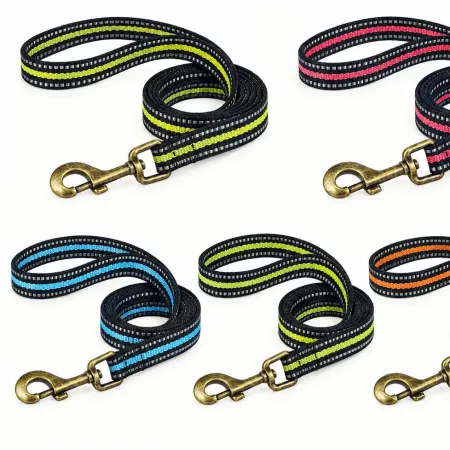
A hands-free system is built from the same nylon webbing base as a hand lead, usually 20 mm for the lead and 25 mm or 38 mm for the belt, and the two can be cut from one order. A polyester webbing belt is the better choice where a waistband will be worn against clothing for hours, because it holds shape and does not stretch with damp. The development route can build the lead and the belt as one set, and the pull report should describe the belt and buckle as well as the lead.
Sizing is the last practical detail and the one most often left to the buyer. A belt offered in one length with a long adjustment tail will fit most bodies and look untidy on all of them, while three sizes with a short tail fit better and multiply what a shop has to stock. A middle route, one band length with two adjustment ranges and a keeper to hold the surplus, usually sells best, because the shop carries a single item and the customer still gets a belt that sits where it should.
Two Things That Decide Whether It Stays Put
Whether the belt climbs under load
A belt with the ring at the front is pulled forward and slightly up, and a smooth band on smooth clothing will ride toward the waist over a walk. Once it has climbed, the anchor is at the softest part of the torso and the advantage of a hip anchor is gone. A wider band, a silicone grip strip on the inside or a ring mounted at the side rather than the front all keep it in place, and the fix is in the belt rather than in the lead.
What happens at a corner
A dog turning a corner applies a sideways load that a hand lead absorbs by moving the arm. A hands-free system absorbs it through the body, and the direction of the pull rotates around the anchor, which is where a fixed ring and a swivel behave very differently. Walking a sample around a corner and then back again is a better test of the ring position than a straight-line pull, because the second turn loads the assembly in the direction it was not designed for.
FAQ: Hands Free Pet Leashes
Is hands free safer than a hand lead?
It is more stable for a steady puller and less controllable for a sudden one, because the hand can react faster than the hips. The quick release is what makes that trade acceptable.
What width for a waist belt?
25 mm for a small dog, 38 mm for a strong one. Wider spreads the pressure across the hips, and the buckle should match the width rather than the band being folded to fit.
Does elastic help a pulling dog?
It softens the lunge and keeps a light tension between lunges. For a dog that pulls continuously, that constant tension can encourage pulling rather than reduce it.
Can one lead serve two dogs?
Yes with a proper coupling and a swivel at the join. Without the swivel the two branches twist around each other within a few walks.
Is a waist belt suitable for running?
It is the usual choice, provided the belt sits low, does not climb, and the ring is at the side. A front ring swings against the legs at running pace.
Hands free pet leashes move the anchor from a wrist to a body, and every design question follows from that move. Specify the belt, the ring position, the length from the anchor and the release, and the system works the way the body does.
Why Xinxiangrui for Hands Free Pet Leashes
A hands-free set is a lead plus a belt, and both come off the same looms. Three production lines across 17 product categories and 65 items mean the band for a waist belt is the same base used for bag straps and harnesses, so a system can grow from one lead into a matched walking set without a fresh development. Send us the drawing, the width and the target market — we reply with a construction.