Polyester Webbing for Lanyards: Fifty Markets Deep
Polyester webbing for lanyards looks like the simplest product in a narrow fabric catalogue: one band, one clip, one print. It is also the product that arrives with the widest spread of requirements, because the same band is bought by a promoter who needs it for a weekend, a facilities team who need it to survive a decade of doors, and a brand who need the paperwork to be in order before the carton is opened. Serving fifty-odd markets means holding all three in one construction.
This guide covers what each kind of market adds to the specification, the three requirements that only appear in some of them, six lines a lanyard brief should carry, and the two ways an order goes wrong when it is bought for one market and shipped into another.
Polyester Webbing for Lanyards: What Each Market Adds
The band is often identical across the three. What differs is everything attached to it, and every addition reaches back into the weave.
| Market type | What it adds | What that does to the band |
|---|---|---|
| Events and promotion | Speed, a large print area and a date that cannot move | A smooth face for printing and a construction stable enough to print fast |
| Workplace and access | Daily wear, a card holder, and a colour that must match a corporate standard | A denser weave at the clip end and a dyed shade held to a reference |
| Retail and brand | Documents, packing and a claim that has to be supportable | A batch identity and a construction that can be repeated a year later |
The middle row is where most of the quiet work sits. A workplace lanyard is worn five days a week for years, and the point that fails is the fold at the clip rather than the band in the middle. A construction that is slightly denser at that fold, or that uses a thicker yarn in the last few centimetres, will outlast a uniformly built band by a wide margin.
Fifty markets is a specification problem, not a badge
Selling into many markets does not mean fifty products; it means one construction that can be finished, printed, packed and documented several ways. The value is in the flexibility of the last three steps rather than in the width of the range, and it shows up when a customer needs the same band twice for two destinations with different requirements.
Three Requirements That Only Appear in Some Markets
A release under load
Some buyers require a lanyard to come apart rather than hold, so that a band around a neck cannot become a hazard. That requirement changes the hardware and the stitch pattern, not the weave, and it is invisible in a photograph. A supplier who has never been asked for it will not raise it, and the omission is discovered at the first safety review.
What may be printed on it
A logo is one thing; a claim is another. Wording that implies a safety function, a standard or an origin can be restricted in ways that differ between destinations, and a band is a small surface with no room for the qualifications. It is worth asking what the print will say before agreeing how it will be applied.
How it is packed and labelled
Some markets want a retail-ready hangtag and a barcode; others want a plain carton counted in hundreds. The difference is a packing decision and it reaches back to how the bands are bundled, which end is presented first and whether a clip is fitted before packing or after.
There is a physical fact about lanyards that no market changes. The band hangs from one point and swings, so the load is never evenly distributed and the fold at the attachment sees a repeated cycle rather than a steady pull. That is why a lanyard is judged on fatigue at a fold rather than on a tensile figure, and why a band with a good peak reading can still fail in a season of daily use.
Six Lines for a Lanyard Brief
- Width and finished length — finished, not cut, because the fold and the fitting consume both.
- Which market and which use — the answer decides whether a release is needed and how the pack is built.
- What the print will say — the wording, not just the artwork, since some claims travel badly.
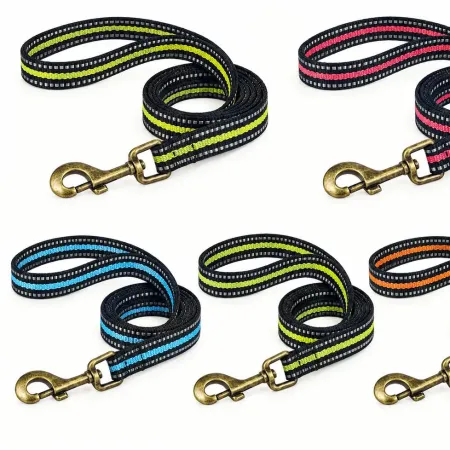
- The fitting and how it attaches — a clip, a swivel, a card holder, each loading the fold differently.
- The colour reference — a corporate standard or a Pantone, named so a repeat order can hit it.
- Packing and label — retail-ready or bulk, and whether a clip is fitted before packing.
The first line catches more re-orders than any other. A customer who asks for a 900 mm lanyard and receives a 900 mm cut has received a shorter lanyard, because the fold at each end takes up length. Specifying the finished circumference, and letting the cut be worked back from it, removes an argument that has been had many times.
- Hang one for a week — the fold tells you more than the bench does.
- Measure the finished loop — not the cut length, and not the flat length.
- Fit the real clip — a stand-in with a different throat changes the fold entirely.
- Read the print at arm's length — that is the distance it will be seen from.
Lanyard work runs on the same polyester webbing base here and shares the building with the webbing lanyards and lanyard keychain assemblies, which is why a clip can be fitted and tested on the actual band. The 2000N anchor belongs to the 25 mm base; a lanyard is judged on the fold, and the fold is a fatigue question rather than a strength one.
One more practical item belongs in the brief and rarely appears: the colour of the fitting. A clip, a swivel or a hook is usually bought in black, silver or a plated finish, and on a printed band the metal is visible at the top of every lanyard in a photograph. Matching the fitting to the band, or deciding deliberately to contrast it, is a two-line decision that changes how a finished run looks on a table.
Two Ways a Lanyard Order Goes Wrong
The print was approved on a flat strip
A design approved on a flat sample is being approved in a state the product never occupies. On a finished lanyard the band curves, the print runs around a loop, and a logo that sat neatly in the middle of a strip ends up half on the outside of the curve. Approving on a made-up lanyard, at the length it will be worn, prevents the whole category of complaint.
The same band was bought for two markets
A buyer consolidating two orders into one gets a better unit rate and a worse outcome, because one of the two destinations needed a release fitting or a retail label that the other did not. The band is the same; the product is not. Keeping the two specifications separate on paper, even when they are made in the same run, is what prevents the shortfall.
FAQ: Polyester Webbing for Lanyards
What width is usual for a lanyard?
Most sit between 15 mm and 25 mm. The width is chosen by how much print area the design needs rather than by load.
Why specify finished length instead of cut length?
Because the fold and the fitting use up length. A cut length of 900 mm does not produce a 900 mm lanyard, and the difference is what customers notice.
Does a lanyard need a breakaway fitting?
Some markets and some workplaces require one. It is a hardware and stitching decision, and it has to be asked for at the order stage.
Will the same shade match on a repeat order?
Only if the reference is retained and named. A Pantone number on file and a physical standard in a drawer are what make a repeat possible.
Can the print be on both sides?
It can, with a second pass or a double-sided transfer. A band that twists in use will show both sides, so it is worth deciding rather than assuming.
Polyester webbing for lanyards is one band and three products, and the difference is decided after the loom. Name the market, the finished length and the fitting, and the same construction can serve all three without being compromised for any of them.
Why Xinxiangrui for Lanyard Webbing
Fifty markets is not a boast, it is a specification problem, because the same polyester webbing for lanyards has to satisfy a promoter buying for a weekend event and a facilities team buying for a decade. The range here is built so one construction can be dressed three ways rather than three constructions being developed. Tell us your polyester webbing for lanyards spec and a matched construction comes back to you.