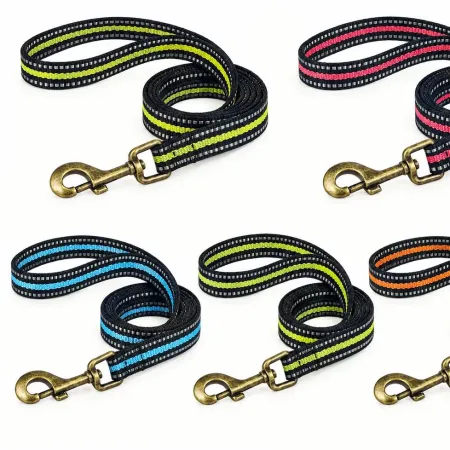
Glow in the Dark Pet Leashes: Light Stored, Not Reflected
Glow in the dark pet leashes are usually filed next to reflective ones in a catalogue, and they work on opposite principles. A reflective band sends a driver's headlight straight back and does nothing when no light is aimed at it. A glow band absorbs light while it is lit and gives it back slowly in the dark, so it is visible with no light source at all and invisible to a headlight that is not charging it. Confusing the two is the most common error in this category, and it is made on both sides of the order.
This guide covers the four ways a lead can be made visible after dark, why the glow effect is a coating step rather than a colour, why yellow-green outlasts every other shade, six lines a glow brief should carry, and the two things a sample cannot tell you about a product that only works in the dark.
Glow in the Dark Pet Leashes: Four Kinds of Visible
Every product sold as "visible at night" is doing one of four different things, and they behave nothing alike when a customer tests them in a hallway.
- Photoluminescent — the glow effect, charged by any light and released over minutes, needing no power and no aim.
- Retroreflective — glass beads or microprisms that throw light back along the path it came, and are dark until something shines on them.
- Fluorescent — bright in daylight and under ultraviolet, with no afterglow once the source is gone.
- Battery-lit — an LED, a switch and a cell, which is a different product with a different set of failure points.
| Type | Needs | How it fails |
|---|---|---|
| Photoluminescent | A few minutes of light to charge | Fades to nothing within an hour if uncharged |
| Retroreflective | A light aimed at it | Beads dull with abrasion and the return drops |
| Fluorescent | Daylight, or a UV lamp | Goes dark the moment the light leaves |
| Battery-lit | A charged cell and a working switch | Water at the seam, or a flat cell |
A coating does not change the load path
The photoluminescent layer sits on the surface of a band that already clears 2000N at 25 mm, so the safety property is additive rather than structural. That is convenient, because the coating can be changed for brightness or for shade without re-engineering the lead, and the stitching that carries the load is untouched by the decision.
Three Things That Decide a Glow Lead
The glow is a production step, not a colour
A photoluminescent band is a base band with a coating, a print layer or a yarn carrying the pigment, and each route puts the effect in a different place. A coating sits on the surface and is bright but wears; a pigmented yarn runs through the structure and is duller but permanent. Because the coating, the print and the base are handled on one site here, changing from one route to another is a work order rather than a conversation between three suppliers, which matters most when the first sample comes back too dim.
Yellow-green is brightest by physics
The human eye is most sensitive in the yellow-green region, so a phosphor emitting there appears brighter at the same energy and holds a usable glow longer. Blues and pinks can be made and sell well to buyers who want a colour match, and they are visibly weaker after the light goes out. A range that offers both should say so, because the customer who chooses pink on a colour card and then complains that it does not glow like the sample has not been misled by the product but by the absence of that sentence.
Charging is a habit, not a feature
A glow lead spends the day in a hallway cupboard and comes out after dark, which is the one routine that defeats it. The material needs a few minutes of light to work, and a lead stored in the dark will be dull for the first part of every walk. Since that is a use pattern rather than a defect, the product description should say it plainly: hang the lead where daylight reaches it, and it will glow when it is needed.
Six Lines for a Glow Brief
- Which mechanism, named — glow, reflective, fluorescent or lit, because a brief that says "visible at night" can be answered four ways.
- The route — coating, print or pigmented yarn, chosen for whether brightness or durability matters more.
- The afterglow expectation — how long after charging the glow should still be visible, stated as a time rather than as "bright".
- The coverage — a full-length strip, a repeating motif or a band along one edge, since coverage sets both the look and the cost.
- The base colour underneath — a pale base lifts the glow and a dark base swallows it, so the two decisions are one decision.
- The care instruction — what washing does to the coating, written for the label rather than for the file.
The care line matters more here than on a plain lead, because the coating is the product. A hot wash with a biological detergent will lift a surface layer over a season, and the customer experiences that as the glow wearing out. A cool hand wash and drying away from direct sun keeps the layer intact for far longer, and printing that on the hang tag prevents the returns that follow from a machine wash.
A glow lead is built on the same nylon webbing base as any other, at 20 mm or 25 mm, with the photoluminescent layer added on the print or coating route. Where a buyer wants reflection rather than glow, a reflective webbing is the correct product and the two can be combined on one lead. A sample pair charged side by side in a dark room settles the brightness question faster than a datasheet, and the abrasion result should state whether it was measured over the coated area.
Two Things a Sample Cannot Tell You
How a photograph will exaggerate it
A camera left open for a few seconds gathers far more light than an eye does, so a glow sample photographed in a dark room looks dramatically brighter than the same sample seen by a person standing next to it. That difference ends up in a listing and then in a review, and it is not dishonesty so much as a mismatch between two sensors. Judging the sample with the eyes, in a room with no light, is the only test that matches what a customer will see.
What the second winter does to the coating
A new coating is at its brightest, and the interesting question is how much of it remains after a season of rain, mud and washing. The surface layer abrades where the lead rubs against a collar, a coat or the ground, and those are exactly the areas a customer looks at. Keeping one sample from the first lot and washing it repeatedly beside an untouched one gives a more honest picture of a second season than any single reading taken on day one.
FAQ: Glow in the Dark Pet Leashes
Is glow the same as reflective?
No. Glow stores light and releases it slowly with no source present; reflective returns a beam that is aimed at it. A lead can carry both, and the two are usually printed in different areas.
How long does the glow last?
Bright for the first minutes and readable for a while after, depending on the charge. It is a decaying glow rather than a constant light, and the brief should name a time.
Why is green brighter than pink?
The eye is most sensitive in the yellow-green region, so the same energy looks brighter there. Other shades are available and read as weaker after dark.
Does washing remove the coating?
A hot wash with strong detergent dulls a surface coating over time. Cool hand washing and drying out of direct sun keep the layer working for longer.
Can the whole lead glow?
It can, and a full-length strip is the most visible option. It also uses the most material, so many ranges run a strip along both edges and leave the centre plain.
Glow in the dark pet leashes are a coating decision on a band that already carries the load. Name the mechanism, the route, the afterglow time and the care instruction, and the product that arrives behaves the way the listing says.
Why Xinxiangrui for Glow in the Dark Pet Leashes
A glow lead is decided at the coating and the dye line, and here those sit on the same site as the loom. Weaving, dyeing, printing and hardware assembly run inside one 8,000+ m² plant in Dongguan, so a change from a coated surface to a printed one, or from a pale base to a dark one, is a single work order rather than a renegotiation between suppliers. Give us the application and the load it must carry, and the construction follows.