Patterned Polyester Webbing: The Loom, the Dye or the Press
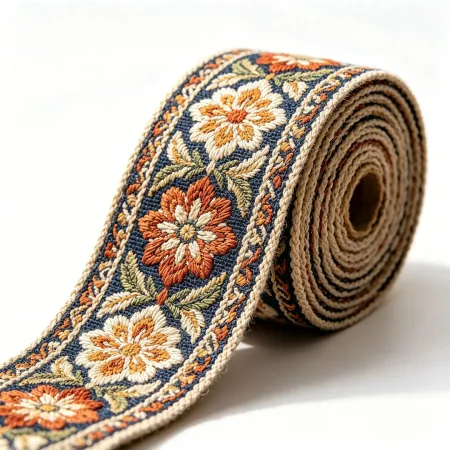
A patterned polyester webbing can get its design from three different places in a mill, and the three are not interchangeable. A pattern can be woven in by lifting selected warp ends, dyed in by printing the yarn before it is woven or by blocking colour onto the cloth, or pressed in by transferring dye into the fibre. Each produces a different look, a different hand and a different life, and each has a minimum quantity below which it stops making sense.
This guide covers the three routes and how to tell them apart, why having all three in one building changes what you can order, six lines a pattern brief should carry, and the two ways a pattern fails that a plain band does not.
Patterned Polyester Webbing: Three Routes to the Same Drawing
The differences below are the ones a buyer notices when the samples arrive, and they are structural rather than cosmetic.
| Route | What it looks like | What it cannot do |
|---|---|---|
| Woven in | A pattern built from the yarn itself, with a slight relief where the floats sit | Fine detail or many colours, since each colour needs its own warp |
| Dyed in | Colour inside the yarn, so the pattern survives abrasion and does not sit on the face | Sharp edges, because dye migrates along the yarn |
| Pressed in | Fine line work and photographic detail, with the hand unchanged | Cover a dark base faithfully, because the ground shows through |
Telling them apart takes a hand and a fingernail. A woven pattern can be felt as a change in thickness across the design; a dyed pattern feels uniform and shows the same colour if the face is abraded; a pressed pattern feels like plain cloth and sits only where the platens reached. A buyer who knows which one is in front of them knows what will happen in a year.
Some briefs are answered by changing the route, not the drawing
A design with six colours and fine lines cannot be woven economically at a narrow width, and a design that must survive heavy abrasion cannot be pressed. When all three routes are available in one plant, the drawing can be adjusted to the route rather than the order being declined, which is usually a better outcome than a compromise nobody chose.
Three Consequences of Keeping All Three Under One Roof
The route can be chosen after the sample
In a mill that only weaves, every pattern is a weaving problem, and a design that should have been pressed is either refused or forced into a construction that suits the machine. When weaving, dyeing and printing sit in the same building, the first sample can be made one way and the production decision taken afterwards, on evidence rather than on capability.
A change of route is a work order
A brand that wants to move a pattern from pressed to woven because the product now rubs against something is asking for a change of process, not a change of supplier. Handled internally that is a note on a production file; split across three companies it is a new development project with new tooling and a new approval cycle.
Colour is settled once, not twice
The most common pattern complaint is a ground shade that does not match the trim it sits beside. When the base is dyed and the pattern is printed under one roof, the base can be matched to the customer's panel before the pattern is applied, and the two decisions are made against each other rather than in sequence.
There is a constraint that belongs to the loom rather than to the process choice. A woven pattern is built from warp ends, and each additional colour needs its own warp beam and its own tension. At a narrow width the number of usable ends is small, so a design that reads as simple on paper can require a harness arrangement that costs more than the order is worth. This is why a pattern brief should state how many colours it really needs, separately from how many it would like.
Six Lines for a Pattern Brief
- The number of colours that are essential — stated separately from the number that are desirable.
- The base shade — because every route multiplies the design by the ground it sits on.
- The repeat and the cut length — a repeat that does not divide the cut leaves a partial motif at every end.
- What the pattern will rub against — the question that decides whether a pressed design is viable.
- Whether the back will be seen — a woven pattern has a reverse, and it is rarely the same design.
- Which edge the pattern must respect — a motif that runs into a curled or tucked edge loses part of itself.
The fifth line is the one that produces the most expensive surprise. A woven pattern is not symmetric: the reverse shows floats where the face shows ground, and a band used on a lanyard or a strap is seen from both sides all day. Deciding whether the back matters, before the harness is built, is the difference between a pattern that works and a pattern that only works one way up.
- Turn the sample over — the face is the half of the story that was designed.
- Rub it with a thumb — a pressed pattern tells you quickly how it will age.
- Measure the repeat twice — once at the start of the roll and once at the end.
- Lay two cuts side by side — the join is where a repeat either works or does not.
Woven, dyed and printed patterns all leave this site, which also runs the polyester webbing base they are built on and the ribbon line where a pattern is often the whole product. The 2000N anchor belongs to the 25 mm plain construction; a pattern is judged on whether it is still legible after the product has been used the way it was meant to be.
A last point on cost of change. Moving a design from one route to another is cheapest at the sample stage, because the artwork can be redrawn for the route rather than the route forced to fit the artwork.
Two Ways a Pattern Fails
It drifts against the edge
A woven pattern is placed relative to the warp, and the warp is placed relative to the selvage. Any wander in the edge therefore moves the pattern with it, and over a long run the motif can end up visibly off centre. On a narrow band there is no room to hide this, and a trimmed edge makes it worse because the reference is cut away.
It disappears where the product bends
A pattern on a band that folds will lose definition along the fold, because the yarns there are held at an angle and the design is compressed. A pressed pattern suffers more than a woven one, since the dye sits in the fibre at the surface and the fold is exactly where the surface is strained. Designing the motif to fall between the folds, rather than across them, is a decision made at the artwork stage and impossible to correct later.
FAQ: Patterned Polyester Webbing
How can I tell a woven pattern from a printed one?
Run a fingernail across it. A woven pattern changes thickness where the floats sit; a printed one is flat, and a pressed one leaves the cloth unchanged.
Which route is most durable?
A woven pattern, because it is the yarn. A dyed pattern follows closely. A pressed pattern sits inside the fibre and is the one that fades first under abrasion.
Can a pattern have many colours?
A woven one is limited by warps, so a few. A printed or pressed one can carry many, at the cost of durability along the edges.
Does the back of the band show the pattern?
On a woven band it usually shows the reverse, which is a different image. On a pressed band the back is plain unless it was pressed as well.
What repeat should I specify?
One that divides the length you cut. Otherwise every piece starts and ends with a partial motif, and that shows at the join.
A patterned polyester webbing is a design decision and a process decision at the same time. Choose the route by what the product will endure, then let the drawing follow, and the pattern will still be legible when the colour has been tested.
Why Xinxiangrui for Patterned Webbing
A pattern can come from three places in a weaving plant, and the choice between them decides how the band looks, how it feels and how long it lasts: a patterned polyester webbing made here can be woven in, dyed in, or pressed on, and all three sit in one 8,000+ m² plant in Dongguan. Share your patterned polyester webbing details with us and we will come back with a matched sample.