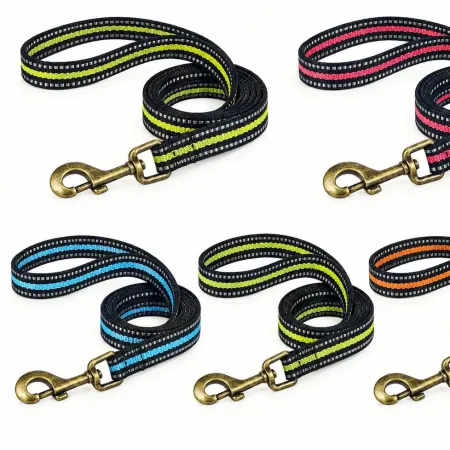
Pet Reflective Webbing for Pet Accessories: Many Lines, One Carton
An accessory order is not one shipment; it is a dozen small ones sharing a container. Pet reflective webbing for pet accessories goes into collars, leads, harnesses, raincoats, backpacks, boot straps and treat pouches, and an order that covers the category arrives as a document with many lines rather than a pallet with one product. The logistics difficulty in this category is not weight or volume in the abstract; it is the number of different things that have to be packed, labelled and declared correctly at the same time.
This guide covers the three kinds of complexity an accessory order carries, why a matched set is one product on a shelf and five in a carton, what a mixed pallet demands of labelling, six lines an accessory brief should carry, and the two things that surface at the packing table rather than at the quotation.
Pet Reflective Webbing for Pet Accessories: Three Kinds of Complexity
A single-product order is one decision repeated. An accessory order is several decisions multiplied, and each multiplication is a place where a small error becomes a large correction.
| Complexity | Where it bites | How to hold it still |
|---|---|---|
| Many product types | The customs file, because each type is its own line | One document written per type, assembled once |
| Many sizes | The packing table, where a size can be swapped in a bag | A size printed on the bag, not only on the card |
| Matched sets | The shelf, because a set short of one piece cannot be sold | Assemble and seal the set at packing |
The third row is the one that decides whether a season is successful. A collar-and-lead set is one barcode and one shelf position, and it is also two products with two sizes and two cut lengths. If the collar is packed and the lead is short, nothing ships, because half a set has no shelf to go on. Assembling the set at the packing table, rather than shipping the components and hoping a warehouse will match them, is the arrangement that keeps the arithmetic honest.
The band is shared; the documents are not
A 25 mm reflective band clearing 2000N may appear in six products in one order, and the customs file still needs six descriptions, because a collar, a lead and a coat are different goods even when they contain the same strip. The material is common; the paperwork is per product, and a file written for the largest line will not cover the rest.
Three Details a Mixed Order Hides
The line that is short
An order of twelve products is finished when the twelfth is packed, and the twelfth is often the smallest item and the one nobody chased. A hold on one line holds the pallet, and the pallet holds the container, which is how a two-day delay on a treat pouch becomes a two-week delay on a season. Asking for a line-by-line readiness report a week before the shipping date is the cheapest protection available, and it only works if the report names each line rather than giving a percentage.
The label in the wrong language
A hang tag carries washing instructions, material content and sometimes a warning, and each of those is language-specific. Where an order ships to two destinations, the tags are not interchangeable even when the products are, and printing one language for a two-language market is the sort of omission that is discovered by a retailer rather than by customs. Sending the label text with the order, in the languages required and marked per destination, is a small file that prevents a large relabel.
The volume of a gift box
Accessories are frequently sold boxed, and a box that presents a collar and a lead nicely is mostly air. Air is charged: a gift box can double the volumetric weight of the goods inside it, and the effect on a full container is not proportional but absolute, since the container fills on volume long before it reaches a weight limit. Choosing a box that fits the product rather than one that frames it is a decision made at the design stage and paid for at every shipment afterwards.
Six Lines for an Accessory Brief
- The full line list — every product named with its quantity, because a total quoted from a summary always hides the smallest line.
- Which items are sets — identified as sets rather than as components, since the shelf treats them as one thing.
- The sizes per item — a matrix rather than an average, because an accessory range is usually weighted towards one or two sizes.
- The labelling per destination — languages, content and warnings, supplied as text rather than described.
- The packing per channel — hook, box or bag, and whether the set is sealed or left loose.
- The readiness date per line — the date each product is packed rather than the date the order is complete.
The sixth line reads like bureaucracy and behaves like insurance. When twelve lines each have a date, the one that is late is visible a week early, and the options at that point are still options: ship partial, substitute a shade, or move the container. When the order has a single completion date, the first signal arrives when the pallet does not, which is late enough that only apologies remain.
- One shade reference for the family — so a set does not arrive as two slightly different silvers.
- One carton mark format — item, size, shade and quantity in the same position on every carton.
- A pack-by-pack weight — so a sealed set can be checked without opening it.
- A sample set kept back — one assembled set from the first carton, retained as the reference for the season.
All of it sits on a single construction. The pet reflective webbing is cut into collars, leads and harness parts on the same site that wove it, the base comes from the polyester webbing line, and the assembled items are described on the pet harness and pet leashes pages along with the packing formats available.
Two Things That Surface at the Packing Table
A set that is not quite a set
Two products from the same construction can still differ in shade if they were coated in different passes, and inside a sealed set that difference is a permanent pairing of two slightly different silvers. Since the set cannot be split on the shelf, the mismatch is what the customer sees. Coating a set from one pass, or at least from adjacent passes, is a scheduling request rather than a technical one, and it has to be made when the order is placed rather than when it is packed.
The card that will not hang
A treat pouch and a folded raincoat are heavier than a collar, and a header card punched for a collar will bend under either. The card, the punch position and the board weight are three decisions that get made once for the range and then applied to products of very different mass. A heavy item needs a stiffer card or a different hanging method, and the difference is invisible until the goods are on a peg in a shop and sagging.
FAQ: Pet Reflective Webbing for Pet Accessories
Can several accessories ship in one container?
Yes, and the constraint is the document rather than the container: each product type needs its own customs description even when they share a material.
Should sets be assembled before shipping?
Usually yes. A set is one product on a shelf, and half a set cannot be sold. Assembling at packing also catches a short component before the container leaves.
Do labels really need to be per destination?
Yes, where a market requires its own language for care or content. One label printed for two destinations is a relabelling job at the other end.
Does gift packaging affect freight?
It can double the volumetric weight of the item inside. A container fills on volume, so a box that frames a product rather than fitting it is paid for on every shipment.
Can a range be added to after the first order?
Yes, on the same construction. A new accessory is a cut list and a packing decision rather than a new development, provided the shade and the substrate stay the same.
Pet reflective webbing for pet accessories is one material behind many lines. List every product, mark the sets, give each line a readiness date, and the container leaves whole rather than waiting on the smallest item.
Why Xinxiangrui for Accessory Webbing
An accessory order with many lines needs one place that can cut, stitch, card and pack all of them, and the pet reflective webbing for pet accessories made here is handled that way inside a single 8,000+ m² plant in Dongguan where the band is woven and coated as well. Sets are assembled and sealed before they are boxed, labels are printed per destination, and the customs file is written per product rather than per material. Share your accessory details with us and we come back with a matched sample and a line-by-line plan.