
Features
Why Choose Xinxiangrui Webbing?
Source Factory
Direct wholesale production from our own plant in Dongguan, not a trading desk. Weaving, dyeing, printing, hardware assembly and packing all run in house, with no middleman margin in the price.
Full Customization
OEM and ODM work starts from your drawing: width, weave, colour, hardware and retail packaging. We match Pantone, send a physical sample before bulk, and keep every change on one work order.
Strict QA & ISO Standards
Every batch is checked for width, thickness, break strength and colour fastness before it ships, and the plant runs to ISO 9001 and ISO 14001. Test reports for your batch travel with the goods.
Proven Track Record
Fifteen years of narrow fabric since 2011, 200+ active partners and shipments to 50+ markets. Long-run programmes are what this factory is built for, which is why most customers reorder.

We Have The Best Solutions for Your Business
Xinxiangrui has made narrow fabric in Dongguan, China since 2011. Our 8,000 m² plant weaves, dyes, prints, cuts and sews under one roof, supplying 200+ active partners in 50+ markets. We produce polyester, nylon, cotton, elastic, reflective and bio-based webbing, ribbon, lanyards, pet leashes, bags and luggage components, from yarn and reflective tape to finished straps and handles.
Because every step stays in one plant, a widening range does not cost tolerance. Our laboratory tests to 2000N+ break strength, 50,000+ Martindale cycles and 1,000+ hours of UV exposure, and every batch carries its own figures rather than a catalogue sample. We work to OEKO-TEX, CPSIA, REACH, RoHS, ISO 9001, ISO 14001 and GRS. Send us your spec sheet and target quantity, and we will recommend the construction that fits.
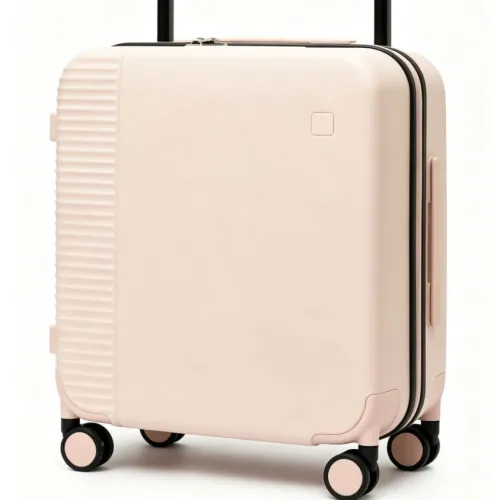
High-End Luggage Case: Three Shell Families
The shell is the part a buyer touches first and the part that most affects how the case ages. The three families below are distinguished by how they fail, which is the question a returns file actually asks.
| Shell | How it behaves under impact | Where it ages | What it suits |
|---|---|---|---|
| Polycarbonate | Flexes and returns; scuffs rather than dents | The corners, and the clear coat over them | Cabin and check-in cases sold on weight |
| Aluminium | Dents and stays dented; absorbs energy by deforming | The frame rivets and the anodised surface | Cases sold on repairability and finish |
| Soft or hybrid | Absorbs impact in the fabric; the frame takes the rest | Abrasion at the base and the zip line | Expandable cases and business travel |
The question that separates the category from a cheap case: can the wheel be replaced without cutting the lining? If the answer is no, the case is disposable no matter what the shell is made of. Ask it before asking about materials, because the answer decides what the product is.
The Frame Carries the Load, Not the Shell
How load travels through a case
When a case is lifted by its handle, the weight of everything inside has to reach that handle. In a well-built case it travels up the frame rails and into a handle mount that spreads the load over an area; in a poor one it travels through the shell itself, which is a thin curved panel with very little tolerance for a point load. That is why two cases of the same weight can behave completely differently after one trip, and why the handle mount is worth more attention than the shell thickness.
Ribs, corners and the shape of resistance
A flat panel resists bending poorly. A rib adds stiffness with almost no weight, which is why every hard case has grooves and why their spacing is not decorative. Corners take the first hit in every baggage system, so they are where material is added or where a separate bumper is bonded on. A bumper that is glued rather than mechanically fixed will lift at the edge after a few flights, and once water gets behind it the corner becomes the first place the shell fails.
The zip or the latch, which is a philosophy
A zip closure lets a case expand and forgive an overpacked bag; a latch or frame closure resists being forced open and keeps water out. A zip is also the part most likely to be damaged by an airport handler's knife, and a frame is the part most likely to be bent by one. Neither is better. What matters is that the choice is made deliberately, because the closure determines the shell geometry and cannot be changed later without a new mould.
Wheels, Handles and the Parts That Wear
A wheel is a bearing, a tyre and an axle housing, and the three fail in that order. A wheel that spins freely on a bench but feels rough under load has a bearing chosen for the wrong load; a wheel that goes flat-spotted has a tyre compound that is too soft for the surface it meets. Spare wheels are the most requested part in any service network, which is why the housing is the one component worth over-engineering.
A telescopic handle is a tube, a lock and a mount. The tube decides stiffness, the lock decides whether the handle rattles, and the mount decides whether the case can be pulled at an angle. A handle tested only at full extension misses the condition that breaks it: half-extended, at an angle, on a kerb. Test it the way a traveller uses it and the specification writes itself.
One more part deserves a line in the brief because it is specified last and noticed first: the feet. A case is designed to stand on four small points, and those points take the whole weight of a packed bag plus whatever is stacked on top of it in a hold. A foot that is riveted through a single layer of shell will pull through within a season, and the case then stands on a corner and wears there. A foot with a backing plate spreads the load across an area, costs almost nothing and is the difference between a case that looks new after two years and one that has been quietly resting on its edge.
Six Lines a Luggage Brief Should Carry
- The shell material and its thickness — named by family and gauge, since two polycarbonate cases at different thicknesses are different products.
- The closure system — zip, latch or frame, with the opening length and, for a zip, the slider type and pull.
- The external dimensions and the internal ones — both, because airline limits are external and packing behaviour is internal.
- The wheel type and its replaceability — including how the housing is fixed, since that decides whether a repair is possible.
- The handle stages and the lock feel — the number of positions, the play allowed at each and the load it carries at half extension.
- The interior specification — lining, dividers, compression straps and whether the lining is removable, which is the difference between a cleanable case and one that smells.
Four Checks Before a Bulk Order
- Drop it loaded, on a corner, twice. The first drop tells you about the shell; the second tells you whether the first one loosened anything inside.
- Stand on it. A case that deflects permanently under a person's weight has a frame that is carrying nothing, and the shell is doing work it was not designed for.
- Pull it half-extended over a kerb. This is the single motion that destroys handles, and it takes ten seconds to reproduce.
- Remove and refit a wheel. Time it. If it takes a technician more than a few minutes, the service model the product is sold on does not exist.
The hard parts of this product come from the same families as the rest of the range: the high-end luggage case line uses compression straps and handles woven as narrow fabric, the interior dividers are sewn by the same team that builds custom spec bags, and the strap that takes the load is often a polyester webbing band. A 25 mm band in that family clears 2000N, which is the reason a compression strap can hold a packed case shut without being the part that fails.
Two Mistakes That Fill a Repair Queue
A shell specified by material name
"Polycarbonate" describes a family, not a thickness, a rib pattern or a corner treatment. Two cases can carry the same material word and differ by a factor in impact performance, because the geometry does most of the work. The specification has to name the gauge and the rib layout, or the sample is being judged on a word.
A lining that cannot be removed
A premium case is expected to be used for years, and over years something spills. A lining sewn shut traps the spill, and the case develops a smell that no amount of wiping reaches. A removable lining, or at least an accessible panel, turns a written-off case into a ten-minute job. It is a construction decision made at the pattern stage and impossible to add later.
A high-end luggage case is defined by what can be repaired, not by what it is made of. Design the load path through the frame, make the wearing parts replaceable, and specify the shell by gauge and geometry rather than by name. Everything else is finish.
Why Xinxiangrui for High-End Luggage Cases
A luggage programme lives or dies on its straps, dividers and handles, and a high-end luggage case built with us is assembled from bands woven in the same Dongguan plant, so the load path is designed beside the fabric rather than after it. Weaving, dyeing, cutting and sewing under one roof means a strap change is a work order, not a shipment. Tell us the load, the closure and the service model you intend to sell, and a matched construction comes back to you.
Featured Products
Collection about Xinxiangrui Webbing

User Reviews
What users say about Xinxiangrui Webbing
Frequently Asked Question
Do you have any question?
Being repairable rather than disposable. A shell that resists a handler, a frame that keeps its shape, wheels and a handle a technician can change, and a lining that survives a wet flight. A cheap case and an expensive one can use the same polycarbonate; what separates them is access to the parts that wear.
Through the frame rails into a handle mount that spreads the load over an area. In a poorly built case the weight travels through the shell instead, which is a thin curved panel with little tolerance for a point load. That is why two cases of the same weight behave completely differently after one trip.
Polycarbonate flexes and returns, aluminium deforms and stays deformed, soft or hybrid absorbs impact in the fabric with a frame taking the rest. The choice is about how the product should fail, not about which material sounds more premium.
Because they take the first impact in every baggage system. Material is added there, or a separate bumper is bonded on. A bumper that is glued rather than mechanically fixed lifts at its edge after a few flights, and once water gets behind it the corner becomes the first place the shell fails.