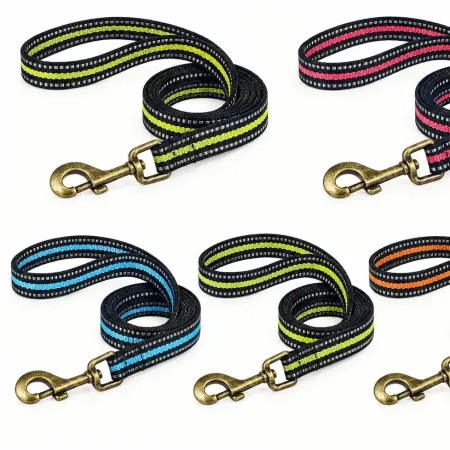
Pet Reflective Webbing for Dog Harnesses: Tested in Place
A harness is the one pet product where the reflective band is judged twice: once flat on a bench, and once with a dog leaning into it. Pet reflective webbing for dog harnesses is specified with figures taken from the roll, and the figures are correct and incomplete, because a harness under load changes shape. The chest strap runs at an angle, the pull moves it, and the reflective face that looked evenly lit in a sample tilts away from the beam exactly when the dog is pulling towards something.
This guide covers the three states a harness has to be measured in, why the chest position is optically better than a collar and structurally harder, what a load does to the angle of a reflective face, six lines a harness brief should carry, and the two things a bench sample cannot report.
Pet Reflective Webbing for Dog Harnesses: Three States
The same band gives three different answers depending on how it is held, and only one of the three describes the product a customer uses.
| State | What it measures | What it leaves out |
|---|---|---|
| Flat on a bench | The coefficient of the material, at its best angle | Every seam, every fitting and every curve |
| Assembled, unloaded | How much reflective area survives the stitching and the hardware | What happens when the straps are under tension |
| Assembled, loaded | The shape the product holds while a dog pulls | Nothing that matters, if the load is applied in the right direction |
The third state is the one to insist on for a harness and the one rarely described in a report. It is also cheap to produce: a harness on a form, a strap under a known tension and a torch at the height of a headlight will show whether the chest panel turns away or stays presented. The result is not a standard figure, and it is the figure that answers the customer's question.
The chest is the best position and the hardest joint
A chest strap sits higher than a collar and closer to the height of a headlight, which is optically the best place on a dog. It is also where the webbing is joined to the girth strap at an angle, and that junction takes the pull. A 25 mm chest band clears 2000N, and the joint rather than the band is what a load test is really examining.
Three Things a Load Changes
The angle of the face
A retroreflector is efficient within a range of angles and falls away outside it. When a dog pulls, the chest strap tightens and rotates slightly around the body, and the reflective face tilts a few degrees in one direction or the other. A few degrees is not dramatic, and it is enough to matter at the edge of the range, which is where a driver at distance sees the product. A harness fitted loosely tilts more than one fitted correctly, which is a fitting instruction rather than a material one.
The area that stays flat
Under tension a strap becomes a flat plane between two anchor points, and the reflective area that was spread across a curve concentrates into that plane. That is helpful when the plane faces the light and unhelpful when it does not, which is why the position of the anchor points decides how much of the band is usefully presented. Moving a D-ring ten millimetres can change whether the chest panel faces forward or twists inward.
The stitching that carries it
A harness is a set of joints, and every joint is a dense block of stitches through coated fabric. Two things happen at once: the coating is perforated, and the load concentrates on a few centimetres of band. Both are acceptable in a well-designed joint and both are invisible in a flat sample. A pull test on the assembled piece, rather than on the band, is what confirms that the joint and the coating survive together.
What a Harness Report Should Contain
- A band figure — the coefficient of the base band with its geometry, which describes the material rather than the product.
- A joint figure — the load at which the chest-to-girth junction holds, which is the weakest point and the one that fails first.
- An assembly observation — the reflective area visible after stitching and hardware, expressed as a share of the original face.
- A loaded photograph — the harness on a form under tension, lit from the height of a headlight, at a stated distance.
The third item is where most reports are thin. A harness can lose a fifth of its reflective face to seams, hardware and the fold where straps overlap, and the loss is invisible in a figure taken from the band. Expressing it as a share turns a vague impression into something a buyer can compare between two suppliers, and it makes the pattern designer aware of a number that the drawing controls.
Six Lines for a Harness Brief
- The style — step-in, over-the-head or a strap harness, because each loads the chest band differently.
- The chest band width — often 25 mm and sometimes 38 mm, with the girth band usually one step wider than the chest.
- The joint detail — how the chest meets the girth, with the stitch pattern and the bartack positions specified rather than left to the bench.
- The reflective layout — front panel, side panels or a continuous band, and whether the pattern runs across a seam.
- The load figure and where it applies — the value for the band and the value for the joint, stated separately.
- The sizing and the fit range — because a loose harness tilts, and tilt is an optical problem before it is a comfort one.
The fifth line is where a harness quotation usually goes quiet. A band figure is easy to give and a joint figure requires a test on an assembled piece, which is a different job and a different machine. Asking for both, and asking which one the supplier means when a single number is quoted, is the difference between a specification and a slogan.
The band itself is the same pet reflective webbing used on collars and leads, cut and joined differently, on a base from the polyester webbing line. The assembled product is described on the pet harness page, and the laboratory record for a harness lot names the joint as well as the band.
Two Things a Bench Sample Cannot Report
How the product moves
A dog walks, trots and stops, and the harness shifts through all three. A reflective panel that is perfectly presented at rest can swing against the shoulder on a trot and spend half the stride at an angle. That movement cannot be measured on a bench and it can be observed in ten metres of walking with a torch and a camera. Recording it once, at the development stage, produces a note that a customer complaint can be answered from years later.
What the seam does after a season
The coating at a seam is perforated by the needle, and that line of holes is where water enters, where dirt accumulates and where the film eventually lifts. In a new harness the seam is invisible under the reflective face; after a winter of wet walks it is a pale dotted line. Retaining a worn sample beside an unused one is the only way to know how quickly that happens for a given coating and stitch density, and it is the sort of evidence that turns a design change into a decision rather than a guess.
FAQ: Pet Reflective Webbing for Dog Harnesses
Is a harness more visible than a collar?
Usually yes, because the chest strap sits higher and is closer to the height of a headlight. The gain comes from geometry rather than from a better material.
Where does a harness fail first?
At the chest-to-girth joint, not in the band. The band clears 2000N at 25 mm; the joint is a block of stitches through coated fabric and it decides the real limit.
Should the reflective panel be on the front?
The front is seen by traffic ahead and the sides by traffic at a kerb. Both matter, and a pattern that wraps from the front onto the sides covers the two directions that count.
Does a looser fit affect visibility?
It does. A loose harness rotates more, and a rotating panel spends part of each stride at an angle to the light. Fitting instructions are a visibility measure as well as a comfort one.
Can the same band be used on a lead?
Yes, and it usually is, which keeps a range consistent. The width may differ by one step and the pattern repeat will, because a lead is longer.
Pet reflective webbing for dog harnesses has to be measured on the assembled piece and again under load, because the joint and the tilt are what change. Ask for a band figure, a joint figure and a photograph of the product being pulled.
Why Xinxiangrui for Harness Webbing
A harness is decided at the joint, and a joint is decided by the people who stitch it and the people who test it sitting close enough to argue. The pet reflective webbing for dog harnesses made here runs on the same base as a collar band, and the chest-to-girth bartack is pulled in the laboratory on the same site. Weaving, coating, stitching and testing share one 8,000+ m² plant in Dongguan, so a failed joint can be re-stitched and re-tested within a week rather than within a quarter. Give us the application and the load it must carry, and the construction follows.