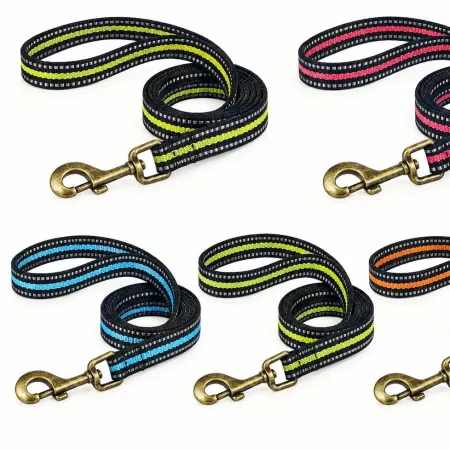
Pet Reflective Webbing for Dog Leashes: Length and Volume
A lead is sold by length and shipped by volume, and those two facts set the arithmetic of everything else. Pet reflective webbing for dog leashes arrives as a roll and leaves as a finished piece between one and five metres long, so the questions that decide a delivery are how the roll is cut, how much is lost at each end and how the finished pieces are packed for a container that charges by space rather than by weight. None of those is a question about reflection, and all of them decide whether the reflective product arrives on time.
This guide covers how a length becomes a cut plan, why a coiled lead costs more to ship than a flat one, what the two ends of a lead demand, six lines a lead brief should carry, and the two things that show up when the carton is opened rather than when the sample is approved.
Pet Reflective Webbing for Dog Leashes: From Roll to Cut Plan
A cut plan is the quiet document that decides how much of a roll becomes product. It starts from the finished length, adds what the ends consume, and works back to how many pieces a roll will yield. The yield figure is what a buyer should be quoted, because it is the number that turns a length of band into a quantity of leads.
| Finished length | Where it is sold | What it does to the cut plan |
|---|---|---|
| 1 m to 1.2 m | Small breeds and urban walking | The offcut at the end of a roll is a large share of the total |
| 1.5 m to 1.8 m | The general-purpose length in most markets | Divides into most roll lengths with little waste |
| 2 m to 3 m | Training and countryside use | Fewer pieces per roll, and a heavier finished carton |
| 5 m and above | Long-line training | The cut is driven by the roll, and long lengths dictate the roll order |
The first row is where a range quietly loses money. A 1 m lead cut from a 100 m roll leaves a tail that is too short for another lead and too long to discard without notice, and the loss is larger as a share of the piece than it is for a 2 m lead. A cut plan that mixes lengths so the tail becomes a short lead is what a factory does when it is asked, and what it does not do when the order simply says a total length.
Volume, not weight, pays the freight
A lead is light and bulky. Coiled and bagged, two hundred leads fill a carton that weighs very little and measures a great deal, and a carrier charging on volumetric weight bills for the space rather than the mass. Hanging the leads flat in a shallow carton, or coiling them tighter around a smaller former, changes the freight on the same goods. It is a packing decision that belongs in the order, because a change of method after the goods are bagged is a repack.
Three Things the Cut Decides
Where the pattern lands
A repeating motif on a continuous roll does not divide evenly by every finished length. If the repeat is 120 mm and the lead is 1.5 m, the cut lands at a different point in the pattern each time, and the join at the handle falls on a stripe in some pieces and between stripes in others. A repeat chosen to divide into the finished length gives a consistent look, and the arithmetic takes a minute at the drawing stage rather than a sorting exercise at packing.
What the ends consume
Each end of a lead absorbs band: a handle loop folded back and stitched, a trigger clip sewn into a turn, a keeper bar tacked over both. On a 1 m lead those ends can account for a tenth of the band consumed, and on a 5 m lead for a fraction of that. Quoting a lead by finished length without accounting for the ends is how a roll ordered to the metre comes up short, which is a small error that arrives as a short delivery rather than as a conversation.
How it coils
A coated band coiled tightly for packing takes a set, and a lead that arrives with a memory of the coil hangs with a spiral for its first week of use. The spiral is harmless and it looks like a defect, which makes it a customer-service problem. Coiling around a larger former, or coiling loose and securing with a paper band rather than an elastic, costs a little space and removes the complaint.
Six Lines for a Lead Brief
- The finished length and its tolerance — measured from the handle to the clip, with a stated allowance either way.
- The mix of lengths — because a range of three lengths cut from one roll yields better than three separate orders.
- The repeat and its division — the pattern pitch, and whether it divides into the finished length evenly.
- Both ends — the handle type and the clip, since each consumes band and each has its own stitching pattern.
- The packing geometry — coiled or flat, former size, and whether a header card is punched through the handle.
- The delivery date at destination — and the mode, because a lead is a volumetric product and the difference between air and sea is measured in cubic metres.
The fifth line connects the factory to the freight bill. A lead packed flat in a shallow carton can carry a header card that would crease in a coil, and a lead packed in a coil fits a shelf hook that a flat pack does not. Those are retail decisions with logistics consequences, and the moment to make them is before the cartons are specified rather than after the first invoice from a carrier.
- One length, one carton count — so a mixed pallet can be built without recounting at the dock.
- A stated former size — a coil wound around a 60 mm former hangs straighter than one wound around a hand.
- A marked cut point — joins in the roll flagged, so a cut plan can avoid them rather than cut through one.
- The volumetric figure — carton dimensions rather than weight, since that is what the carrier will bill on.
Under all of this the band is a settled component: 25 mm of pet reflective webbing clears 2000N, and a lead rarely approaches that figure except in a panic, when a dog lunges and the whole load arrives at once. The base comes from the polyester webbing line, the assembled product is on the pet leashes page, and the packing formats list what can leave the plant ready for a shelf.
Two Things That Appear at the Carton
The last twenty centimetres of a roll
The tail of a roll is where the loom's tension wandered and where the coating run was ending, and the difference is small enough to pass a casual look and large enough to notice when a lead made from it hangs beside one made from the head. A cut plan that starts each roll from the head and leaves the tail for the last pieces concentrates the risk in a few items, which is better than spreading it and worse than flagging it. Receiving checks on leads should include the last piece cut from each roll, not a random one from the middle of the carton.
A length that measures short
Finished length is measured between two points nobody agrees on: the inside of the handle loop, the outside of it, the tip of the clip or its swivel. Two centimetres of disagreement is one per cent of a two-metre lead and a visible difference to a customer who compares it with the description. Writing the measurement points into the brief, and into the listing, prevents a complaint that is about vocabulary rather than about goods.
FAQ: Pet Reflective Webbing for Dog Leashes
How many leads come from one roll?
It depends on the finished length, the ends and the waste at the tail. Ask for a yield figure rather than a total length, and the difference becomes visible before the order.
Why is a coiled lead expensive to ship?
Because carriers bill on volumetric weight, and a coil traps air. Packing flat or winding around a smaller former reduces the space on the same goods.
Should the pattern repeat divide the length?
Ideally yes. If it does not, the look at the handle varies from piece to piece, and that inconsistency is noticed at retail rather than on the line.
Can a lead be cut to a custom length?
Yes, within the roll, and unusual lengths cost more in waste than in material. Where a range has three lengths, cutting them from one roll is the efficient arrangement.
How is length measured?
It has to be stated: handle inside or outside, clip tip or swivel. Two centimetres of disagreement is enough to make a correct delivery look short.
Pet reflective webbing for dog leashes is a length product with a volume problem. Ask for a cut plan and a yield, fix the repeat to divide the length, and choose a packing geometry before the carton is specified.
Why Xinxiangrui for Lead Webbing
A lead is a cut plan with two ends on it. The pet reflective webbing for dog leashes made here is cut, stitched, carded and packed on the same 8,000+ m² site in Dongguan that wove and coated the band, so a change of finished length is a new cut plan rather than a new supplier conversation. Carton dimensions are chosen around the carrier's volumetric figure rather than the shelf, and air, sea and express are quoted against that figure, so the number a buyer sees is the number that gets billed. Tell us your lead spec and a matched construction comes back to you.