ODM Pet Leashes: The Decisions That Are Already Made
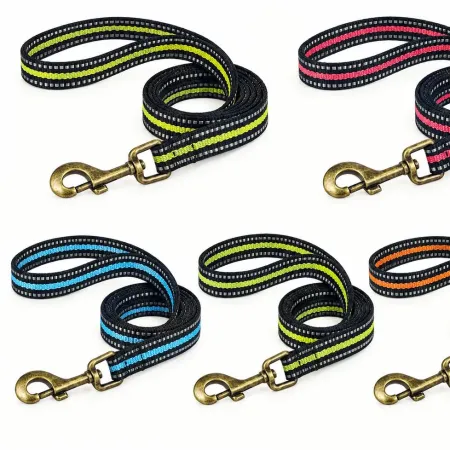
ODM pet leashes begin from the opposite end to a development project. The structure, the width, the fitting, the stitching pattern and the packing have been settled by the time a buyer sees the product, and what changes is the layer on top: the brand, the colour, the label and the carton. That is not a lesser service; it is a different trade, and understanding which decisions are already closed is what makes it fast.
This guide covers the four layers that are already decided in an ODM lead, why the second market costs almost nothing and the fifth does not, why a ready structure constrains colour more than shape, six lines an ODM brief should carry, and the two things a buyer should still test even when nothing needs designing.
ODM Pet Leashes: Four Layers Already Settled
An ODM lead is a product that exists, and the existing product carries four decisions that a buyer inherits rather than makes.
- The structure — band, width, stitch layout and handle build, which are the same for every customer ordering that model.
- The fitting — the hook, ring and swivel already chosen and load-checked, which is the part a buyer most often wants to change and least often needs to.
- The packing — header card, bag or box, already tooled and already priced into the model.
- The document set — the material declarations and test records that already exist for that construction and can be reused.
| Layer | In ODM | Still open to a buyer |
|---|---|---|
| Structure | Fixed, and proven in production | Length, and the colour of the band |
| Fitting | Chosen and load-checked | Finish, and size within the same family |
| Packing | Tooled and costed | The print on the card, and the language |
| Documents | Already held for the construction | The buyer's name on the transaction record |
The structure arrives with its numbers
An ODM model built on a 25 mm band comes with a base that clears 2000N already established, so a buyer inherits a proven load path rather than a promise. That is the practical advantage of ordering an existing model: the engineering question was answered before the brand question was asked.
Three Things That Decide an ODM Order
The second market is cheap, the fifth is not
The first ODM order carries the cost of a colour, a label and a carton print. The second market that uses the same model adds a language on the card and a second carton, and almost nothing else. By the fifth market the buyer is usually maintaining five card variants, four languages, three carton sizes and a shade for each, and the admin has become the expensive part. Consolidating languages and carton sizes early is dull work that keeps an ODM range profitable as it widens.
Structure constrains colour more than shape
A ready model can be recoloured freely, because colour is a dye decision. Shape is different: changing the handle build or the stitch layout changes the model rather than the colourway, and that pushes the order into development. This is the reverse of what buyers expect, who often assume the look is fixed and the colour is the flexible part. In ODM the colour is the variable and the geometry is the constant.
Fifteen years is a library, not a claim
The useful thing about a long record in narrow fabric is not the number of years but what has accumulated: which stitch density holds on a 20 mm band, which hook suits a handle loop, which packing survives a courier. A factory that has run the same product family since 2011 has answers to those questions stored as standard models rather than as opinions, and an ODM buyer is effectively ordering from that library.
There is one more economy in ODM that buyers rarely ask about, and it is the test records. A model already in production has abrasion, colour fastness and tensile results on file for its construction, so a new colourway inherits a documented history instead of starting one. That is why an established model can be quoted and shipped sooner than a new design, and why the current production list matters more than the illustrated catalogue.
An ODM model is worth asking for as a document rather than a photograph. A useful one lists the width, the thickness, the stitch density, the fitting reference, the length options, the packing unit and the colours currently running, and it fits on a single page. Two models compared on that page can be chosen in an afternoon, while two compared on photographs need samples of both, which costs a week and a courier.
Six Lines for an ODM Brief
- The model reference — named precisely, because two models that look alike can differ in width and stitch and cannot be mixed in one order.
- The colourway — the one thing genuinely open, with a reference and the light it will be judged under.
- The length — because a model is usually offered in one or two lengths and a third is a change rather than an option.
- The brand layer — label, print or tag, and the position on the band, which is the only place a brand appears.
- The card and the language — how many markets are planned and whether they share a card, decided before the print rather than after.
- The supporting pieces — collar, harness or waste-bag pouch from the same family, since an ODM range is usually sold as a set.
The sixth line is where an ODM order becomes a range. A single model in three colours is a listing; the same model with its matching collar and harness is a fixture in a shop, and because the pieces come from one family the colour matches without a separate approval. Buyers who plan the set at the first order avoid the situation where the lead arrives in six shades and the collar in four.
The models are built on a nylon webbing base in the common widths, with a polyester webbing option where sun resistance is the priority, and the same constructions serve collars, harnesses and bag straps. Because weaving, dyeing, printing and hardware assembly run on one site, a colourway change is scheduled against the existing model rather than re-engineered. The OEM and ODM routes are described side by side, and the test records for a model can be reused for a new colourway.
Two Things to Test Anyway
The colourway in the model's own hand
A colour approved on a flat swatch behaves differently on a finished lead, because the band is doubled at the handle and folded at the hook, and a shade that reads well flat can look dull where the weave compresses. Since the structure is fixed in ODM, the only variable is the colour, and it deserves to be judged on the actual model rather than on a card. One stitched piece in the intended shade is enough.
What "available in our range" hides
A range list is not a stock list. Some models are run regularly and some are run on request, and the difference shows up in how fast a colourway can be scheduled. Asking which models are in current production, rather than which are illustrated, is the question that turns an ODM order from a two-month project into a short one, and it costs a single email to answer.
FAQ: ODM Pet Leashes
What is the difference from OEM?
In ODM the design already exists and the buyer brands it. In OEM the buyer brings the design and the factory makes it. ODM is faster; OEM is more specific.
Can the fitting be changed on an ODM lead?
A finish or a size within the same family, usually yes. A different fitting body turns the order into a development and should be scoped as one.
How many colours can one model take?
As many as the order can carry in dye lots. Three or four that work as a group sell better than twelve that each stand alone.
Do the documents come with the model?
The material declarations and test records exist for the construction. What is added for a buyer is the transaction record carrying their name.
Is ODM suitable for a first order?
It is the usual route for one. An existing model removes the engineering risk, and the brand layer is enough to make the product distinct.
ODM pet leashes are a library of settled decisions with one open variable. Choose the model, choose the colour, decide how many markets the card must serve, and add the matching pieces while the family is open.
Why Xinxiangrui for ODM Pet Leashes
Established in 2011 in Dongguan, this factory has spent fifteen years on narrow woven fabric, and the useful result is a set of models that have already survived production. Those models carry their stitching, their fittings and their packing with them, so an ODM order starts from something proven rather than from a drawing. Share your lead details with us and we will come back with a matched sample.