Custom Woven Lanyard: What the Loom Decides Before Print
A custom woven lanyard is settled at the loom, long before anybody approves a logo. The sett, the pick density and the yarn count decide how the surface behaves: whether a fine line reads as a line or dissolves into a blur, whether a shade sits inside the cloth or floats on top of it, and how the strap looks after a year of being dragged across a collar. Printing can be arranged later. Weaving cannot be arranged differently later, which is why the loom decision belongs at the front of the brief rather than at the end of it.
This guide covers the two looms that produce lanyard cloth and what each one can and cannot do, where a woven surface beats a printed one and where the printing wins, what sett and width do to the finished strap, and the six lines that make a woven specification reproducible from one order to the next.
Custom Woven Lanyard: Two Looms, Two Products
The word woven covers two quite different products, and a buyer who treats them as one ends up comparing samples that were never equivalent. Both are cloth. They are not the same cloth, and they are not specified the same way.
Jacquard: the pattern is the cloth
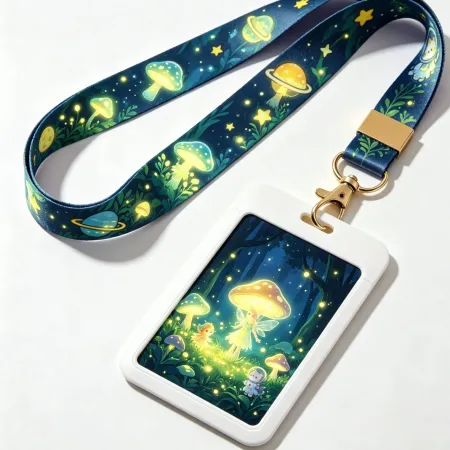
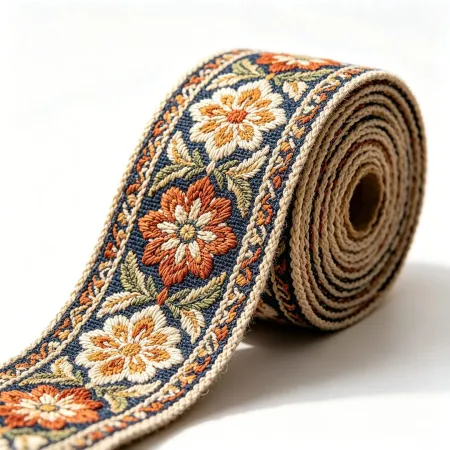
On a jacquard loom each warp end can be lifted independently, so a pattern is built by interlacing coloured yarns rather than by applying anything to the surface. The logo is not on the strap. It is a region of the strap. There is no film to lift, no ink to crack across a fold, and no edge where a print stops. That advantage is paid for in resolution: detail is limited by how many weft picks fit into a centimetre, so a strapline set at 3 mm will read as a grey smear however good the artwork is.
Needle loom: the cloth is the ground
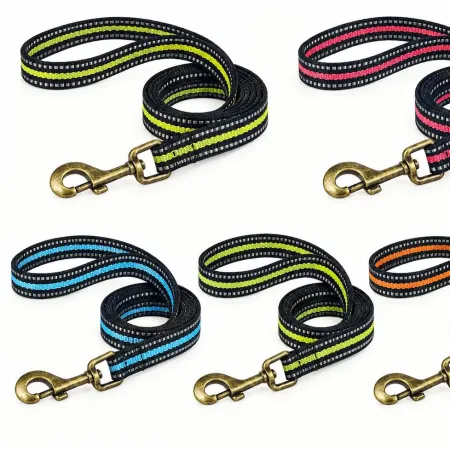
A needle loom weaves a flat narrow tape and does it quickly. Solid shades, simple longitudinal stripes, a contrast edge — that is the natural range. The tape is then a substrate: it can be printed, it can be dyed, it can carry a heat transfer. Where a programme needs a wide colour range, photographic detail or a short run, this is the sensible route, and calling it a woven lanyard is still accurate because the base really is woven.
- Choose jacquard — when the mark must survive folding, washing and years of abrasion without a visible edge.
- Choose needle loom — when the artwork needs gradients, small type or a colour count that would need too many yarns.
- Choose a combination — a woven ground with a printed name or a variable element, which keeps the durable part durable.
- Avoid mixing unthinkingly — a jacquard band printed on top is paying twice for the same surface and usually looks it.
Woven Against Printed: Where the Difference Shows
The comparison only becomes useful when it is made property by property, because the two surfaces fail in different places and at different times.
| Property | Woven jacquard | Printed tape |
|---|---|---|
| Logo durability | Part of the structure; nothing to delaminate | Ink or film on the surface; wears from the high points |
| Fine detail | Limited by picks per centimetre | Small type and gradients both possible |
| Colour range | One yarn per colour; four to six is a practical band | Wide, with photographic reproduction |
| Where it fails | Floats snag; a loose sett shows it first | Edge wear at the fold and at the cut |
| Changing the mark | New harness set-up; the same warp can often stay | New artwork file only |
Read down the last row and the practical consequence appears: a woven programme is cheap to repeat and dear to change, while a printed one is the reverse. That single difference decides which route suits a brand with a fixed identity and which suits one that reprints every quarter.
Judge a woven proof at the width it will be worn
A jacquard artwork viewed on a monitor at 800 pixels wide flatters itself. A 20 mm strap at a realistic pick density gives roughly forty usable horizontal units across the band, and that is the whole canvas. Ask for the strike-off at production width, laid on a desk, viewed from a metre away — the distance at which a wearer's colleague will actually read it. Artwork that survives that test is artwork that will survive the programme.
Sett, Width and the Shrink Allowance
Three numbers travel from the loom to the invoice, and a specification that omits any of them will be renegotiated at the sample stage.
- Sett — the number of warp ends across the width, which sets the hand of the cloth and the finest line the jacquard can hold.
- Greige width — the width off the loom, before dyeing and finishing pull it in. A woven band loses several per cent in the warp and a little in the weft.
- Finished width — what the buyer measures. Quoting greige as finished is the most common cause of a strap that arrives a millimetre narrow.
- Cut length — the flat piece before folding, not the finished circumference. The difference is the fold allowance at each end.
- Fold allowance — typically 8 to 10 mm per fold, and it grows with the thickness of the cloth and the size of the hardware.
- Edge treatment — hot cut, ultrasonic or folded and stitched, each of which changes the usable width and the feel against skin.
A woven strap is also strong enough that strength stops being the constraint. A 20 mm band at a normal sett clears 2000N without special yarn, so the conversation moves to behaviour: how the edge sits, how the cloth drapes, whether the fold stays flat after a hundred openings. Those are loom and finish questions, and they are answered by a sample rather than by a data sheet.
Care, Abrasion and the Life of a Woven Surface
What snags first
A jacquard pattern is built from floats — stretches where a yarn passes over two or more ends without interlacing. Those floats are what make a shape readable, and they are also the weakest point of the surface, because a hook, a zip or a badge holder clip can catch one and pull it. Tightening the sett reduces the float length and the problem with it, at the cost of a stiffer cloth. Where a strap will live against a tool harness, a tighter sett is worth more than a softer hand.
What the wash does
Yarn-dyed cloth holds its shade through repeated washing better than a surface print, because the colour is inside the fibre rather than sitting on it. What changes instead is the geometry: a woven band can relax and lengthen slightly in the first few washes as internal tension releases, which a wearer notices as a lanyard that suddenly hangs lower. Washing a sample three times before measuring is a cheap way to find out how much, and it is the figure worth writing into the specification.
What the cut edge does
A hot-cut edge seals the yarns and stops a woven band fraying, and it does so with a slightly hardened bead along the edge. On a strap that is folded and stitched, that bead sits inside the fold and never touches anything. On a strap left flat, it is the part that rubs. The choice is decided by the construction, not by the cloth, which is why the two should be specified in the same conversation.
Woven formats and the widths they are normally run at sit in the custom lanyard range, the base cloth is drawn from the polyester webbing and nylon webbing lines, and strength figures come from the in-house laboratory with the OEM and ODM development route covering new harness work.
FAQ: Custom Woven Lanyard
Is a woven lanyard stronger than a printed one?
The strap strength is similar, because both start from a woven tape. What differs is the logo: a woven mark cannot peel, crack or wear off, while a print eventually shows the cloth underneath at the fold. If the question is about the mark rather than the strap, woven wins on anything worn daily.
How many colours can a woven logo have?
Four to six is the comfortable band on a 20 mm band, because every colour is a yarn that has to be carried and interlaced. Beyond that the cloth stiffens and the design has to be simplified anyway. Gradients are not available; a woven shade is a yarn, not a value on a scale.
Can a woven lanyard carry small text?
Only to a point. Detail is limited by picks per centimetre, so lettering below about 5 mm cap height tends to close up on a 20 mm band. A website address set in small type is the classic casualty. Either enlarge it, shorten it, or move it to a printed element.
Does a woven strap fray at the cut?
Not if the edge is sealed, which a hot cut or an ultrasonic cut does as it separates the cloth. A cold cut leaves loose yarns and will fray from the first day. If the strap is folded and stitched, the raw edge is hidden inside the fold and the question does not arise.
Can woven and printed elements share one strap?
Yes, and it is often the right answer: a woven ground carries the permanent identity, and a printed panel carries the variable part such as a name, a year or a venue. Keep the two zones apart in the artwork so the print does not land on the woven mark, and specify which one is allowed to change between runs.
A custom woven lanyard is a cloth decision with a print decision attached, not the other way round. Fix the sett and the finished width, accept the colour count the loom can carry, judge the artwork at the width it will be worn, and the strap will still look like itself after two years of daily use. Everything after that is a reprint of a decision already made well.
Why Xinxiangrui for Custom Woven Lanyard
A woven programme usually runs across borders, because the same jacquard band is ordered for several markets from one artwork file. Products from this site reach 50+ markets and 200+ active partners, so a custom woven lanyard is quoted with the destination's document set named at the start rather than discovered at the port, and one woven lot can be split into several shipments without restarting the warp. Give us the application and the load it must carry, and the construction follows.