Custom Dye-Sublimation Lanyard: Why the Fibre Decides Everything
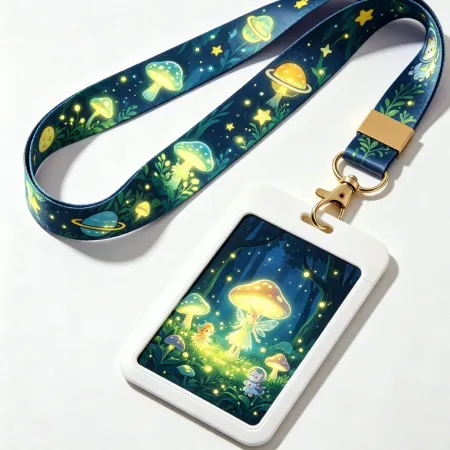
A custom dye-sublimation lanyard can carry a photograph, a gradient or a six-colour pattern with no plate and no ink build-up, which is why event teams ask for it by name. It also only works on one fibre. Order the same artwork on cotton and the ink has nothing to bond to; the print sits on the surface, rubs off on a collar and looks tired after a week. The process is not a printing upgrade that can be applied to any strap — it is a chemistry that requires a specific substrate.
This guide explains what the ink actually does, why polyester is the only practical base, how colour depth and registration are controlled on a narrow woven band, and which fastness figures are worth asking for before a large run.
What the Process Actually Does to the Strap
Sublimation ink is printed onto paper, then pressed against the fabric at around 200 degrees Celsius. At that temperature the solid dye turns to gas and migrates into the polymer, where it cools and stays. There is no film on the surface, no thickness to crack and no hand change — which is exactly why the same process fails on a fibre that will not accept the gas. Nothing about it weakens the strap either: a 20 mm polyester band clears 2000N before it is printed, and the dye adds no layer that could become a failure point.
- Polyester is the substrate — the polymer chains open enough at press temperature to take the dye. A 100 per cent polyester strap prints deep and stays deep.
- Cotton cannot take it — cellulosic fibre has no affinity for disperse dye, so the image sits on top and crocks. A cotton strap needs screen print, transfer or a woven logo instead.
- Nylon is partial — some nylon prints acceptably and some do not, and the difference is not visible until after washing. A nylon strap should be proved on a strike-off rather than assumed.
- White is the paper, not the ink — the process adds colour and never removes it, so white areas must be white fibre. Printing onto a coloured strap shifts every tone in the file.
The table compares sublimation with the two other ways a logo or pattern reaches a lanyard, because most enquiries are really a choice between them.
| Method | Best at | Limits | Hand feel |
|---|---|---|---|
| Dye sublimation | Full colour, gradients, photographic detail, short runs without plates | Polyester only; no white ink; pale shades on a dark base are impossible | Unchanged — the dye is inside the fibre |
| Screen print | Opaque spot colour on any fibre, including cotton and nylon | One screen per colour; fine detail fills in on a coarse weave | Slightly stiffer where the ink sits |
| Woven logo | Durability and a premium look; no ink to wear at all | Jacquard programme and a minimum quantity; detail limited by pick count | Softer and thicker at the logo |
Custom Dye-Sublimation Lanyard: Where the Colour Goes Wrong
Four variables control how a file turns into cloth, and only one of them is the file itself.
- Press temperature and dwell — too cool and the dye stays shallow, too hot and it migrates past the surface and dulls. A four-degree window is normal on a calendar press.
- Pressure and paper contact — a woven surface is not flat. Where the paper lifts off the crowns of the weave, the colour goes light, which is why a coarse sett looks mottled at full colour.
- Weave density — a tight plain weave gives a cleaner edge than an open one, and a twill shows a faint diagonal through large flat areas.
- Registration across the width — the print has to centre on a 20 mm band to within a fraction of a millimetre, or the artwork creeps toward one edge and the border looks broken.
One site keeps the shade and the print honest
When the strap is woven, dyed and printed under one roof, the base shade can be adjusted for the artwork rather than the artwork being adjusted for whatever base arrived. A pale grey requested as "light" comes off the dye line at a measured figure, the print is set against that figure, and the result is checked on the same bench. Split those steps across three suppliers and the third one inherits a base colour nobody chose.
Fastness Figures Worth Asking For
A sublimation print either survives a wash or it does not, and the difference shows up fast on a lanyard that is worn against a collared shirt every day.
Rubbing, wet and dry
Crocking is the first thing to check on a dark print, because a lanyard rubs against a shirt collar, a jacket and a bag strap all day. A deep black or navy that transfers is a complaint, and the test is quick: a white cloth, a stated load, a stated number of rubs, wet and dry.
Washing and light
A colour change figure after a domestic wash at 40 degrees and a light fastness figure after a stated exposure tell you what a year of use will look like. Sublimation on polyester is generally strong on both, but the figures should come from the roll that ships rather than from a mill's general claim, and they should name the shade — a pale yellow and a deep red do not behave alike.
Migration into plastic
Disperse dye can move from the strap into a plastic clip or a PVC badge holder held against it in warm storage. The symptom is a coloured ghost on the clip after a summer in a warehouse. Where the lanyard ships with a holder, ask for a stacked storage check rather than discovering the problem in a customer's hands.
Six Lines for a Sublimation Enquiry
A brief that carries these six items can be quoted and sampled without a single clarifying email.
- Base fibre and shade — polyester, white or a named pale colour, with the shade reference stated rather than described.
- Width and finished length — the print area is the width, so 15 mm and 25 mm are entirely different design problems.
- Artwork with a repeat length — vector where possible, and a stated repeat so the pattern lands cleanly at the neck.
- Which side prints — one side, both sides, or a plain reverse for a strap that turns over in wear.
- Closure and clip — a breakaway, a metal lobster clasp or a plain loop, each with its own fold allowance.
- Fastness targets — the crocking and wash figures the end customer will care about, written down before the strike-off.
The base cloth is ordinary narrow fabric; the print is what makes it interesting. A plain polyester webbing base takes the ink cleanly, the custom lanyard range covers the widths most programmes use, and the fastness numbers come from the testing laboratory rather than from a data sheet. Development work starts through OEM and ODM development.
FAQ: Custom Dye-Sublimation Lanyard
Why can't a cotton lanyard be sublimated?
Because the dye needs a polymer to bond into. Cotton is cellulose, so the ink stays on the surface and rubs away. If the strap has to be cotton for hand feel or sustainability reasons, the logo has to be screen printed, transferred or woven instead.
Can I print white on a black strap?
No. Sublimation cannot deposit white, so white areas of the file become the strap colour. On a black base the design has to be built from the colours that will show, or the base has to be white or a pale tint and the dark areas printed.
How fine can the detail be?
Fine in one direction and coarse in the other. Across the strap, the weave limits resolution — a 1 mm gap between lines may close up on a coarse sett. Along the strap the print is continuous, so small text runs cleanly if it is set at a readable height.
Does the print change the feel of the strap?
Almost not at all, which is the main reason to choose it. The dye is inside the fibre, so there is no layer to stiffen the band or to crack at a fold. A strap printed this way still folds flat at the closure and still feels like webbing rather than like a printed ribbon.
What is a strike-off and do I need one?
A strike-off is a short printed length made on the production base with the production settings. It is the only reliable way to see how a file behaves on cloth, and yes — anything with a photographic element, a gradient or a colour that has to match a brand standard should have one approved before the run.
A custom dye-sublimation lanyard is a polyester product with a print inside it. Get the fibre, the base shade and the fastness targets right and the artwork can be as ambitious as the brief wants; get the fibre wrong and no amount of file preparation will save it.
Why Xinxiangrui for Custom Dye-Sublimation Lanyard
One site covering loom, dye line, sublimation table and hardware bench is why the base shade on a custom dye-sublimation lanyard can be set against the artwork instead of the artwork being fitted to whatever base arrived. The print is checked at production width, crocking and wash figures come off the shipping roll, and a retained piece is kept once the colour is approved. Give us the application and the load it must carry, and the construction follows.