Puppy Pet Leashes: The Exposures a Young Dog Creates
Puppy pet leashes meet a different set of conditions from an adult lead, and the difference is not the size of the dog. A young dog chews the lead when it is bored, mouths the handle when it is carried, and doubles its weight inside a year. Those three facts change which materials matter, which parts must not be able to detach, and how long the product stays in use before it is outgrown rather than worn out.
This guide covers the four exposures a puppy creates, why a declared material list written for adult handling does not describe a chewed lead, why growth makes length a temporary decision, six lines a puppy brief should carry, and the two things no supplier should be asked to promise.
Puppy Pet Leashes: Four Exposures
A safety conversation about a puppy product is a list of exposures, and each one points at a different part of the lead.
- Mechanical chewing — teeth on the band and the stitching, which is a wear question rather than a chemical one, and the first thing to fail.
- Saliva — a wet, warm, enzyme-bearing exposure that is continuous rather than occasional, and acts on dye and thread.
- Growth — a dog that outgrows a width and a length within a year, which turns the product into a temporary one by design.
- Detachable parts — a charm, a tag or a loose end that a young dog can reach and remove, which is the only exposure with an immediate consequence.
| Exposure | Why a puppy differs | What answers it |
|---|---|---|
| Chewing | Teeth are on the lead for minutes at a time | A tight weave and a dense tack, not a thicker band |
| Saliva | Continuous rather than occasional wetting | A dye and a print declared for wet contact |
| Growth | The product is outgrown before it wears | An adjustable length and a mid-range width |
| Small parts | Reach and curiosity are at their highest | Nothing detachable below a stated size |
The band outlasts the teeth
A 20 mm or 25 mm band clearing 2000N will not be broken by a puppy, and that is exactly why the strength figure is not the useful one here. What a young dog damages is the surface, the stitching and the print, so the specification should describe those rather than repeat a tensile number the animal cannot approach.
Three Things a Puppy Changes
It chews the lead, not the toy
A young dog left attached to a lead while its owner talks will mouth the band, and the damage starts at the point where the stitching is thickest because that is the most interesting texture. A tight weave resists it better than a loose one, and a dense tack resists it better than a long single row, which is the opposite of what a strength-led specification would suggest. The part that fails on a puppy lead is the part that a puppy can reach.
Growth makes length temporary
A lead bought for an eight-week puppy is being bought for an animal that will double in weight and add height at the shoulder. A fixed length that suits a small dog at floor level becomes short once the head is higher, and a width chosen for a puppy's neck becomes narrow against an adult's pull. An adjustable length and a width in the middle of the range are the two decisions that keep the product useful through the first year.
A small lead is not a puppy lead
A lead for a small adult breed and a lead for a puppy of a large breed look similar and answer different problems. The small adult will never chew with the same persistence and will never outgrow the product; the puppy will do both and will also be walked in a way that involves stopping, waiting and standing still. Selling one as the other is how a range ends up with a product that fits neither case well.
A puppy is often bought a matching collar at the same time, and the collar has a shorter useful life than the lead because a neck grows faster than a walking distance. Selling the set is sensible; expecting both pieces to last the same length of time is not, and a range that treats them as one purchase sets up a replacement the customer did not plan for.
Six Lines for a Puppy Brief
- The expected adult weight — because the width should survive the dog it will become rather than fit the dog it is.
- The length range — adjustable rather than fixed, with both ends stated so the product still works at twelve months.
- The weave and the tack — specified for surface resistance rather than tensile, since teeth attack the face of the band.
- The dye and the print declaration — stated for wet contact, because a puppy's mouth is on the product for minutes at a time.
- The no-detachable rule — nothing a mouth can remove, stated as a size below which no part may be attached.
- The care instruction — how to clean a lead that has been in a mouth, written for the tag in plain words rather than as a warning.
The sixth line is read more carefully than any other on a puppy product, because the buyer is often a first-time owner. A sentence telling them to rinse the handle and dry it away from heat is more useful than a list of standards, and it reduces the complaints that come from a lead left damp in a bag. Care instructions are the cheapest form of quality control available on this product.
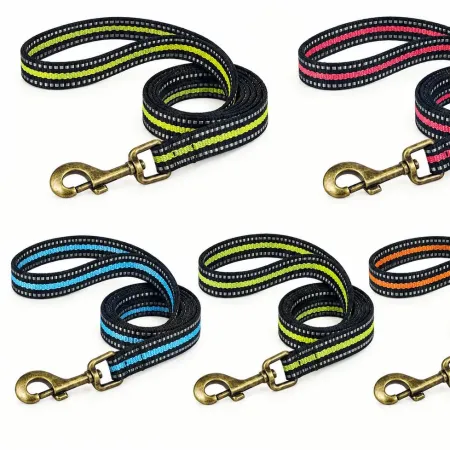
The band for a puppy lead is a nylon webbing construction at 20 mm, and a polyester webbing version holds colour better where a product is washed often. The laboratory provides abrasion and fastness data on the dyed band and the print, which is the evidence a puppy product actually needs. Material declarations for OEKO-TEX, CPSIA and REACH are held with certificate numbers, and the development route can build a short adjustable version from the standard lead range.
One more use pattern belongs in the brief: a training lead spends much of its life on the ground, being stepped on and dragged. That is a different abrasion path from a walking lead, which hangs from a hand, and it is why a puppy product should be tested flat against a rough surface rather than only in tension.
Two Things Not to Ask For
A chew-proof claim
No woven band is chew-proof, and a product described that way invites the one test it will certainly fail. A supplier who offers the phrase is offering a liability rather than a feature, and a brand that prints it has taken on a complaint it cannot answer. The honest version describes resistance, names the weave and the stitch, and advises training rather than promising immunity.
A promise about behaviour
A puppy product is used in ways no specification predicts: tied to a chair, held while the owner answers the door, dragged along a wall. Those are use conditions rather than manufacturing faults, and no supplier can certify them. What can be certified is the material, the print and the joint, and separating those from the behaviour is what keeps a safety claim credible when a customer reports damage.
FAQ: Puppy Pet Leashes
What width for a puppy?
20 mm for most, chosen against the expected adult weight rather than the current one. A 15 mm lead may be outgrown before it is worn.
Can a puppy lead be chew-proof?
No. A tight weave and a dense tack resist it, and training is what stops it. Any product described as immune is being over-sold.
Should the print be avoided on a puppy lead?
Not avoided, but it should be declared for wet contact. A print is a surface layer, and a mouth works on surfaces before anything else.
Is an adjustable lead better for a puppy?
Usually, because the dog changes height and pace within months. The adjuster adds a slider that a mouth can reach, so it should be small and firmly set.
Can a charm be added to a puppy lead?
It can be, and it is the one part a young dog can remove. Where a charm is used, it should be attached so it cannot be pulled free.
Puppy pet leashes are specified against a mouth, a growth curve and a pair of curious paws. Name the adult weight, the weave, the wet-contact declaration and the no-detachable rule, and the product fits the year it is sold for.
Why Xinxiangrui for Puppy Pet Leashes
A puppy lead is judged on its surface and its stitching rather than its tensile figure, and both are measured here. Martindale abrasion past 50,000 cycles and wet-rubbing fastness are run in the on-site laboratory, and the declarations for OEKO-TEX, CPSIA and REACH carry certificate numbers that match the yarn and dye used. Share your lead details with us and we will come back with a matched sample.