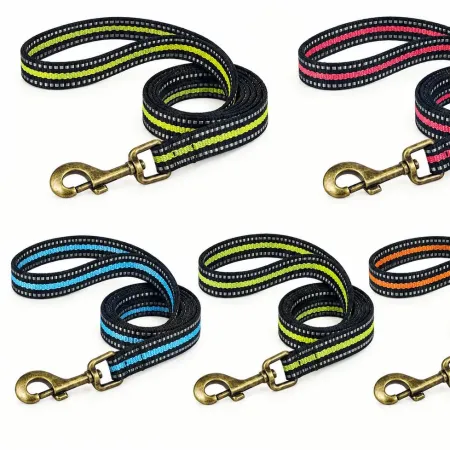
Personalized Pet Leashes: Where One Name Changes the Run
Personalized pet leashes look like a retail idea and behave like a production problem, because a single variable is different on every unit. A lead with a name is not one product made many times; it is many products made once each, and the moment a run contains a variable, the cutting, the stitching, the marking and the packing all stop being batch operations. The commercial question is where to draw that line.
This guide covers the four ways a name is put on a narrow band, why the character limit is a physical measurement rather than an editorial preference, why the margin is where personalization fails, six lines a personalized brief should carry, and the two errors that cost more than the marking itself.
Personalized Pet Leashes: Four Ways to Add a Name
Each marking method costs a different amount to set up and survives a different number of washes, and the choice is usually made on appearance when it should be made on legibility at size.
- Embroidery — thread on the surface, durable and textured, and limited by the smallest letter a needle can form.
- Laser marking — a change in the surface rather than an addition, sharp at small sizes, and permanent on the right fibre.
- Heat transfer — a printed film pressed on, capable of fine detail and colour, and the film is the part that lifts.
- A woven label — the name woven into a separate label and sewn on, which moves the variable off the band entirely.
| Method | Smallest letter | After a year |
|---|---|---|
| Embroidery | Around 5 mm for a clean capital | Intact, with slight fuzz on the edges |
| Laser | Small, but tone depends on the fibre | Unchanged, and it will not lift |
| Heat transfer | Very small, fine detail possible | Edges soften, film may lift at a fold |
| Woven label | Set by the label reed, similar to embroidery | Outlasts the band, but adds an edge |
The band does not care what is written on it
A name is a surface treatment on a 25 mm band that clears 2000N, so personalization never enters the load argument. That is fortunate, because it means the marking method can be chosen on legibility, durability and setup, and the construction does not change between a plain lead and a named one.
Three Limits That Decide the Design
The character limit is a measurement
A band 20 mm wide with a 15 mm usable face holds a name at a certain letter height, and the letter height decides how many characters fit across. That is arithmetic rather than policy: eight characters at 6 mm will fit, twelve will not, and a longer name has to go smaller, run onto two lines or be abbreviated. Stating the limit in characters at a stated height prevents the conversation that begins with a nine-letter name and ends with a compromise on legibility.
A font that survives the size
A light, elegant typeface that looks refined on a proof closes up at 5 mm, because the strokes fall below the width the process can hold. A heavier weight with open counters reads at that size and looks less delicate on paper, which is the trade. The practical test is to print the name at final size, hold it at arm's length and read it in poor light, because that is where a lead is read.
The margin is where it fails
A name placed too close to the edge is trimmed by the cut or rubbed by the seam, and the failure appears at exactly the letters that matter. A minimum margin from both edges, held as a rule rather than judged per design, is what keeps a personalized range consistent. The same margin applies at the top and bottom of a two-line layout, and it is the number most often omitted from a brief because it feels like a detail.
The name usually appears somewhere else as well, and that second place is easy to forget. A hang tag, a belly band or a printed sleeve often carries the same name, and if the tag is produced in a separate run the two can disagree on spelling. Treating the tag as part of the personalized item and ordering it from the same data file is the difference between a gift product and a customer service case.
Six Lines for a Personalized Brief
- The marking method — embroidery, laser, transfer or label, chosen for the smallest letter the design needs.
- The character limit and the height — given together, with the rule for a name that exceeds it.
- The font and its weight — a named typeface in a specific weight, tested at final size rather than approved from a screen.
- The margins — from the cut edge and from the seam, stated in millimetres and applied to every layout.
- The thread or ink colour — and how it reads on each band colour in the range, since one thread cannot serve a pale and a deep band equally.
- The order of operations — whether the name is applied before or after the lead is stitched, which decides how the piece is handled and how mistakes are corrected.
The last line has a visible effect on quality. Marking a flat length of band before it is cut is faster and allows a mistake to be trimmed away; marking a finished lead is slower and makes every error a scrap. Since personalization is the part of the process with the highest error rate, applying it earlier in the sequence is usually worth the handling cost.
The band is a nylon webbing or polyester webbing base at the width the design needs, and the marking is added on the print or embroidery route. Colour can be matched to a supplied reference through the development route, and the sample should carry a real name rather than a placeholder so the size is judged honestly. The abrasion and fastness results should state whether they were taken over the marked area, which is the part most likely to wear first.
Two Errors That Cost More Than the Marking
A long name discovered at the proof
Personalized orders collect names from customers, and names vary far more than a product specification anticipates: hyphens, double capitals, accents and names that simply do not fit. The design decision that prevents most of this is to fix the rule in advance, for example abbreviate to the first name above a set length, and to show that rule where the customer types. Retro-fitting a layout to an individual order is where a profitable personalization programme loses its margin.
The typo nobody owns
A misspelt name is the one defect a customer will not accept, and the responsibility is usually ambiguous. The workable arrangement is a proof step that the customer approves in writing for the first order in a range, followed by a data file that is used exactly as received. That converts a dispute about spelling into a record of approval, and it protects both sides without slowing the run or asking a customer to remember what they typed a month earlier.
FAQ: Personalized Pet Leashes
How many characters fit on a lead?
It depends on the letter height and the usable width. Eight characters at 6 mm is a realistic figure on a 20 mm band, and more only at a smaller size.
Which marking lasts longest?
Laser and embroidery both outlast a heat transfer film, which softens at the edges and can lift at a fold. Embroidery is the softer look.
Can a name be added to both sides?
It can, and both faces then need their own margin. A single face is usually enough, since a lead is seen from one direction when it is held.
Does a name weaken the band?
No. Marking sits on the surface, and the base clears 2000N at 25 mm regardless of what is written on it. The stitching remains the only structural joint.
Is a woven label better than printing?
A label is durable and moves the variable off the band, so the leads can be made in advance. It adds an edge and a stitch line that some designs do not want.
Personalized pet leashes are one variable on an otherwise settled product, and the variable has to be bounded before the run. Fix the method, the character limit, the font and the margins, and a name becomes a feature rather than a rework queue.
Why Xinxiangrui for Personalized Pet Leashes
A named lead is a marking decision on a band that is already in production, so the sample has to show the name at its real size. Free samples, Pantone matching and development from a drawing are standard, and with weaving, printing and hardware assembly on one site the marked band and the finished lead are handled in one sequence rather than two. Give us the application and the load it must carry, and the construction follows.