1 Inch Pet Reflective Webbing: A Narrow Band Coated at the Edge
1 inch pet reflective webbing is a 25 mm band, and the number that decides whether it works is not the width but where the coating sits. A 50 mm band carries its optical layer across a wide flat centre and leaves two plain margins to take the abrasion. A 25 mm band has no margin to spare: the coating runs from selvedge to selvedge, so both edges sit inside the optical area and inside the wear area at once. That is a fact about the coating line rather than a preference held by a designer.
This guide covers what a 25 mm width changes in optical terms, why the selvedge becomes the first line to fail, why a narrow reflective band is best coated on the site that wove it, six lines a one-inch brief should carry, and the two things a sample strip cannot show before a bulk order.
1 Inch Pet Reflective Webbing: What the Width Changes
Reflectivity is quoted as a coefficient, in candelas per lux per square metre, and that unit is per unit area. A narrower band at the same coefficient returns less total light, simply because there is less area doing the returning. Nothing about the material is worse; the strip is smaller, and an eye and a camera both integrate over area rather than sampling a point.
- 20 mm — cat collars and toy-breed collars, where the fitting sets a hard ceiling on width and the band has to stay light enough to sit still.
- 25 mm — the standard dog collar and lead width, and the widest band that still bends cleanly around a neck without standing away at the side.
- 38 mm — harness chest straps and coat trim, where area can be added without making the neck piece heavier.
- 50 mm — high-visibility vests and horse gear, where the wide band is the product and the assembly around it is built to suit it.
Two consequences follow. The first is that a 25 mm band used where a 38 mm would fit gives away a third of its returned light for no gain in comfort. The second is that a 25 mm band used where 20 mm would do buys visibility with weight, and on a cat collar that weight decides whether the band stays where it was set or rotates until the reflective face points at the ground.
| Step | What 25 mm changes | Where you see it |
|---|---|---|
| Coating | The knife meets two selvedge ridges instead of leaving a plain margin | A raking light along both borders |
| Cutting | A one millimetre drift is four per cent of the whole width | Roll end laid against a square |
| Folding | The doubled thickness eats the clearance in the fitting | The buckle the band has to thread |
| Stitching | The seam sits nearer the optical area and can clip it | Needle marks inside the coated zone |
The coating does not change the load path
A 25 mm base band clears 2000N, and the optical layer does not alter that number. The coating rests on the surface, the weave carries the tension, and the stitching that joins the band to a buckle is untouched by any decision about brightness. That separation is what makes a narrow reflective band predictable: the reflective route can be changed for a stronger return without re-engineering the part that holds a dog.
Three Things That Decide a Narrow Reflective Band
The coating has nowhere to hide
On a wide band a coating flaw in the middle of the face is one poor patch among many good ones, and the eye averages it away. On a 25 mm band the same flaw occupies a fifth of the visible width, and a buyer holding the roll up to a window finds it in seconds. Narrow coating is therefore a tighter process rather than an easier one: the same pan, the same knife and the same line speed leave a smaller tolerance for error in absolute millimetres, because the strip has less room to absorb it.
The selvedge is the first thing to fail
A woven edge is not a cut edge. It is formed by the weft turning back on itself, so it is slightly thicker and slightly rougher than the face, and a knife riding across it either thins the coating there or rides over and skips. On a 25 mm band that ridge is a large share of the total edge, and it is also where a collar rubs against fur, a coat and a car seat. The result is a band that looks whole across its face and has lost its reflection along both borders, which happens to be where a headlight strikes it at an angle.
The colour underneath sets the ceiling
The optical layer is thin enough that the base shows through the gaps between beads or prisms. A pale grey base lifts the return and a black base absorbs whatever passes between the optics, so the same nominal grade reads as bright silver on one band and dull charcoal on another. At 25 mm there is less face carrying the effect, which makes the base colour a larger variable than it is at 50 mm. That is why the base belongs in the brief as a named shade rather than as whatever the mill has on the beam.
Six Lines for a One-Inch Brief
- The width and its tolerance — 25 mm is a nominal figure, and a band that measures 24.4 mm will not pass a 25 mm slot once it is coated and folded.
- The base band — polyester or nylon, and the shade underneath, because that shade sets how bright the coating can look.
- The coefficient with its angles — a candela figure is meaningless without the observation and entrance angles it was measured at.
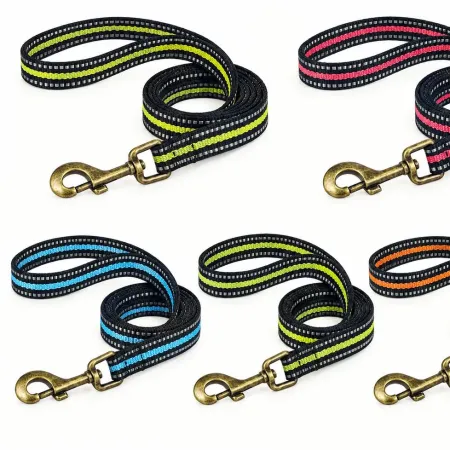
- The pattern — full face, twin edge stripes or a repeated motif, since each puts the optical material in a different place.
- The fitting it threads through — the measured slot, not the catalogue size, because the slot is the real maximum width after folding and stitching.
- The care line — what a wash does to the coating, written for the hang tag rather than for the order file.
The fifth line is the one that gets skipped and costs a sampling round. Coating adds thickness, folding doubles it, and stitching pulls the two layers together, so a band specified at 25 mm can measure 26 mm at the point where it has to slide through a buckle. Measuring the slot on the actual fitting with a caliper, rather than reading its nominal size off a drawing, is the difference between a first sample that threads and one that has to be trimmed before anyone can judge the reflection.
A 25 mm reflective band is normally built on a polyester webbing or nylon webbing base with the optical layer added afterwards. Where the same band also needs a closure, a hook and loop fastener can be sewn on the same line, and the pet reflective webbing range lists the widths and patterns already running. The test record should state the angle the coefficient was measured at, because two laboratories can report the same band an order of magnitude apart.
Two Things a Sample Strip Cannot Show
How it reads at forty metres
A sample is judged at arm's length and a collar is judged at the distance a car closes in a second. Returned light falls with distance and with the observation angle, and a strip that looks brilliant in a hand can be a grey smudge at forty metres on a wet night. The test that answers the question is dull rather than technical: a photograph from a measured distance, with a fixed lamp and the camera at the height of a driver's eye. It is not a laboratory substitute, and it is much closer to the decision the customer is making.
What a season of washing does to the edge
The face of a coated band survives a wash cycle better than its borders do. Detergent and agitation work on the selvedge first, and after twenty machine washes a narrow band will show a pale matt rim under a raking light while the centre still returns cleanly. That rim is the part a driver sees edge-on, so it matters more than its area suggests. Keeping one strip from the first lot and washing it beside an untouched one turns the effect into something to look at rather than something to argue about.
FAQ: 1 Inch Pet Reflective Webbing
Is 1 inch exactly 25 mm?
Nominally, yes, and in practice the woven width is quoted with a tolerance of about a millimetre. Ask which way the tolerance runs, because a band at the low end is easier to thread and a band at the high end is easier to see.
Does a wider band always reflect more?
For the same coating, yes, because the returned light scales with area. A wider band at a lower grade and a narrower band at a higher grade can still come out equal, which is why the coefficient and the width have to be quoted together.
Will it pass through a 25 mm buckle?
Usually it needs a slot slightly wider than the nominal width, because coating, folding and stitching each add a fraction. Measure the slot, not the drawing.
Can it be machine washed?
It can, and the edges age faster than the face. A cool wash inside a bag, and drying away from direct heat, keeps the border reflective for longer than a hot cycle will.
Is a black base dimmer than a silver one?
Yes, at the same coating weight. The base shows through the gaps in the optical layer, so a dark base absorbs light that a pale base would send back. It reads as a grey band by day and a duller one at night.
1 inch pet reflective webbing is decided by the coating line and the selvedge rather than by the width on its own. Name the base shade, the coefficient with its angles, the pattern and the fitting the band has to pass through, and a 25 mm strip arrives behaving the way the brief describes.
Why Xinxiangrui for 1 Inch Pet Reflective Webbing
A narrow reflective band is coated close to both edges, and here the coating line stands in the same 8,000+ m² plant in Dongguan as the loom that wove the base. Weaving, dyeing, coating, printing and hardware assembly run on one site, so a knife reset for a 25 mm run, or a change of base shade under the same optical layer, is a work order rather than a negotiation between three suppliers. Tell us your one-inch spec and a matched construction comes back to you.