Pet Leashes for Small Dogs: Light Hardware, Light Cartons
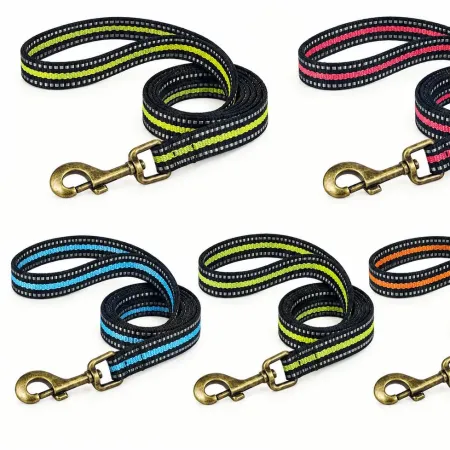
Pet leashes for small dogs are usually specified as a narrower version of a large lead, and the interesting problems are somewhere else. At 15 mm the band is still far stronger than the animal needs, so strength stops being the constraint and three other things take over: the fitting has to shrink without becoming fragile, the carton has to shrink without becoming uneconomical, and the pack has to look proportionate in a shop where the product sits beside a much larger sibling.
This guide covers the three elements that shrink with the dog, why the hook rather than the band is the part that needs care, why a light carton decides the freight on a small product, six lines a small-dog brief should carry, and the two packing decisions that change what a shipment costs before it leaves.
Pet Leashes for Small Dogs: Three Elements That Shrink
A small-dog lead is not one decision made smaller; it is three decisions that each have their own floor.
- The band width — 15 mm or 20 mm, chosen for the hand and the proportion rather than for strength, since the load is small.
- The fitting — a smaller hook body with a gate and spring that still work, which is where a scaled-down product usually fails.
- The carton — a smaller box that may fall below the economical size, and the point where packing starts to cost more per unit.
- The pack count — how many leads go in a bag and a carton, which is the lever that keeps a light product economical to ship.
| Element | Small-dog version | What changes |
|---|---|---|
| Band | 15 mm to 20 mm | The hand feels the width before the strength matters |
| Hook | A smaller body, and the same gate travel | Less material around the gate, so the spring is critical |
| Carton | Fewer pieces per box, or a higher pack count | Volume per unit rises unless the pack count rises too |
| Presentation | A narrow header card and a smaller bag | A small lead in a standard bag looks lost |
Half the width is not half the strength
A 25 mm construction clearing 2000N tells you what the weave can do; the 15 mm version cut from the same family reads lower and is still several times what a small dog can generate. The useful thing to state is that the band is not the limiting part, so the attention belongs on the hook, the tack and the packing.
Three Things That Decide a Small-Dog Order
The hook is the part that must not be scaled blindly
A hook shrunk in every dimension loses material exactly where the gate bears on the nose, and the spring becomes proportionally weaker as the body gets smaller. A well-made small hook keeps a sensible section around the gate and reduces the body instead, which is why the smallest fittings are not simply the largest ones shrunk on a drawing. On a small lead this is the only component whose failure matters.
Light cartons decide the freight
A small-dog lead weighs little, and freight is charged on whichever is greater between weight and volume. A carton sized for the pieces it holds will have a volume figure that dominates, so the pack count is the real lever: more leads per carton lowers the volume per unit and the figure per piece, without touching the product. This is a packing decision, and it is cheap to make before the cartons are printed.
A small lead in a big bag looks expensive
Proportion is a merchandising issue that becomes a logistics one. A narrow lead in a bag designed for a 25 mm product uses more material, occupies more shelf width and reads as a cheaper item than it is. A narrower header card and a smaller bag cost less, look right, and reduce the packed volume at the same time, which is the rare case where the commercial and the visual answer agree.
A punched header card deserves a line of its own, because it is the packaging detail most often assumed. A card hung on a peg needs a stiffening board behind it or it folds under a small lead, and the punch position has to clear the stitching at the handle. A card that sags on a hook looks worse than no card at all, and correcting it is a change to two dimensions.
Six Lines for a Small-Dog Brief
- The weight, in kilograms — because a small dog ranges from two to ten and the width should follow the weight rather than the breed name.
- The width and the length — 15 mm with a short lead for a toy breed, 20 mm for a terrier, and the length matched to the handler rather than the dog.
- The hook size and its gate — named by fitting reference, with a note on whether the gate spring has been specified or inherited.
- The pack count — leads per bag and bags per carton, stated as a pair, since this is what sets the freight on a light product.
- The carton dimensions — with the volume written down, so the freight basis can be calculated before the shipment is booked.
- The presentation size — header card and bag dimensions matched to the product, which affects both the shelf and the box.
The fifth line is the one that turns a shipping surprise into a plan. Once the carton dimension and the pack count are known, the volume per lead can be calculated and compared against the weight, and the chargeable basis becomes a number rather than a discovery at the forwarder's desk. On a product this light that calculation is where most of the margin sits, and it costs nothing to do before the order is confirmed.
The band is a nylon webbing construction at 15 mm or 20 mm, and a polyester webbing option holds its shape better where a small lead is stored coiled. The lead range shows the standard widths and the fittings that go with them, and the packing options cover retail-ready bags, header cards and carton configurations. Air, sea and express routes are all handled with the paperwork, and the test record for a narrow band should name the width it was taken on.
Two Packing Decisions
Weight or volume, whichever is charged
A carton of small leads almost always bills on volume, because the material is light and the box is not. That means shrinking the box matters more than reducing the weight, and the practical move is to raise the pack count and reduce the empty space rather than to look for a thinner band. A carton with a smaller internal height and a tighter fill is the cheapest freight improvement available on this product.
Whether small and large ship together
A range usually includes both sizes, and mixing them in one carton fills the space efficiently and complicates the receiving end. Keeping the sizes in separate cartons makes the shipment a few percent more expensive and the warehouse work much simpler, and most distributors prefer it. The question to ask is not which is cheaper to send but which is cheaper to receive, and the answer is usually separate.
FAQ: Pet Leashes for Small Dogs
Is 15 mm strong enough?
For a dog under about eight kilograms, comfortably. The band is not the limiting part at that width; the hook and the tack are what to look at.
Why does a small lead cost nearly as much to ship?
Because freight bills on volume as well as weight. A light lead in a standard carton is charged for the space, so the pack count matters more than the grams.
Can a small lead use the same hook as a large one?
It can, and the fitting will look oversized on a 15 mm band. A smaller body with a properly sized gate looks right and works better.
Should small and large be packed together?
Usually not. Separate cartons cost slightly more to send and considerably less to receive, which is what a distributor experiences.
What length suits a small dog?
Shorter than a large-dog lead, because the handler is usually closer. A fixed length of about 1.2 metres is common, and an adjustable version is worth offering.
Pet leashes for small dogs are a fitting, packing and proportion problem, not a strength problem. Specify a hook that shrank properly, a bag that fits the product and a pack count that beats the volume charge.
Why Xinxiangrui for Pet Leashes for Small Dogs
A light lead is decided by its carton as much as its band, and both are handled here. Air, sea and express routes are quoted with the full customs paperwork, retail-ready packing is built to the channel's requirement, and a carton configuration can be agreed alongside the specification so the volume charge is known before booking. Share your lead details with us and we will come back with a matched sample.