Custom Nylon Lanyard With Badge Holders: Buying the Set
A custom nylon lanyard with badge holders is a kit, and kits are priced, packed and judged differently from single items. The strap and the holder are made by different processes, wear at different rates, and are almost always bought together — which means the practical questions are about the set: which holder, how it hangs on a nylon strap, whether the colours match, and how the kits are counted at the door.
This guide covers the holder formats that pair with a nylon strap, the one property of nylon that changes the pairing, how a set is colour matched across two materials, and the packing decisions that turn a box of components into something a registration desk can hand out.
Five Holders and the Straps They Suit
A holder is chosen for the card, the environment and the life it needs to survive. The strap is then chosen for the holder's weight.
- Soft PVC, vertical — the standard badge holder. Light, cheap, and adequate for a card that is shown rather than scanned. Pairs with a 15 or 20 mm strap.
- Rigid polycarbonate — a hard shell that protects a printed card and survives being handed back at the end of a shift. Heavier, and better on a 20 or 25 mm strap.
- PU leather, side load — for programmes where the holder is part of the uniform. Needs an eyelet rather than a punched slot, because the material is thicker.
- Expandable, multi-card — two or three pockets for a door card, a canteen card and a travel pass. The heaviest common holder, and the one that pulls hardest on a strap.
- Shielded holder — a holder with a screening layer for contactless cards. A different construction again, and one where the window material and the print on the strap behind it both matter.
The table pairs the holders with the strap widths and lengths that behave, since a heavy holder on a light strap is the most common mismatch in a badge programme.
| Holder | Strap width | Strap length |
|---|---|---|
| Soft PVC | 15 to 20 mm | 900 mm loop |
| Rigid shell | 20 to 25 mm | 900 mm loop, 1,000 mm if worn over a jacket |
| PU leather | 20 mm | 900 mm loop |
| Expandable multi-card | 25 mm | 900 to 1,000 mm, with a denser sett |
Custom Nylon Lanyard With Badge Holders: One Property Changes the Pairing
Nylon is a good fibre for a badge strap and it has a characteristic that matters more here than anywhere else: it elongates under sustained load and does not fully recover. A badge holder hangs for eight hours a day, which is exactly the load case that reveals it.
- A heavy holder lengthens the loop — a multi-card holder can add several millimetres over a season, which moves the badge lower and changes where it sits against a shirt.
- The fix is sett and width — a denser sett and a 25 mm band carry the same holder with less growth than a light 15 mm one. Nylon's softness is a reason to go wider, not narrower.
- Heat setting matters — a stabilised nylon strap holds its width and hangs straighter. An unstabilised one curls at the edge and the holder sits at an angle.
- The eyelet takes the load — where the holder is heavy, an eyelet rather than a punched slot keeps the force off a narrow bridge of PVC.
Buy the pair from one place, or budget for two matches
A nylon strap and a moulded holder are two different materials, and the same colour reference lands differently on each. Sourcing them together means one approval against the pair rather than two approvals that have to be reconciled, and it means the strap can be adjusted for the holder's weight instead of the holder being chosen to suit a strap that already exists. Where they come from separate suppliers, the difference in colour and hang is discovered at assembly.
Colour Across Two Materials
Matching a dyed nylon strap to a moulded holder is not a like-for-like comparison, and the practical approach is different from matching two textiles.
Match the strap to the holder, not the reverse
A moulded holder is made in a fixed set of colours and a dyed strap can be matched to almost anything. Since the strap has more freedom, it should follow the holder. Approving the holder first shortens the process by a round.
Nylon reads deeper
Acid-dyed nylon produces a dark, saturated result that a moulded plastic rarely matches at the same reference. The holder will usually look lighter or greyer than the strap. Choosing a slightly lighter strap than the target, or accepting a deliberate contrast, works better than chasing an exact match that will not arrive.
Transparency changes the calculation
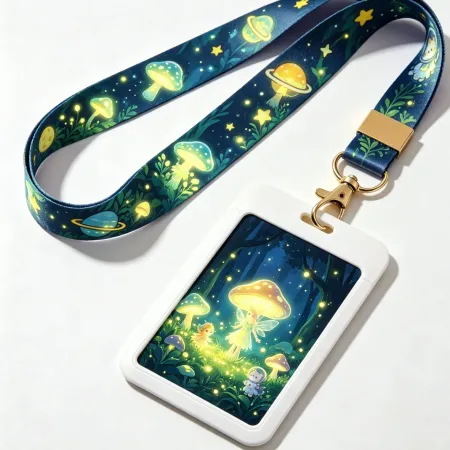
Where the holder is clear, the strap behind it is visible through the card window and becomes part of the visual. A printed strap will show its pattern through a thin holder, which can make the card harder to read. A plain reverse, or a white backing card, fixes it for almost nothing.
Six Decisions That Turn Components Into a Kit
A set is judged by whether it can be handed over, not by whether the parts are good. These six items decide that.
- Assembled or flat — holder on the strap, or separate in the same bag. Assembly costs labour and saves time at the desk.
- One kit, one count — count kits rather than components, or the reconciliation happens in a queue.
- Colour grouping — packed by strap colour and holder type, not mixed, where the programme runs more than one.
- A spares bag per carton — a few extra holders, because holders break more often than straps.
- Labelled cartons — the contents and the count on the outside, readable in a loading bay.
- A retained set — one complete kit kept as the approved reference, not a strap and a holder in separate drawers.
Nylon webbing, holders and hardware all sit in the same catalogue here, which is why a set can be developed as one product rather than assembled from three purchases. A 20 mm nylon band clears 2000N with a rigid holder hanging from it, so the strap is not the constraint. The strap formats are in the custom lanyard range, the nylon webbing base is woven on site, and holder and strap development runs through OEM and ODM development.
FAQ: Custom Nylon Lanyard With Badge Holders
Why does my badge hang lower than it did?
Because nylon grows under a hanging load. A heavy holder on a light 15 mm strap will lengthen the loop over a few months. A denser sett, a 20 or 25 mm width and a heat-set finish all reduce it, and a slightly shorter starting length compensates for the rest.
Can the holder be a different colour from the strap?
Yes, and a deliberate contrast often looks better than a near miss. Black holder on a coloured strap, or a clear holder over a printed one, both read as choices. The problem case is a match that is almost right, which reads as a mistake.
Should the set arrive assembled?
If the badge is printed in advance, yes — one item per person is the fastest possible desk. If badges are printed on site, ship the holders fitted to the straps and let the cards be inserted, which is a two-second operation and needs no tools.
Which fails first, strap or holder?
The holder, by a wide margin, and usually at its slot or its welded edge. That is why a spares bag of holders is worth more than a spares bag of straps, and why an eyeleted holder pays for itself on a programme that runs for a year.
Do the documents differ from a strap-only order?
The strap and the holder are different materials, so the declaration has to cover both rather than the textile alone. Where the destination asks for substance declarations and labelling, the holder's material and any print on it belong in the same file as the strap's yarn and dye recipe.
A custom nylon lanyard with badge holders is a set, and a set is decided by the weakest component and the way it is counted. Choose the holder for the card, widen the nylon for the holder's weight, match the strap to the moulding rather than the other way round, and pack kits rather than parts.
Why Xinxiangrui for Custom Nylon Lanyard With Badge Holders
Straps, holders, clips and eyelets come from one catalogue, so a custom nylon lanyard with badge holders is approved as a pair rather than as two purchases that meet at assembly. The base cloth is often already qualified for the shade, and the strap width can be set against the holder's weight instead of chosen in advance. Give us the application and the load it must carry, and the construction follows.