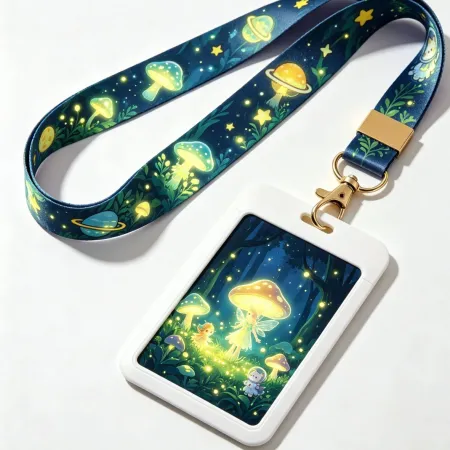
Custom Lanyard With ID Holder: Testing the Assembly, Not the Parts
A custom lanyard with ID holder is a three-part assembly — strap, clip, holder — and the number that matters is not the strength of any one of them. It is whether the card is still in the holder and the holder is still on the strap after a week of ordinary use. Most programmes test the webbing, approve the artwork and never pull the assembled product, which is why failures appear in service rather than on the bench.
This guide sets out a test protocol for the pair: the six checks worth running, how many specimens each one needs, what an acceptance criterion looks like when it is written down properly, and how to read a report that claims more than it measured.
Six Checks That Cover the Assembly
Each check targets a different joint in the product, and between them they describe everything that can reasonably go wrong in a badge lanyard.
- Retention pull — pull the holder away from the strap at a steady rate and record the peak. The target is a multiple of the assembled weight, not a fixed figure.
- Drop test — five drops from about 1.2 m onto a hard floor, with the card in place. This is the check that finds a slot which releases too easily.
- Slot tear — load the holder throat until it deforms, and note where the tear starts. A slot that tears upward at the first firm pull will do the same in a doorway.
- Attach and detach cycles — several hundred open-and-close cycles on the clip, checking that the gate still closes flush.
- Swing abrasion at the fold — a pendulum motion at the neck point, with the real holder fitted, to see how the edge behaves under repeated flexing.
- Warm storage transfer — the holder and strap stacked in a warm place for a period, then checked for colour migration between the two materials.
The table turns those checks into targets, with the practical note that makes each one useful rather than decorative.
| Check | Reasonable target | What a failure tells you |
|---|---|---|
| Retention pull | Holds at several times the assembled weight | The clip grade is too light for the holder |
| Drop test | Card and holder stay together through five drops | The holder is too shallow, or the card format is wrong for it |
| Slot tear | No visible deformation at the working load | Soft PVC without an eyelet; a rigid holder is needed |
| Cycle test | Gate closes flush after hundreds of cycles | Spring gauge too light for daily use |
Custom Lanyard With ID Holder: Sampling and Acceptance
A test performed once produces a story. A test performed across specimens and lots produces a number a buyer can rely on, and the difference is entirely in how the sample is drawn.
- Five specimens per check — enough to see a spread, few enough to be practical. Report the range, not just the mean.
- Across production, not across the bench — specimens drawn from different hours or different rolls. A single shift sample hides the variation that a long run reveals.
- Assembled, mounted as worn — the holder hanging, the strap over a bar. Clamping the strap flat changes the geometry and the result.
- A written criterion, agreed first — "holds without visible damage at three times the assembled weight" is a criterion; "feels strong" is not.
Name the weak link in the report
A good report says which part failed first. If it says only that the assembly withstood a load, the reader learns nothing about where the margin sits. The useful sentence is short: "the clip opened at 4.1 kg with the holder fitted; the strap and the holder slot showed no damage." That single line tells a buyer which component to change and by how much, and it is the kind of detail a compliance reviewer will ask for anyway.
Reading a Report That Claims Too Much
Reports from different suppliers are rarely comparable, and the reasons are structural rather than dishonest.
Two reports can carry the same headline figure and describe different products, because the specimen, the mounting and the failure criterion were each chosen by the party being tested. None of that requires bad faith. It requires a buyer who reads the method before the number and asks what was clamped, what was hung and what counted as a pass.
The specimen is often a component
A clip tested on its own, or a strap tested without a holder, produces a figure that does not describe the product. Since the strap alone clears 2000N while the assembly may fail at a few kilograms, a report quoting the strap figure is technically accurate and practically useless for this decision.
The mounting changes the number
A gauge length that lets the strap stretch absorbs part of the travel, so the same product measured two ways gives two peaks. The mounting has to be described as carefully as the load, and it is the first thing to check when two suppliers disagree.
The date and the lot matter
A test certificate without a lot reference describes a product that may no longer be the one being supplied. Where a programme runs for years, the report has to be refreshed against current production rather than carried forward, because hardware grades and holder materials change quietly.
Six Lines for a Test Request
A request that carries these six items gets a report that can be compared with another supplier's, which is the whole purpose.
- The assembled product — strap, clip and holder, with the part numbers of each.
- The load case — the weight it will actually carry, and the way it is worn.
- The checks required — retention, drop, slot tear, cycles, abrasion, as applicable.
- The number of specimens — and whether they must come from different lots.
- The acceptance criterion — written as a pass or fail condition before the test runs.
- The report format — method, gauge length, mounting and which part failed first.
Testing is the cheapest part of a badge programme and the least often specified. The custom lanyard range supplies the strap and the clip, holders are developed alongside them through OEM and ODM development, and the retention, drop and abrasion work is done in the in-house laboratory.
FAQ: Custom Lanyard With ID Holder
Do I need a test on every order?
On the first order, yes; on a repeat of an unchanged construction, a periodic check is enough. The point where a test becomes necessary again is when a component changes — a new clip grade, a different holder material, a thicker strap — because each of those alters the weak link without changing the product name.
What load should the retention test use?
Take the assembled weight — card, holder and clip — and work to a multiple of it, so the margin is visible. A twenty gram badge and a forty gram rigid holder are the same test method with different targets, and writing the multiple into the spec makes the report comparable across products.
Why does a drop test matter for a lanyard?
Because a lanyard is dropped, sat on and caught in doors, and the failure that matters is the card falling out rather than the strap breaking. A holder that retains the card through five drops from waist height is a holder that will behave at a barrier; one that releases on the second drop will lose badges daily.
Can an eyelet be tested the same way?
Yes, and it is worth comparing the eyeleted holder against the plain slot on the same rig. The difference is usually visible in the deformation point rather than the peak load, which is why the report should describe what deformed rather than only what held.
Where should the test record be kept?
With the order file, next to the sett, the dye recipe reference and the retained sample. A report stored separately from the product it describes is a document; a report stored with the order is evidence, and it is the version a buyer's compliance team will want to see.
A custom lanyard with ID holder should be tested as the thing it is: three components carrying one card, with one of them always weaker than the others. Measure which one, write the criterion down before the test runs, and the report becomes a specification rather than a certificate.
Why Xinxiangrui for Custom Lanyard With ID Holder
Retention, drop and slot behaviour for a custom lanyard with ID holder are measured on the assembled piece in the in-house laboratory, across specimens drawn from different rolls, with the part that failed named in the report. The strap behind it clears 2000N, so the report can say exactly where the margin sits rather than implying it. Tell us your custom lanyard with ID holder spec and a matched construction comes back to you.