Custom Lanyard Card Holder Factory: What the Site Has to Own
A custom lanyard card holder factory is judged by the processes it can run under its own roof, not by the catalogue it can show. The strap is woven, the shade is dyed, the print is applied and the holder is cut and welded or sewn — four different skills, and a supplier that owns two of them is a trader with a workshop attached. When a programme needs the holder and the strap to match, those skills have to be in the same building.
This guide sets out the six processes a real factory owns for this product, the questions that expose a site which outsources the difficult half, and how to read a capability file rather than a brochure.
Six Processes Behind One Small Product
A lanyard with a card holder looks like one item and is really the output of six operations, each with its own failure mode. A factory that owns all six can answer a question about any of them in a day, and the strap it weaves still clears 2000N on the same rig the laboratory uses for every other width.
- Weaving — narrow looms with reeds for the widths in the range. Outside this, every width becomes a purchased roll and the sett is somebody else's decision.
- Dyeing — a continuous line for the shades, with the recipe recorded per order. This is what makes a colour repeat possible two years later.
- Printing — sublimation for polyester, screen for cotton and for opaque work. Owning one method and buying the other is common and should be declared.
- Holder fabrication — cutting, high-frequency welding or stitching of PVC and PU sheet. This is a separate trade from weaving and the step most often subcontracted.
- Hardware assembly — clips, rings, eyelets, rivets and closures fitted to the finished strap. Small parts, big consequences, and a bench that has to be next to the cutting table.
- Testing — a laboratory that can pull a clip, rub a print and measure a width on the goods that ship rather than on a sample card.
The table shows what happens to a programme when each process sits outside the site, because the cost of outsourcing is rarely visible in a quotation.
| Process outsourced | What the buyer feels | Where it shows up |
|---|---|---|
| Weaving | Widths limited to what a mill will run; the sett is fixed by somebody else | A 20 mm request quietly becomes a 25 mm strap |
| Dyeing | Shade drift on the reorder; no recipe to return to | The second shipment does not match the first |
| Holder fabrication | Holder and strap arrive from two places, in two colours | Nobody can approve the pair, only the parts |
| Testing | Reports describe a sample, not the shipment | The figure cannot be defended in an audit |
Custom Lanyard Card Holder Factory: Questions With No Safe Answer
Four questions separate a site that makes the product from one that assembles a quotation, and none of them can be answered from a catalogue.
- Which widths come off your own looms? — a straight answer names the reeds. A vague one means the strap is bought in, and the width will be whatever is on the shelf.
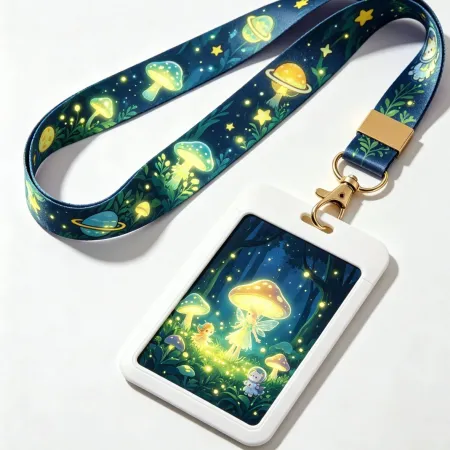
- Who welds the holder? — high-frequency welding of PVC sheet is a different trade from weaving. If it is outsourced, ask who to, and whether the holder can be sampled with the strap in one shipment.
- Where is the test done? — a laboratory on site can test a run the day it is woven. A third-party laboratory meeting a deadline tests what was sent, which may not be what ships.
- Can I see the order file for a past job? — a factory keeps the sett, the dye recipe, the print file and the test record for a job it made. A trader keeps a purchase order.
Read the file for what is missing
A capability file is more useful for its gaps than its photographs. If it lists looms and a dye line but no holder process, the holder is bought in. If it lists certificates but no test method, the numbers come from somewhere else. Ask for the process list first, the machine list second and the certificates third — in that order, the gaps are obvious before the sales conversation starts.
What Fifteen Years on One Site Buys a Buyer
Longevity is not a virtue in itself, but the things that accumulate on a site over fifteen years are exactly the things a repeat order depends on.
A sett library
Every width has a house sett learned on the loom, including how much the greige has to be woven over to land on the finished figure after dyeing. That knowledge is not in a textbook; it is a set of notebooks and habits. It is also why a quotation can carry a finished width and a shrinkage allowance together rather than promising one and hoping for the other.
A dye recipe archive
A shade approved three years ago can be repeated if the recipe was recorded with the fibre, the liquor ratio and the line speed. Without that, a reorder is a new match, and a new match on a small quantity is where colour drift enters a programme.
A base cloth already qualified
Most new lanyard programmes reuse a base cloth that is already running for another product, which turns development into a print and assembly exercise rather than a new weave. The practical effect on a schedule is measured in weeks, and the effect on risk is larger still: the cloth already carries its test history.
Six Things to Confirm Before Placing an Order
A short checklist keeps a factory conversation on the processes rather than on the pictures.
- Site address and floor area — one address for weaving, dyeing, printing and assembly, or several.
- Machine list by process — looms, dye line, print equipment, welding or stitching, and the hardware bench.
- Which steps leave the site — a declared list, not a denial that anything does.
- Test method and gauge length — named on the report, on the assembled product.
- Retained sample policy — whether an approved piece is kept, and for how long.
- Document set per shipment — what travels with the goods and who signs it.
The product is simple enough that the factory question is the whole question. A card holder programme touches the custom lanyard range and a holder line, the strength and fastness data comes from the in-house laboratory, and new development runs through OEM and ODM development.
FAQ: Custom Lanyard Card Holder Factory
How do I tell a factory from a trading company?
Ask which processes happen at the address on the quotation, then ask for the machine list for each one. A factory can answer both from memory; a trader has to check with somebody. A video call walked through the production floor settles it faster than any document.
Does the holder have to be made in the same place as the strap?
It does not have to be, but if it is not, the colour match becomes a negotiation between two suppliers and the approved sample becomes two samples. For a programme where the holder and the strap are seen together, one site is worth more than a marginally better unit cost.
What does a capability file usually contain?
A process list, a machine list, the range of widths and holders, the test methods available, the certificates held with their scope, and the packing options. A useful one also states what is not done on site, because that is the information a buyer needs to plan around.
Is a smaller factory a risk for a large programme?
It depends on whether the capacity is inside the site or borrowed from somebody else's. A small site that owns its looms and its dye line can run a steady programme; a small site that brokers everything is exposed to the first busy month at its supplier. Ask how a peak month is handled before placing a seasonal order.
What should the first order look like?
Start with a sample that includes the holder, the strap and the hardware assembled, then a modest first run in the colours that will actually be sold. Approving three colours you will not reorder spends the sampling budget on the wrong things, and a first run that exercises the real construction tells you more than a large run of a simplified one.
The right custom lanyard card holder factory is the one that can weave, dye, print, fabricate the holder, fit the hardware and test the result without sending the work down the road. Everything else — the catalogue, the certificates, the photographs — is easier to arrange than that.
Why Xinxiangrui for Custom Lanyard Card Holder Factory
Since 2011 the same Dongguan site has run needle looms, a continuous high-temperature dye line, print equipment and a hardware bench, which is why a custom lanyard card holder factory conversation here starts with processes rather than with pictures. A sett and its shrink allowance are quoted together, and the test record describes the roll that ships. Tell us your card holder spec and a matched construction comes back to you.