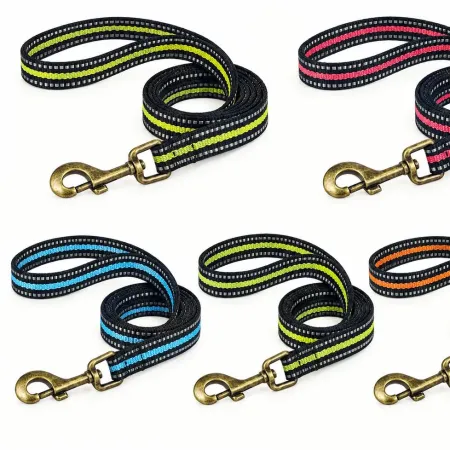
Pet Reflective Webbing Manufacturer: Three Things You Cannot Buy In
A manufacturer is asked for a product and is really being asked whether the same product will exist in three years. Pet reflective webbing manufacturer is a phrase that promises continuity, and continuity rests on three things a buyer cannot inspect in a sample: where the yarn comes from, where the optical film comes from, and who is standing at the coating line. Fifteen years on narrow woven fabric since 2011 in Dongguan is mostly a statement about those three, since a plant that had none of them would not have lasted.
This guide covers the three capabilities that separate a manufacturer from an assembler, the questions that expose each one, why a substitute material is a bigger risk than a higher figure, six lines a manufacturer brief should carry, and the two things that decide what happens in year three.
Pet Reflective Webbing Manufacturer: Three Capabilities
Behind every reflective band there are three separate supply chains that meet in one place. A manufacturer owns or controls all three; an assembler buys the output of all three and joins them.
| Capability | The question that tests it | A good answer sounds like |
|---|---|---|
| Yarn supply | Which spinner, and what happens if they stop that count | Two approved sources, with a tested substitute already on file |
| Optical material | Which film or bead supplier, and has it changed in three years | A named supplier, a stated change, and the tests run on the new one |
| Coating skill | Who sets the line, and how long have they set it | A name, a tenure, and a second person who can take over |
The third row is the one nobody asks about and the one that decides quality most often. Coating is a craft of small adjustments: a knife gap a fraction wider on a humid morning, an oven zone raised by a few degrees because the line speed changed, a decision about whether a streak is worth stopping for. Those judgements live in a person, and a plant with one experienced operator and no second is a plant with a single point of failure that no certificate describes.
A substitute is a change of product
A base band clearing 2000N at 25 mm can be woven from more than one yarn, and the two will not coat identically: one grips a binder better, one takes a shade differently, one shrinks more in a wash. When a yarn is substituted without a new test, the figures on file describe the old band. That is why the second question in the table is the one worth pressing.
Three Signs a Manufacturer Is Really an Assembler
Every technical question is answered with a range
A plant that coats its own band knows that a 25 mm strip with a given binder holds within a narrow band of values and can state a typical figure. An assembler who buys coated roll from several converters answers with a range wide enough to cover all of them, because a narrower answer would be wrong for some of the stock. A range is not dishonesty; it is the signature of a business that resells rather than makes.
The minimum is a container
An assembler buys in bulk and sells in bulk, so a first order below a certain size is not worth the handling. A manufacturer with its own looms can run a short length as a beam alongside other work, and is more likely to accept a modest first order because the constraint is scheduling rather than purchasing. The size of the smallest order a supplier will discuss is a rough map of where the material actually comes from.
Samples arrive without a lot number
A sample cut from a production run carries a lot number in the plant's own records, and the number can be quoted. A sample cut from a stock roll bought in has nothing behind it but the roll it came off, and even that is often unknown. Asking for the lot number of a sample, and then asking what else was made from that lot, is a small question that reveals whether the sample came out of a process or out of a warehouse.
Six Lines for a Manufacturer Brief
- The annual volume, honestly — a figure that reflects the second year rather than the first, since a supplier plans capacity on the repeat.
- The construction and its tolerances — width, weave, coating and shade, each with the band that will be accepted.
- The figures that must be repeated — the coefficient with its geometry and the tensile value, named as figures that will be re-checked on later lots.
- The substitution rule — what may change without notice and what requires a new sample, written before it is needed.
- The order pattern — how many times a year, in what sizes, and whether the mix is stable enough to plan a beam.
- The records wanted — retention period, document set and who signs, since a manufacturer is being bought partly for its file.
The first line is uncomfortable and worth answering anyway. A supplier allocates looms and coating time on the basis of what it expects to make, and a buyer who overstates a first order to look important is a buyer whose second order arrives to a schedule built for somebody else. An honest first figure with a stated intent for the following year produces a better plan than an inflated one, because the plan is made of time rather than of enthusiasm.
- Two sources per input — a yarn and a film each with an approved alternative, so a closure at one supplier does not stop a line.
- A retained standard per construction — the physical reference that makes a reorder a comparison.
- A second operator trained — the least visible and most useful insurance in a coating plant.
- A written change history — a page that says what was substituted and when, which is what a complaint three years later is answered from.
None of this is visible in a swatch, and all of it determines whether the swatch can be reproduced. The band itself comes off a polyester webbing beam and through the pet reflective webbing line, and the test record for each lot is written against that lot, which is the plainest evidence that a manufacturer is a manufacturer.
Two Things That Decide Year Three
Whether your order is a filler or a line
Every plant has a few customers whose orders set the schedule and many whose orders fill the gaps. The distinction is not about size alone; a small customer with a predictable, repeatable requirement can be easier to plan than a large one that changes specification every season. What moves a buyer from one category to the other is the reliability of the pattern, and it is worth asking directly where a given order sits in the plan, because the answer explains a delivery date better than any promise.
Whether the file survives the people
Fifteen years is long enough for a plant to have changed staff, suppliers and equipment, and the question is whether the knowledge moved into the file or left with the people. A construction sheet with a revision number, a retained sample per lot and a written change history are what make a plant's experience transferable rather than personal. That is the real content of an established manufacturer: not age, but the amount of its own history it can still read.
FAQ: Pet Reflective Webbing Manufacturer
How do I tell a manufacturer from an assembler?
Ask for the lot number behind a sample, and for the second source of the yarn. An assembler can produce neither, because the lot belongs to whoever ran the line.
Does a longer history matter?
Only if the history is written down. A plant that has run for fifteen years and can produce a construction sheet from year three is a different proposition from one that remembers.
Why does the coating operator matter?
Because the settings are adjusted by judgement all day. A plant with one experienced operator and no second has a single point of failure that no certificate records.
What if a yarn is discontinued?
A tested substitute already on file makes it a scheduling matter. Without one, it becomes a new development project in the middle of a season.
Can a small first order still be placed?
Often, where the plant owns its looms and can run a short length alongside other work. The limit is then scheduling rather than purchasing.
Pet reflective webbing manufacturer is a claim about three supply chains meeting in one place, and about a file that survives the people who made it. Ask for the lot number, the second source and the change history.
Why Xinxiangrui as a Manufacturer
A narrow-fabric manufacturer of this kind keeps three supply chains on one site, and this pet reflective webbing manufacturer does: yarn through the loom, the optical layer through the coating line, and both under the laboratory that signs the figures. Fifteen years since 2011 shows up as a shelf of constructions rather than as a claim about time, and a 25 mm base band clearing 2000N is one line on it. Give us the application and the load it must carry, and the construction follows.