Polyester Burlap Ribbon: Burlap Is a Look, Not a Fibre
A polyester burlap ribbon is a woven polyester band that has been built to look like jute. The distinction is not pedantic, because burlap is a word for a cloth made of a plant fibre and the ribbon in question contains none of it. On a shelf the two are hard to tell apart at arm's length. On a label, in a customs file and in front of a customer who bought the product believing it was natural, they are entirely different objects.
This guide covers what the look actually consists of, what polyester does better than jute and what it cannot do at all, how a fibre declaration should read, six lines a brief should carry when the finish matters as much as the construction, and the two claims that must not be made about a synthetic burlap.
Polyester Burlap Ribbon: The Look and What Makes It
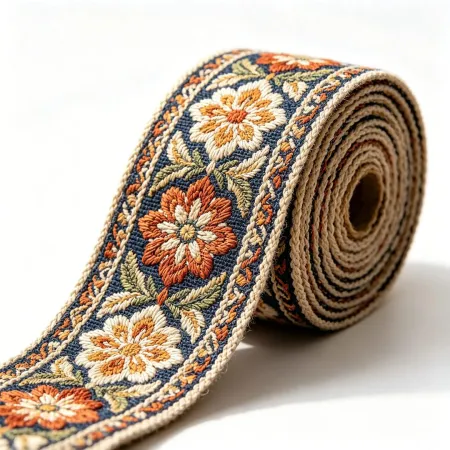
The burlap appearance comes from three things rather than from the fibre: a coarse yarn with visible thickness variation, an open plain weave that lets light through, and a colour somewhere between flax and straw. A polyester ribbon can reproduce all three, and the reproduction is more controllable than the original because the yarn is made rather than grown.
| Property | Jute burlap | Polyester burlap |
|---|---|---|
| Shedding | Fibres come off on hands, clothes and everything it touches | Almost none, because the filaments are continuous |
| Smell | A distinct vegetable odour that strengthens when damp | Odourless, which for a sealed gift pack is an advantage |
| Colour consistency | Varies with the crop, so a reorder is a new shade | Dyed to a reference, so a reorder repeats |
| Moisture | Absorbs water, stiffens, and can stain pale goods | Takes up little water and dries without marking |
| End of life | Cellulosic and able to break down in soil | A thermoplastic that does not, whatever it looks like |
The last row is the one that decides which product a buyer actually wants. Every advantage in the first four rows comes from the same property that makes the fifth row a limitation: polyester is continuous, uniform and unreactive, and those are exactly the reasons it does not rot. A brand that wants a rustic look for a photograph and a compostable story for its packaging is asking for two different ribbons.
A fibre declaration has to name the fibre, not the cloth
Burlap, hessian and jute are words a customer recognises and a customs officer does not accept as a fibre content. A ribbon made of polyester is declared as polyester, whatever the surface looks like, and a label reading burlap on a synthetic product is a misdescription rather than a style choice.
Three Documents This Product Touches
Fibre content on the label
Markets that regulate textile labelling require the fibre composition as a percentage, and the requirement applies to ribbon sold as a retail item in the same way it applies to a garment. A pack of pre-cut burlap-look ribbon with a header card is a textile product on a peg, and the card is the label. Writing rustic jute style on a card without a fibre content is the kind of gap that is invisible until a retailer's compliance team reads it.
Restricted substances in the dye
A natural-look product attracts requests for natural dyes, and the request is usually about the absence of certain azo colourants rather than about the origin of the dyestuff. The useful document is a test report on the actual shade rather than a general statement about the mill, because a restricted substance question is answered per colour and not per company. A straw shade and a deep olive are two different chemical questions even when they come from the same dye line.
Anything added to make it stiff
Burlap-look ribbons are often given a finish to hold a bow shape, and that finish is a chemical addition that has to appear in a declaration if it is present in quantity. A buyer comparing two samples that feel equally firm may be comparing a dense weave with a treated one, and only one of them adds a substance to the material list. Asking whether the hand comes from the weave or from a finish is a question that belongs in the first email.
Six Lines for a Rustic Brief
- The fibre, stated plainly — polyester, a blend, or jute; the look does not settle this question and the label does.
- The shade and its reference — straw, flax and sand are three different colours and only one of them matches the sample on the desk.
- How open the weave should be — the see-through quality is part of the look and part of the strength.
- Whether the hand is woven or finished — a treated ribbon adds a substance to the declaration and softens in humidity.
- The label text and the market — a fibre content and a country of origin, checked against the destination rather than assumed.
- The edges at the cut — an open weave unravels at a cold cut, so a sealed or pinked end is a specification and not a courtesy.
The sixth line matters more on this construction than on a satin. An open plain weave holds its shape by friction between the yarns, and once a cut end begins to release, the loss travels along the ribbon rather than stopping. A hot cut seals the thermoplastic yarns and ends the problem; a cold cut on a rustic ribbon produces a fringe that grows every time the roll is handled.
- Keep the two fibres apart in the warehouse — a jute roll beside a polyester one is a mis-pick waiting to happen.
- Write the fibre into the artwork — the header card is printed once and lives with the product.
- Test the shade, not the company — a restricted substance report is specific to a colour.
- Ask for a cut end in the sample — a length with two finished ends shows what the delivered pack will look like.
The polyester ribbon range includes rustic constructions woven on the same looms as the polyester webbing that goes into custom spec bags, so a shade can be matched across a ribbon and the bag it ties. A 25 mm webbing base clears 2000N; a rustic ribbon in an open weave is chosen for how it looks and how it holds a knot.
Two Claims Not to Make
That it is natural
A burlap look invites the word natural, and on a polyester product the word is a claim about origin that the material does not support. It is not a small risk: the phrase travels into retail copy, marketplace listings and sometimes into the packaging itself, and correcting it after a print run means new cards, new photographs and a conversation with every retailer holding stock. The safe language describes appearance rather than origin — a woven texture, a straw shade, an open weave.
That it breaks down
A compostable or biodegradable claim on a polyester ribbon is wrong in a way that is easy to test and expensive to defend. The material's durability, which is the reason it was chosen over jute, is the same property that prevents it from breaking down. A brand that needs the claim should be buying jute and accepting the shedding, the smell and the crop-dependent shade; a brand that needs the consistency should be buying polyester and describing it accurately.
FAQ: Polyester Burlap Ribbon
Is polyester burlap actually burlap?
No. Burlap is a jute cloth. A polyester product reproduces the texture and the shade, and contains no jute at all.
How should the label read?
With the fibre content as a percentage, in the wording the destination market requires. The appearance can be described in marketing copy; the fibre belongs on the label.
Can it be printed?
Yes, and better than jute: an open weave still presents a flatter surface than a hairy natural yarn, and a light colour prints cleanly.
Why does a rustic ribbon fray at the cut?
An open weave relies on friction between yarns. A sealed end holds; a plain cut end releases, and the loss travels inward with handling.
Does it hold a bow as well as jute?
Better in most cases, because the yarns are uniform and the ribbon does not soften with damp. A treated version holds an even crisper shape at the cost of an added finish.
A polyester burlap ribbon is a texture built from a filament, not a plant. Say the fibre on the label, keep the marketing focused on appearance, and the product will do everything asked of it except the one thing it cannot.
Why Xinxiangrui for Rustic Ribbon
Yarn and weave are the two decisions behind a polyester burlap ribbon, and both are made on the loom rather than in a finishing house. Here the loom, the dye line and the cutting bench sit in one 8,000+ m² plant in Dongguan, so a shade can be matched across a ribbon and the bag it ties. Give us the look you want and the market it ships to, and the construction follows.