2 Inch Nylon Webbing: One Width Across Twelve Categories
A 2 inch nylon webbing band is fifty millimetres, and that one width appears on bag shoulder straps, lawn chairs, cargo tie-downs, harnesses, pet leads and a dozen other products that have nothing to do with one another. The reason is simple: fifty millimetres is where a strap becomes comfortable on a shoulder and strong enough to be worth fitting with real hardware. The differences between those products are not in the width but in the four things built on top of it.
This guide covers the four variables that turn one width into many products, three examples of how the same face becomes a different part, six lines a two-inch brief should carry, and the two signs that a programme is really one product wearing several names.
2 Inch Nylon Webbing: The Width That Serves a Dozen Products
Once the width is fixed at 50 mm, four variables do the rest of the work. A programme that varies them deliberately gets a family of parts; one that varies them by accident gets a warehouse of near-duplicates.
- Thickness — a bag strap wants to fold over a ring; a chair band wants to resist folding entirely, and the two are the same face at different gauges.
- Weave style — flat for a clean face that prints well, twill for a diagonal line that wears longer where it rubs.
- Finish — dyed, water-repellent, or left natural, which changes both the look and how the band behaves when wet.
- Edge — a woven selvedge, a hot cut, or a folded and stitched edge, each of which changes how the band feels where a hand grips it.
| Application | What decides the construction | Where it usually fails |
|---|---|---|
| Bag shoulder strap | Fold around a ring, edge comfort | Seam at the ring, edge fray |
| Chair and seating band | Resistance to sag and to sun | UV loss of strength, creep at the fixing |
| Cargo and utility tie-down | Low stretch, high break, abrasion at the hook | Rub through at a steel edge |
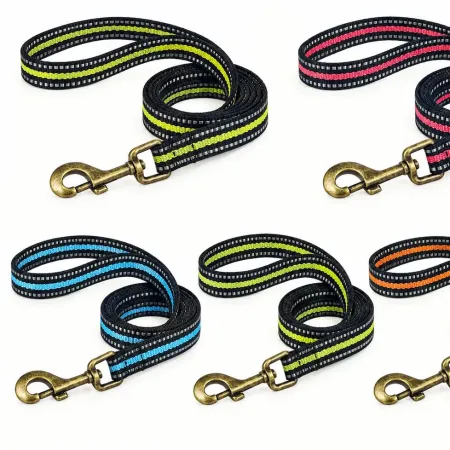
| Pet lead and harness | Shock absorption, hand feel, colour range | Hardware, and dirt in the weave |
The depth is in the base, not the catalogue
A factory that already weaves for bags, seating, pet and tie-down work does not start from nothing when a new application arrives; it starts from a base cloth that has been dyed, finished and sewn before. That is why a new two-inch part can be quoted off an existing construction instead of a fresh development, and why the sensible first question to a supplier is which existing base is closest rather than what a new one would require.
Three Ways One Face Becomes a Different Part
The bag strap: thinner, softer, folded
A shoulder strap is judged against a body, so the construction goes thinner and slightly softer, and the edge becomes the whole story because that is what touches a collarbone. The band is usually folded at the ring and stitched with a box-and-cross, and the fold is where the load lands. A strap that feels good on a hanger can still cut into a shoulder after an hour, and the fix is usually the edge treatment rather than the weave.
The chair band: thicker, flatter, tensioned
A seating band is tensioned between two rails and asked to stay flat under a person, so it goes thicker and denser and the edge matters less than the face. Its enemy is not abrasion but creep and sun: a band that relaxes sags, and a band that loses strength to ultraviolet light fails at the fixing after a season outdoors. The same fifty millimetres, engineered in the opposite direction to the bag strap.
The tie-down: denser, lower stretch, harder wearing
A tie-down needs the load to stay where it was put, which means low stretch at the working load rather than a high peak figure, and the band usually rubs a hook or a rail so the face has to take abrasion. A denser weave and a tighter pick count do that, and the trade is a stiffer band that is harder to thread. Three products, one width, three different answers, and none of them better than the others.
Six Lines for a Two-Inch Brief
- The product, not the width — say what the band does, because the width is already decided and the four variables are not.
- The load, and whether it is static or shock — a hanging bag and a lunging dog are different problems wearing the same width.
- The edge a hand will touch — selvedge, hot cut or folded, stated explicitly, because this is what customers notice first.
- The fixing method — sewn, riveted, stapled or threaded, since each one changes how much band sits past the fixing point.
- The exposure — sun, salt, chlorine, mud or a hot wash, because a pet lead and a boat tie-down are not the same environment.
- The palette — how many shades the range needs, since a pet programme often carries six colours where a tie-down carries one.
The sixth line is the one that separates a pet programme from an industrial one before any sampling begins. A range in six colours needs six dye lots, and a shade that is approved in one colour tells you nothing about the next. Naming the palette early lets the dye house plan the sequence, which is cheaper than running them one at a time and gives a better chance that red and navy sit together without one looking dull beside the other.
Where the range spans categories, a single reference construction keeps the family honest. A 1 inch nylon webbing base clears 2000N, and the 50 mm band across bags, seating and tie-downs is built on the same weave at a heavier gauge, so the test report can present the family rather than a set of unrelated parts. Where a lower stretch or a different hand is needed, a polyester webbing comparison on the same rig shows what changes, and custom development can hold the thickness so a customer recognises the range by feel.
Two Signs a Programme Is Secretly One Product
Five part numbers, one construction
When the same band turns up under five names because five products were developed separately, the symptom is a warehouse that cannot substitute one for another and a buyer who cannot tell them apart on the shelf. Consolidating to two or three constructions usually removes inventory without changing the products, and the consolidation is only possible when thickness and finish were written down rather than approved by eye.
Every product asking for its own shade
A family that carries twelve near-blacks has stopped being a family and become twelve programmes, each with its own dye lot and its own approval. A palette of four shades, agreed once and reused across the products, is what lets a range look deliberate and lets the dye house run efficient batches. The saving is not only in the dyeing; it is in the fact that a customer can buy two products and have them match.
FAQ: 2 Inch Nylon Webbing
What is 2 inch in millimetres?
50.8 mm exactly, quoted and sold as 50 mm. Hardware sold as 50 mm usually has the clearance, but check the slot on anything load-bearing.
Can one construction serve several products?
Often yes, at some cost in optimisation. A band that suits a bag and a chair will be a compromise on both, and the compromise is worth taking when volumes are modest.
Why does my chair webbing sag?
Either it crept under tension or it lost strength to sun. A denser band and a fixing that grips rather than pierces both help, and shade matters more outdoors than most buyers expect.
Is 50 mm too wide for a bag strap?
For a heavy tote or a duffel it is normal; for a small shoulder bag it looks out of proportion. Width is a visual decision as much as a load one, and the two rarely disagree by much.
How many colours should a range launch with?
Four to six is typical for a pet or consumer range and one or two for industrial work. Each extra shade is another dye lot to approve and another item to stock.
A 2 inch nylon webbing range is one width and a handful of deliberate choices. Fix the thickness, the weave, the finish and the edge, reuse them across products, and the catalogue stays a family instead of drifting into a collection of near-identical parts nobody can tell apart.
Why Xinxiangrui for 2 Inch Nylon Webbing
Fifty millimetres is one width serving a dozen categories, and the depth behind it is what keeps those categories from becoming a dozen separate products. Three production lines across 17 product categories and 65 items mean the base behind a 2 inch nylon webbing band already exists for bags, seating, pet and tie-down work, so a new application reuses a construction instead of starting one. Tell us the category and the load, and the nearest construction comes back.