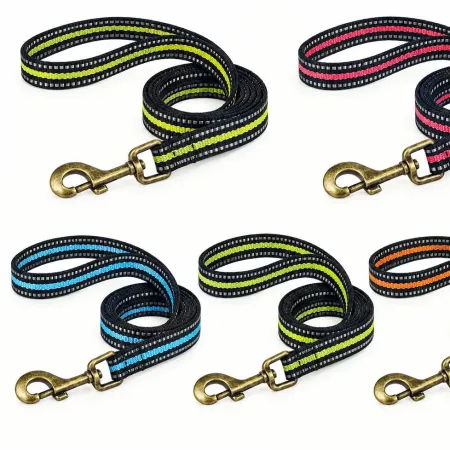
Nylon Imprinted Pet Leashes in Bulk: Repeat and Batch
Nylon imprinted pet leashes in bulk are ordered on a picture and delivered on a repeat, and the gap between those two things is where a large order becomes expensive. A motif that looks right on a screen has to tile along a band, print in register across a width, survive being cut into individual leads and stay consistent across several dye lots. Each of those is a number, and each number is easier to fix before the run than after it.
This guide covers the three figures that decide a bulk print layout, why the print direction has to be agreed before the cut, why shade drift arrives as a complaint months later, six lines a bulk brief should carry, and the two things a strike-off cannot tell you about a shipment of several thousand pieces.
Nylon Imprinted Pet Leashes in Bulk: Three Figures First
A print layout for a narrow band is arithmetic, and the arithmetic is settled before a single metre is printed.
- The repeat length — the distance from one motif to the next, which sets how many appear on a lead of a given length and whether the pattern ends cleanly at the tip.
- The bands across the width — how many leads are printed side by side before slitting, which decides the press setup and the registration risk at the outer edges.
- The roll length and the yield — total metres against the number of finished leads, including the length lost to the join, the test piece and the cut allowance.
| Figure | Decides | What goes wrong |
|---|---|---|
| Repeat length | Motifs per lead, and where the last one lands | A motif sliced in half at the tip |
| Bands across | Press setup and how much is lost to trim | Blur at the outer edges from registration |
| Roll length | Total metres needed for the order | A shortfall discovered at packing |
| Cut allowance | How much extra to print for setup and tests | A second run at short quantity and a shade mismatch |
Printing does not change what the band can hold
An ink film on a 25 mm band that clears 2000N is a surface layer, and the load path through the weave is untouched by it. That keeps a bulk order simple: the printed band can be specified on the same construction as the plain one, and the print decisions stay in the print shop rather than spreading into the weaving plan.
Three Things That Decide a Bulk Run
The repeat sets the quantity per metre
A repeat of 200 mm on a 1.2 metre lead gives six motifs, with a little space at each end; a repeat of 150 mm gives eight and lands closer to the tip. Neither is better, and the choice changes how many metres are needed for a given number of leads and how the product looks coiled on a shelf. Fixing the repeat first also tells the designer how much room a motif has, which prevents a drawing that has to be redone smaller.
The print has a direction
A motif with any asymmetry, such as lettering or an animal facing one way, has an orientation, and the cut has to respect it on both ends of the lead. On a narrow band printed in a continuous run, one end of every lead will show the motif the other way up unless the layout accounts for it. That is a layout decision, and it is invisible until the first carton is opened.
Shade drift arrives late
A large order spread across several dye lots will show a slight shift from the first lot to the last, and the shift is measured against the approved standard rather than between the pieces in one carton. Because a carton usually contains one lot, the problem surfaces when a shop puts two shipments side by side, which is months after delivery. Keeping a retained standard and stating the tolerance in the brief turns that into a managed difference rather than a dispute.
A fourth colour is not simply more ink. Each colour is a station on the press and one more chance for the register to move, and on a narrow band printed several lanes across a small shift in one station shows as a fringe on the outer lanes. Two colours with a strong shape usually read better at a metre than four with soft edges, and they hold their position more reliably over a long run.
Six Lines for a Bulk Print Brief
- The repeat in millimetres — and the tolerance, because a repeat that drifts across a long run shows as a creeping gap at the tip.
- The usable print width — inside the cut allowance, not the full band, so the motif never loses an edge to the blade.
- The orientation rule — which way the motif faces, and what happens at the second end of the lead.
- The colour and the substrate — a print on a pale band and the same print on a dark band are two recipes, and a Pantone reference fixes one of them.
- The extra metres — for setup, for the strike-off and for the test pieces, agreed in advance so the order is not short at the end.
- The packing unit — leads per bag, bags per carton, and whether the carton is mixed by shade or single lot.
The packing line is where a bulk order is either easy or painful for the buyer's warehouse. A carton that contains one shade is simple to receive and simple to reorder; a carton mixed across two lots is faster to pack and creates an invisible inconsistency inside a single delivery. Deciding which of those the channel prefers is a commercial question, and it is worth asking before the layout is finalised because it changes how the run is scheduled.
Imprinted leads are printed on a nylon webbing base at 20 mm or 25 mm, and dye-sublimation gives the widest colour range while holding detail on a polyester webbing surface. Because printing and weaving are on one site, a change to the repeat or the width is a work order rather than a conversation with a third party. The abrasion result should say whether it was measured across the print, and the packing option should be fixed alongside the layout.
Two Things a Strike-Off Cannot Show
How the print behaves at the slitting edge
A strike-off is usually a short piece from the middle of the web, where registration is best and the blade has not yet run. On a full run the outer bands sit closest to the trim, and that is where a motif shows a sliver of unprinted edge or a blurred boundary. Asking for a sample cut from the edge of the web, not the centre, is a small request that reveals the part of the layout most likely to be criticised.
How two cartons look side by side
A single strike-off is consistent with itself and says nothing about the relationship between lots. The question a shop will ask is whether the second delivery matches the first, and that can only be answered by holding two lots together under the same light. Retaining a piece from each lot, labelled with its date, builds the record that makes the next order a confirmation rather than an experiment.
FAQ: Nylon Imprinted Pet Leashes in Bulk
What repeat should a lead use?
One that divides evenly into the finished length, so the last motif is complete. A partial motif at the tip looks like a production error rather than a design.
Can the print go right to the edge?
It can be printed there and it will not survive the slit. Leave a margin inside the cut allowance so the trim removes only plain band.
Why do two lots look different?
Different dye lots, and sometimes a different print run. Both should be measured against a retained standard rather than against each other.
Does the print crack when the lead bends?
A thin film on a flexible band bends with it. A heavy ink layer on a stiff band will craze at a tight fold, which is why the print area and the fold should not coincide.
How much extra should be printed?
Enough for setup, the strike-off and the test pieces. A shortfall discovered at packing means a second run and a shade difference.
Nylon imprinted pet leashes in bulk come down to three figures and one orientation rule. Fix the repeat, the usable width and the extra metres, and the print run delivers what the picture promised.
Why Xinxiangrui for Nylon Imprinted Pet Leashes in Bulk
Bulk print orders arrive from 50+ markets with 200+ active partners behind them, and the recurring lesson is that the layout decides the outcome. Dye-sublimation printing sits alongside the looms and the dye line on one site in Dongguan, so a repeat change, a width change and a packing change are handled as one work order, with customs paperwork and retail-ready packing included. Send us the drawing, the width and the target market — we reply with a construction.