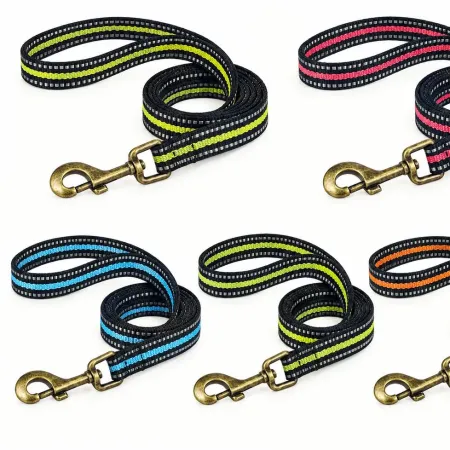
High Visibility Pet Reflective Webbing: Whose Standard?
High visibility is two requirements wearing one phrase: being seen in daylight and being seen in a headlight. High visibility pet reflective webbing is sold on both, and the two are measured by different methods that no single number covers. That would be a technical curiosity if the phrase also arrived from different markets with different expectations attached, which it does; a buyer in one country asks for a class, a buyer in another asks for a colour, and a buyer in a third asks only that the band look bright in a photograph.
This guide covers the three things a high-visibility band can do, why the pet category has no mandatory standard to point at, how the same request translates across markets, six lines a high-visibility brief should carry, and the two questions that decide whether one band can serve several countries.
High Visibility Pet Reflective Webbing: Three Jobs, One Phrase
A band can raise visibility by being conspicuous in daylight, by returning light at night, or by both. Each is produced differently, ages differently and is measured differently, and a brief that names only the phrase leaves the supplier to choose one on the buyer's behalf.
- Fluorescent colour — a dye that converts ultraviolet into visible light, which makes the band stand out against foliage and tarmac in daylight and does nothing at night.
- Retroreflection — an optical layer that returns a beam towards its source, which works only when a light is aimed at it and is otherwise a grey band.
- Combination — a fluorescent base with a reflective stripe, which covers both conditions and is what most safety clothing does.
The third option is the one most pet ranges settle on, and it is also the one most often under-specified, because a fluorescent base with a stripe can be made at almost any ratio. The ratio decides which condition the product is really optimised for, and it is a decision the buyer should make rather than inherit.
No mandatory standard covers a dog collar
High-visibility clothing for workers is regulated in most large markets, and those rules are written for garments worn by people at work rather than for accessories on an animal. A pet product can borrow the test methods and the material grades, and it cannot claim conformity to a garment standard it was never assessed against. What fills the gap is the buyer's own specification, which is why the same phrase produces different goods in different countries.
The Same Request in Four Markets
| Market type | What is usually asked for | What it means for the band |
|---|---|---|
| Northern Europe | A strong reflective stripe and a documented grade | Optics lead, colour follows, and paperwork is expected |
| North America | A fluorescent lime or orange face with a wide silver band | Colour and area are the visible cues, and both are checked by eye |
| Urban Asia | A bright band that photographs well for an online listing | Appearance leads, and consistency between lots matters more than grade |
| Warm climates | A band that survives sun and salt rather than a class rating | Fade resistance and coating adhesion matter more than peak brightness |
A supplier shipping into many markets sees this variety as a matter of course, and the practical consequence is that a single band offered to all four is usually a compromise that satisfies none of them properly. The better answer is one construction with three variables that can be changed without re-engineering the base: the stripe width, the base colour and the optical grade.
Three Things a High-Visibility Brief Should Fix
Which condition matters more
A dog walked before dusk needs a fluorescent face; a dog walked after dark needs optics. A product used at both ends of the day needs a split, and the split should be stated as a proportion rather than left to the pattern. Saying "evening walks, mostly lit streets" is more useful to a mill than saying "high visibility", because it settles the ratio without further discussion.
How many washes it must survive
Fluorescent dyes fade under ultraviolet and detergent, and the fade is gradual enough to go unnoticed until a collar is compared with a new one. A wash count turns that into a number, and it also forces the care instruction to be honest. A band specified for thirty cool washes and then sold to someone who machine washes at sixty degrees will fail in a way that looks like a manufacturing fault to the customer and like misuse to the factory.
How much of the face is optical
On a 25 mm band a 10 mm stripe leaves 15 mm of base, which is a different product from two 5 mm stripes with 15 mm of base between them, even though both cover the same area. A single wide stripe reads as a solid line at distance; two narrow ones read as a pair of lines and can disappear into each other when the band twists. Coverage is an area question and the pattern is a legibility question, and both belong in the brief.
Six Lines for a High-Visibility Brief
- The condition — daylight, darkness or both, and in what proportion, since that single line settles the rest.
- The base colour to a reference — a fluorescent lime or orange named against a physical standard rather than described in words.
- The stripe layout — number of stripes, width and spacing, with the finished widths rather than the artwork's.
- The optical grade and its angles — a coefficient with the geometry it was measured at, so two suppliers can be compared.
- The wash count and temperature — the number of cycles the colour and the optics must survive, and at what setting.
- The market and its paperwork — which country the goods are for, because that decides whether a test report is expected with the shipment.
The sixth line is where a supplier shipping to many destinations earns its keep. The same band can need a different document set for different buyers, and a run split across two markets should carry two files rather than one, because a test report written for one destination is not automatically accepted at another. Getting that right at the order stage costs nothing; discovering it at the port costs a week.
Nothing about the structural side changes with any of this. A 25 mm base band clears 2000N whether its face is fluorescent, reflective or both, so the high-visibility decision sits entirely on top of a load figure that the buyer can treat as settled. That separation is useful when a range has to be widened quickly: the base stays, and the face is what gets re-specified. The constructions are listed on the pet reflective webbing page, the base options on polyester webbing, and the assembled products on pet harness and pet leashes.
Two Questions Before One Band Serves Several Countries
Does the colour survive the sun where it will be used
A fluorescent dye that holds for a season in a temperate market can soften noticeably under a summer of strong ultraviolet, and the market that buys most of a high-visibility range is often the one with the most sun. A band tested only in the factory's own latitude describes a milder life than the product will live. Asking for a light-exposure result, rather than assuming the dye is stable because the swatch is bright, is the difference between a range that photographs well in year one and one that still matches in year three.
Is the same band sold under two claims
A band can be marketed as high visibility in one country and as a fashion reflective accessory in another, and the two claims carry different expectations. Where the same construction is sold under both, the stricter claim sets the standard for the lot, and the looser one benefits from it at no extra work. Where the two are made to different specifications, the cheaper version tends to find its way into the market with the stricter expectation, which is the failure mode worth designing out at the start.
FAQ: High Visibility Pet Reflective Webbing
Is there a standard for pet high-visibility products?
No mandatory one. Garment standards exist for workers, and a pet product can borrow their methods without claiming conformity. The specification is normally the buyer's own.
Is fluorescent the same as reflective?
No. Fluorescent colour works in daylight by converting ultraviolet; reflective works at night by returning a beam. Most high-visibility bands use both, and the ratio is a design decision.
Which colour is most visible?
Yellow-green for the human eye in daylight, and silver-grey for a headlight at night. A lime base with a silver stripe is the combination that covers both.
Does washing dull a fluorescent band?
It does, gradually, and more at high temperature with strong detergent. A cool wash and drying in shade keep the colour and the optics for longer.
Can one band serve several markets?
Often yes, with the stripe width and the grade as variables. What does not travel is the paperwork, which is written per destination rather than per product.
High visibility pet reflective webbing answers two different questions, and different markets weight them differently. Fix the condition, the colour reference and the stripe layout, and one construction can serve several countries without becoming a compromise.
Why Xinxiangrui for High Visibility Pet Reflective Webbing
Shipping to 50+ markets and supplying 200+ active partners means the same phrase has arrived here in most of its variants, and the file for each destination is already written: customs paperwork, retail-ready packing and air, sea or express routing are handled in-house from Dongguan. A band that has to satisfy a European grade and an American colour at once is a specification this plant has made before. Give us the application and the load it must carry, and the construction follows.