Source Factory
Direct wholesale production from our own plant in Dongguan, not a trading desk. Weaving, dyeing, printing, hardware assembly and packing all run in house, with no middleman margin in the price.
Full Customization
OEM and ODM work starts from your drawing: width, weave, colour, hardware and retail packaging. We match Pantone, send a physical sample before bulk, and keep every change on one work order.
Strict QA & ISO Standards
Every batch is checked for width, thickness, break strength and colour fastness before it ships, and the plant runs to ISO 9001 and ISO 14001. Test reports for your batch travel with the goods.
Proven Track Record
Fifteen years of narrow fabric since 2011, 200+ active partners and shipments to 50+ markets. Long-run programmes are what this factory is built for, which is why most customers reorder.
Floral Canvas Tote Bag: Print, Embroidery or Jacquard
A floral canvas tote bag can be made three completely different ways, and the three are routinely confused in a brief because they look similar in a reference photo. A printed flower, an embroidered flower and a woven flower have different minimum sizes, different colour limits, different behaviour in the wash and a different relationship with the fabric underneath.
Choosing the wrong route is expensive in a way that shows up late: the sample looks right, and the production run reveals that the motif could not hold its detail at scale. This guide compares the three routes on the variables that decide whether a floral design can actually be manufactured.
Three Routes to a Floral Canvas Tote Bag
The route decides the resolution, the colour count and the hand of the finished bag. Each has a natural territory.
- Screen print — one screen per colour, so a five-colour floral is five passes. It gives clean flat shapes and a soft hand with water-based ink, and it cannot reproduce a painted petal with tonal shading.
- Embroidery — thread built up in satin and fill stitches. It gives a dimensional, tactile flower with a visible sheen, and it has a hard minimum size: below about 25 mm a flower becomes a coloured blob with no recognisable petals.
- Jacquard weaving — the pattern is woven into the cloth itself, so it cannot fade, crack or peel because there is nothing on the surface to lose. It requires a loom setup and a minimum run, and it constrains the design to what a weave can express.
The table compares the three on the constraints that decide the brief.
| Route | Smallest usable motif | Character after ten washes |
|---|---|---|
| Screen print | 8 to 12 mm per shape, with 1 mm minimum strokes | Softens and fades evenly; plastisol cracks along the weave |
| Embroidery | 25 to 30 mm overall, 2 mm minimum detail | Unchanged, unless the thread itself is not colourfast |
| Jacquard woven | 15 to 20 mm, limited by yarn diameter | Unchanged; the pattern is the cloth |
| Digital print | Very small, but the weave breaks fine lines | Fades gradually; the ground colour dominates |
| Appliqué | 20 mm, with a stitched outline | Edge fraying is the failure mode, not colour |
| Combination | Depends on the base route | Mixed ageing: the print fades while the embroidery does not |
What a Floral Design Asks of Each Route
A floral motif is not one design, it is a set of them: large blooms, small filler flowers, stems and leaves. Each element has a route that suits it.
Large blooms reward embroidery
A 60 mm flower has enough area for satin stitching, shading and a defined petal edge, and the thread gives it a depth that no flat print reaches. The same flower printed looks like a sticker; the same flower embroidered looks like a detail someone paid for. Below roughly 25 mm that advantage disappears and embroidery becomes an expensive coloured dot.
Small filler flowers reward print
The scattered small flowers that make an all-over pattern read as floral are 10 to 15 mm, which is print territory. A five-colour screen print can cover them in a fraction of the time embroidery needs, and the repeat can be placed accurately across a panel.
All-over patterns reward jacquard
If the whole bag should be floral rather than a bag with a flower on it, weaving the pattern into the cloth is the only route that survives abrasion at the base and the handle, because there is no surface layer to wear off. The trade-off is a loom setup and a minimum run, and a palette limited by the number of yarn colours that can be carried.
Check the motif at full size on the finished panel
A floral design approved on a screen at 400 percent looks dense and delicate. Printed at 40 mm on a 12 oz canvas, the same design loses a third of its elements to the weave. Lay the artwork out at 1:1 on the actual canvas before the strike-off, and count how many petals survive; it is a five-minute check that prevents a whole sample round.
Four Decisions for the Brief
A floral brief that answers these four produces a quote that can be compared with another supplier's.
- Route and colour count — print, embroidery or jacquard, and if print, how many spot colours. Each screen is a setup cost and a registration risk, so a five-colour floral is a different project from a two-colour one.
- Motif size and repeat — the overall dimensions of the largest element, the repeat length of the pattern, and its position relative to the seam. A pattern that runs into a seam loses half an element on every bag.
- Stitch count for embroidery — a figure in thousands of stitches, because that is what drives machine time. A 60 mm flower can be 4,000 stitches or 12,000 depending on how it is digitised.
- Fastness requirement — how many washes the floral must survive and at what grade. A thread that is not colourfast will bleed into a pale canvas, which is the one failure that cannot be corrected after production.
Six Questions Before Approving a Floral Sample
All six are visible on a finished sample without destructive testing, which is why they are worth asking early.
- Is the motif the size it will be in production? — a sample printed larger to show detail is a common and misleading practice. Measure the flower, not the artwork.
- Does the pattern break at a seam? — look at the side seam and the base. A floral that is cut mid-petal at every seam reads as a cheap print regardless of the quality of the print.
- Is there backing behind the embroidery? — feel the inside of the bag. Without a stabiliser the stitches pull the canvas out of shape and the motif puckers after the first wash.
- Does the thread match the ink? — on a combination design, an embroidered bloom next to a printed leaf rarely matches exactly. Decide whether that difference is intentional.
- What does it look like after one wash? — embroidery may shrink the panel around it; print may crack on a plastisol base. One washed sample answers both.
- Is the floral placed on a flat panel or across a seam? — a large single bloom belongs on a flat panel with a fixed distance from the seam; an all-over repeat has to be designed with the seam in mind from the start.
Combining Decorations Without Losing the Bag
Many floral totes combine two routes, and the combination is where a good design turns into a heavy, stiff panel.
- Keep embroidery away from the fold — a dense motif on the line where the bag folds will crack the canvas along the stitch line within a season.
- Print the ground, embroider the focus — an all-over printed pattern plus one embroidered bloom gives depth for far less machine time than embroidering the whole design.
- Match the strap to the decoration — a jacquard floral bag with a plain strap looks unfinished, and a striped or patterned strap can carry the theme onto the handle for a small amount of extra weaving.
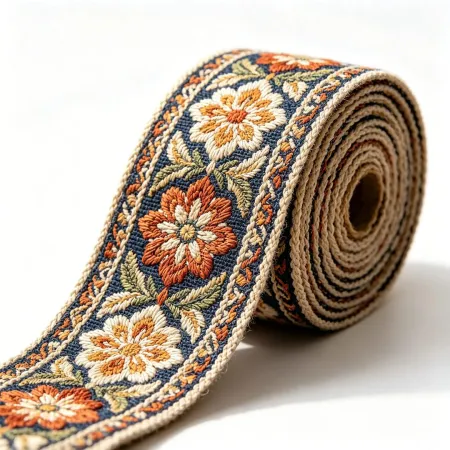
A finished floral tote using embroidery is the embroidered floral cotton canvas shoulder bag, and a second example with a logo mark rather than a motif is the organic cotton tote with embroidered logo. The jacquard route is available on the strap as well as the body, as shown in the jacquard cotton webbing for bag straps, and the wider custom spec bag range covers the finished assembly.
FAQ: Floral Canvas Tote Bag
Is printed or embroidered better for a floral tote?
Embroidery for a single large bloom, print for an all-over scattered pattern. Embroidery below about 25 mm loses its advantage, and print above 100 mm tends to look flat beside a woven or stitched texture.
How many colours can a screen-printed floral use?
Four to six is practical on canvas. Beyond that registration becomes difficult on a textured surface and the print starts to feel heavy. A design that needs eight colours is usually better as a digital print.
Does embroidery make a tote bag stiff?
Locally, yes. A dense motif of several thousand stitches adds weight and rigidity to that patch of canvas. Keep embroidery off the fold line and away from the handle attachment and the bag keeps its drape.
What is a jacquard floral tote?
One where the flower is woven into the cloth on a jacquard loom rather than added afterwards. There is no surface layer to wear, which makes it the most durable option, and it needs a loom setup and a minimum run.
Can the floral pattern match across the seam?
On a printed panel it can be positioned to break at a natural point, and on a woven pattern it can be planned into the repeat. It cannot be held consistently on a small motif placed by eye, which is why the position needs a tolerance in the specification.
A floral canvas tote bag is a route decision before it is a design decision. Large blooms want embroidery, scattered repeats want print, and a fully patterned cloth wants the jacquard loom. Once the route is fixed the constraints are known — minimum motif size, colour count, stitch count — and the design can be drawn to them instead of being redrawn after the sample.
Why Xinxiangrui for Floral Canvas Tote Bag
Xinxiangrui Webbing runs the three routes that a floral canvas tote bag needs — jacquard weaving, dye-sublimation printing and in-house hardware assembly — inside one Dongguan plant, across 17 product categories. A pattern can be trialled as a woven strap and an embroidered panel in the same development round instead of two suppliers' calendars. The handle webbing is woven on site to 2000N+ break strength, and a colour is matched on the actual fibre. Give us the application and the load it must carry, and the construction follows.