
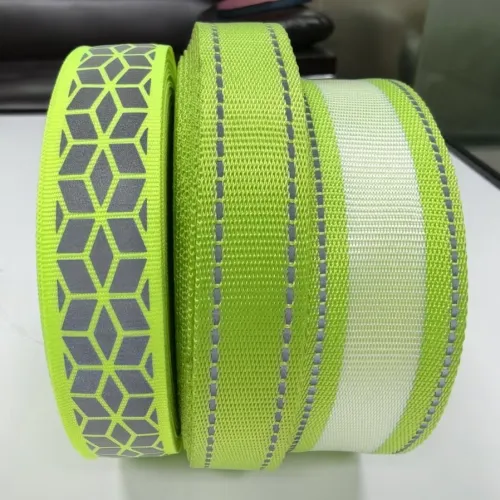
Features
Why Choose Xinxiangrui Webbing?
Source Factory
Direct wholesale production from our own plant in Dongguan, not a trading desk. Weaving, dyeing, printing, hardware assembly and packing all run in house, with no middleman margin in the price.
Full Customization
OEM and ODM work starts from your drawing: width, weave, colour, hardware and retail packaging. We match Pantone, send a physical sample before bulk, and keep every change on one work order.
Strict QA & ISO Standards
Every batch is checked for width, thickness, break strength and colour fastness before it ships, and the plant runs to ISO 9001 and ISO 14001. Test reports for your batch travel with the goods.
Proven Track Record
Fifteen years of narrow fabric since 2011, 200+ active partners and shipments to 50+ markets. Long-run programmes are what this factory is built for, which is why most customers reorder.

We Have The Best Solutions for Your Business
Xinxiangrui has made narrow fabric in Dongguan, China since 2011. Our 8,000 m² plant weaves, dyes, prints, cuts and sews under one roof, supplying 200+ active partners in 50+ markets. We produce polyester, nylon, cotton, elastic, reflective and bio-based webbing, ribbon, lanyards, pet leashes, bags and luggage components, from yarn and reflective tape to finished straps and handles.
Because every step stays in one plant, a widening range does not cost tolerance. Our laboratory tests to 2000N+ break strength, 50,000+ Martindale cycles and 1,000+ hours of UV exposure, and every batch carries its own figures rather than a catalogue sample. We work to OEKO-TEX, CPSIA, REACH, RoHS, ISO 9001, ISO 14001 and GRS. Send us your spec sheet and target quantity, and we will recommend the construction that fits.
Pet Reflective Webbing: Two Optical Technologies
Almost every reflective band on the market uses one of two mechanisms, and the choice affects brightness, flexibility and cost in ways that are visible only at night.
| Technology | How it returns light | Strength | Weakness |
|---|---|---|---|
| Glass bead | Bead focuses light onto a mirror layer and sends it back | Bright across a wide angle, flexible, familiar | Performance falls sharply at steep angles |
| Microprism | Moulded cube corners reflect through total internal reflection | Much brighter on axis, holds up at a distance | Stiffer, narrower working angle, less kind to narrow bands |
A number that belongs to the band underneath: a 25 mm base band in this range clears 2000N, and adding an optical layer does not change it. The coating rests on the surface, the weave carries the tension, and the stitching that joins the band to a fitting is untouched by any decision about brightness. That separation is what makes a reflective product predictable: brightness can be changed without re-engineering the part that holds a dog.
The Coefficient and the Angles It Needs
What the unit means
Reflectivity is quoted as a coefficient of retroreflection, in candelas per lux per square metre. The unit is per unit area, which has two consequences a buyer should hold on to: a narrower band at the same coefficient returns less total light, and a wider band at a lower coefficient can return more. Comparing two products by coefficient alone, without the width, compares a material property to a product property.
Why the angles must be printed beside the figure
A retroreflective coefficient depends on two angles: the entrance angle at which light arrives and the observation angle at which it is seen. The same band can be quoted at a very high figure measured almost straight on and a modest one measured at the angle a driver actually views from. A specification that gives a number without both angles is not a weaker specification; it is an unusable one, because two suppliers can report the same band an order of magnitude apart and both be honest.
What the base colour does
The optical layer is thin enough that the base shows through the gaps between beads or prisms. A pale grey base lifts the return; a black base absorbs whatever passes between the optics. The same nominal grade can therefore read as bright silver on one band and dull charcoal on another, and at narrow widths there is less face carrying the effect, so the base becomes a larger variable. That is why the base shade belongs in the brief as a named colour rather than as whatever is on the beam.
Washing Attacks the Edge First
The face of a coated band survives a wash cycle better than its borders do. A woven edge is formed by the weft turning back, so it is slightly thicker and rougher than the face, and a knife riding across it either thins the coating there or rides over and skips. Detergent and agitation work on that ridge first, and after twenty machine washes a narrow band shows a pale matt rim under a raking light while the centre still returns cleanly.
That rim matters more than its area suggests, because it is the part a driver sees edge-on. A collar approaching a car presents its side to the headlamp before it presents its face, so the border is doing a large share of the work in the situation the product exists for. Keeping one strip from the first lot and washing it beside an untouched one turns this into something to look at rather than something to argue about.
Sewing is the step where a reflective band is most often damaged after the fact. A needle passing through the optical layer leaves a line of holes that scatter light instead of returning it, and a stitch run along the centre of the face removes a visible stripe from the product. Both are avoidable by moving the seam to the margin and by choosing a needle and thread that part the coating rather than punching it. On a narrow band the margin is thin, which is why the pattern for a reflective product is best drawn by whoever knows where the optics sit, rather than adapted from a pattern built for a plain band.
Six Lines a Reflective Brief Should Carry
- The width and its tolerance — because a band that measures under the nominal figure will not thread the fitting it was designed for.
- The base band — fibre and shade, since the shade underneath sets the ceiling on how bright the completed band can look.
- The coefficient with both angles — entrance and observation, stated together, or the figure cannot be compared with another supplier's.
- The pattern — full face, twin edge stripes or a repeated motif, because each puts the optical material in a different place relative to wear.
- The care instruction — written for the hang tag, since a hot wash and a tumble dry are what a customer will actually do.
- The fitting it threads through — the measured slot rather than the catalogue size, because coating, folding and stitching each add a fraction of a millimetre.
Four Checks Before a Bulk Order
- Photograph it at a measured distance. A fixed lamp, a camera at driver height and a known distance tell you more about the real product than a hand-held sample in a corridor.
- Look along both borders under a raking light. Coating coverage at the selvedge is where a narrow band differs from a wide one, and where a knife setting shows.
- Wash one twenty times. Not once. The change at the border is cumulative and invisible in a single cycle.
- Fold and rub it against itself. A band on a collar meets its own edge constantly, and an optical layer that scuffs at that contact will go dull where it is folded.
The pet reflective webbing range is coated on bases that are also woven as plain nylon webbing on the same site, which is what makes a controlled comparison possible: identical band, with and without the optical layer. The angle each coefficient was measured at is written into the test record for the lot rather than left to a catalogue line.
Two Mistakes That Leave a Product Invisible
A coefficient quoted without angles
A high figure measured near the normal looks excellent in a document and describes a viewing condition no driver occupies. The specification reads well, the sample passes, and the product is dimmer on a wet road at night than the number suggests. Ask for the pair of angles and compare only figures measured the same way.
A narrow band treated as a small version of a wide one
On a wide band a coating flaw sits among many good patches and the eye averages it away. At 25 mm the same flaw occupies a fifth of the visible width, and the selvedge ridges are a much larger share of the total edge. Narrow reflective work is a tighter process rather than an easier one, and a programme that moves a wide specification down to a narrow width without re-qualifying the coating line will find the difference at the border.
Reflective webbing is a surface product carrying a structural band. Specify the base shade, the coefficient with its angles and the pattern, then test the border rather than the face. What a driver sees at forty metres depends on all three, and none of them is visible in daylight.
Why Xinxiangrui for Pet Reflective Webbing
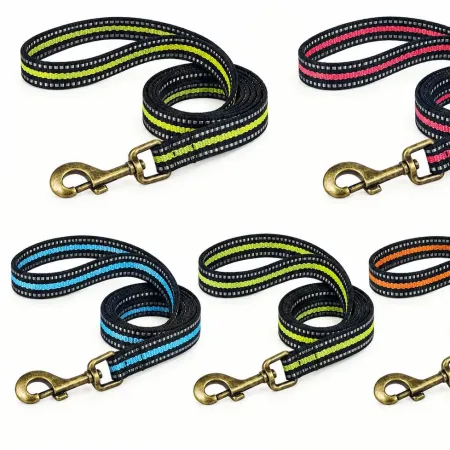
A reflective band is woven on one line and coated on another, and pet reflective webbing made here comes off both lines in the same Dongguan plant, so a change of base shade or coating weight is a work order rather than a shipment between suppliers. We have run narrow fabric since 2011 and record the observation and entrance angles with every coefficient we report. Send the width, the base shade and the distance it must be seen from, and a matched sample comes back to you.
Featured Products
Collection about Xinxiangrui Webbing

User Reviews
What users say about Xinxiangrui Webbing
Frequently Asked Question
Do you have any question?
An optical layer of tiny glass beads or moulded prisms returns light along the path it came from, so a headlamp's beam reaches a driver's eye instead of scattering past it. It works at forty metres in the dark and looks unremarkable on a shelf, because the effect depends on geometry rather than on colour.
Glass bead is brighter across a wide angle and more flexible, which suits narrow bands. Microprism is much brighter on axis and holds up at a distance, but it is stiffer and has a narrower working angle. The choice follows the viewing geometry of the product, not a general preference.
Because retroreflective performance depends on the entrance angle of the light and the observation angle of the viewer. The same band can be quoted at a very high figure measured almost straight on and a modest one at the angle a driver actually views from. Without both angles the number is unusable.
The optical layer is thin enough that the base shows through the gaps between beads or prisms. A pale grey base lifts the return and a black base absorbs it, so the same nominal grade can read bright silver on one band and dull charcoal on another.