Heat Transfer Polyester Webbing: Why the Press Comes After
A heat transfer polyester webbing is coloured by driving dispersed dye into the fibre rather than laying ink on its surface, and that single difference decides the order of operations. The press cannot come first, because there is nothing yet to press: the thickness of the band sets how much pressure has to travel through it, the base shade sets what the transferred colour will read as, and the heat setting has already fixed the dimensions the press must not disturb.
This guide covers the three settings that have to agree, why the sequence runs loom then dye then press, six lines a transfer brief should carry, and the two failures that appear only after a wash.
Heat Transfer Polyester Webbing: Three Settings That Must Agree
A transfer press has three dials and no fourth. Every result that a customer describes as sharp, dull, patchy or permanent comes from how those three were balanced against the cloth in front of them.
| Setting | Too low | Too high |
|---|---|---|
| Temperature | Dye stays near the surface, colour looks thin and washes out early | Fibre softens, the face flattens and the edge can glaze |
| Pressure | Contact is uneven, so fine lines break and edges blur | The weave is crushed, and a shine appears that no finish removes |
| Time | Dye does not diffuse far enough, so the depth sits on one face | Dye migrates sideways and a crisp edge becomes a soft one |
Polyester is the forgiving case here, and not for a reason that appears on a datasheet. Its melting point sits well above the temperature at which dispersed dye transfers, so the window between colouring the fibre and deforming it is wide. A polyamide band of the same construction has a narrower window, and the operator feels that as a press that has to be watched rather than set.
The paper is part of the process
A transfer is a sandwich of film, ink and cloth, and the release paper controls how the ink leaves the film. A paper that releases too early gives a patchy result at the edge of a wide platen; one that holds too long pulls fibres up as it is peeled. The same press settings on a different paper lot can produce a different band, which is why paper is specified rather than substituted.
Three Reasons the Sequence Is Fixed
Thickness decides how pressure arrives
A 1.2 mm band and a 2 mm band on the same platen do not receive the same pressure at the face, because the thicker one absorbs more of the travel. Settings developed on a thin sample will under-press a thick production roll, and the failure looks like a colour problem when it is a mechanical one.
The base shade is the paper
A transfer adds colour to what is already there. On a white base the ink reads as designed; on a dyed base it reads as the ink multiplied by the ground. This is why a pattern specified on white and then ordered on a coloured base never matches, and why the base is decided before the artwork rather than after it.
Heat setting has already fixed the size
By the time a band reaches the press its width, length and residual shrinkage are set. The press must therefore work below the temperature that would relax that setting. A press run hot enough to speed production will quietly undo the dimensional work done earlier, and the symptom appears as a band that grows slightly after printing.
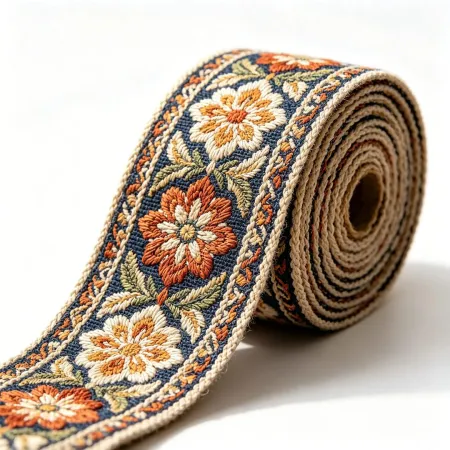
There is a second-order effect worth knowing about. A transferred pattern sits inside the fibre, so it does not sit on top of the weave and does not change the hand. That is why a heavy coverage design on a transfer band still feels like the band rather than like a coated one, and why a screen print of the same design does not. The two processes are often compared on colour and should be compared on feel.
Six Lines for a Transfer Brief
- The base shade, stated first — the ground the pattern will be multiplied by, not an afterthought.
- The thickness of the production roll — settings taken from a thin sample do not transfer to a thick one.
- Where the pattern sits — full width, one edge or a repeating band, since each needs a different platen arrangement.
- The repeat and how it is cut — a repeat that does not divide the cut length leaves a partial motif at every end.
- The wash and rub standard — named as a test rather than as a hope, because it sets the press window.
- Whether hardware goes on before or after — a metal fitting under a platen is a mark waiting to happen.
The sixth line catches more first orders than any other. A band that is assembled and then printed has to carry its buckles and rings through the press, and the platens cannot reach the cloth beneath them. Printing flat and assembling afterwards is the normal order, and it has to be said out loud because the alternative is discovered only when the first box arrives with pale patches around every fitting.
- Approve on production thickness — a strike-off on a thin strip is an illustration, not a sample.
- Look at the edge of the pattern — the crisp line is the first thing to soften when pressure is wrong.
- Wash one piece before approving — a transfer that has not been washed has not been tested.
- Check the hand, not just the colour — an over-pressed band feels glazed where it should feel like cloth.
Transfer printing runs alongside the rest of the polyester webbing range here, and the same site also handles custom lanyards, where a printed face is the whole product and a repeat has to line up with the clip. The 2000N anchor belongs to the 25 mm woven base; a transfer band is judged on whether the pattern is still there after twenty washes.
One more setting deserves a mention even though it is not on the press. The cooling that follows a transfer matters: a band stripped hot and stacked immediately keeps the film's shape at the fold, and the mark shows as a faint line where two layers met. A short cooling run before stacking costs seconds per metre.
Two Failures That Appear After Washing
The colour loses depth rather than leaving
A transfer that was pressed too cool puts dye near the surface, and washing removes it gradually instead of in one go. The pattern does not disappear; it becomes lighter and flatter, and the change is easy to miss between two inspections a month apart. A crock and wash test on the first production lot catches it while the press settings can still be changed.
A pale halo appears around the motif
Dye that has migrated sideways during a long press shows as a faint ring outside the design, and it becomes visible once the band has been washed and dried. On a dark base it hides; on a pale one it is the first thing a customer photographs. Shorter time and a cooler platen fix it, at a small cost in depth.
FAQ: Heat Transfer Polyester Webbing
Is a transfer print the same as a screen print?
No. A transfer drives dye into the fibre and leaves the hand unchanged. A screen print lays a film on the surface, which is more opaque and slightly stiffer.
Why does polyester take a transfer so well?
Because its melting point sits well above the transfer temperature, so there is a wide window between colouring the fibre and deforming it.
Can a transfer be done on a coloured band?
Yes, and the result is the ink multiplied by the base. Pale bases behave predictably; dark ones change the artwork, which is why the base is chosen first.
Does the pattern change the strength?
A transfer does not, because nothing is added to the surface. Over-pressing can, because the weave is crushed, and that is one more reason to set the press to the cloth.
Can hardware be fitted before printing?
It can, and the platens cannot press the cloth beneath it. Printing flat and assembling afterwards avoids pale patches around every fitting.
A heat transfer polyester webbing is a three-step product pretending to be a printed one. Fix the base, the thickness and the repeat first, then let the press do the only job it has, which is to put colour inside the fibre without changing anything else.
Why Xinxiangrui for Heat Transfer Webbing
Three steps have to agree before a pattern sits on cloth: the loom sets the thickness the press has to reach through, the dye line sets the base the ink goes onto, and the press sets the colour itself. Here a heat transfer polyester webbing moves between those three in one 8,000+ m² plant in Dongguan, so a change in one is a work order rather than a shipment. Share your heat transfer polyester webbing details with us and we will come back with a matched sample.