Dog Leash Nylon Webbing: Where a Lead Actually Breaks
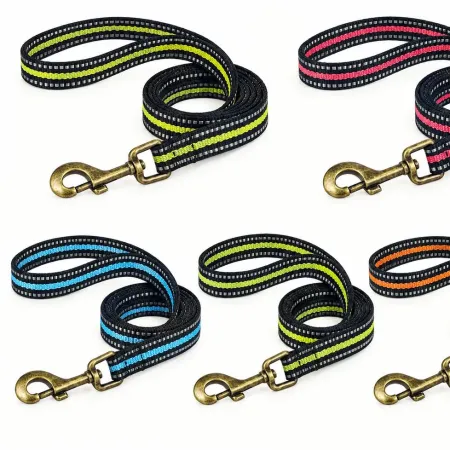
A dog leash nylon webbing band is the part of a lead that almost never fails, and that is the most useful thing to know about it. The band is chosen for hand feel, for colour and for how it hangs, while the failure in service is nearly always a bar tack pulling through, a snap hook whose gate has bent, or a handle that has worn thin where a hand grips it every day. Understanding the order of failure is what turns a leash from a strap with a clip into a product.
This guide covers the four parts that decide a lead, the width and hook that suit each size of dog, the three places a leash actually wears out, six lines a leash brief should carry, and why nylon rather than polyester is the usual choice for this particular product.
Dog Leash Nylon Webbing: The Four Parts That Decide It
A leash is a small assembly and each part has its own specification. A programme that treats it as one item usually ends up with a good band and a hook chosen by availability.
- The band — width and thickness set the hand, the colour range and how the lead hangs when it is not under tension.
- The hook — the part that meets the collar ring, and the part whose rating is least often read and most often tested.
- The bar tack — the short dense stitch run that holds the loop closed, and the joint that takes every shock the dog produces.
- The handle — a doubled section that a hand and a wrist work against for years, and where salt and skin oils collect.
| Dog size | Usual width | What fails first |
|---|---|---|
| Small, under 10 kg | 15 mm to 20 mm | Hook, usually the gate spring |
| Medium, 10 to 25 kg | 20 mm to 25 mm | Bar tack at the hook end |
| Large, 25 to 45 kg | 25 mm to 32 mm | Hook under a sharp lunge |
| Working and pulling dogs | 25 mm and up | Joints and the handle, not the band |
The band has more strength than the leash can use
A 1 inch band clears 2000N, which is far beyond anything a dog on a lead can generate, and even a 20 mm band carries a large margin. That is not a reason to relax; it is a reason to move attention. When the band is effectively unbreakable in service, every remaining risk sits in the stitching, the hook and the handle, and those are the parts a specification should describe in detail.
The Three Places a Lead Wears Out
The bar tack, because it takes the shock
A dog that lunges puts a short, high load into the loop and the bar tack absorbs it, which is why the stitch density there matters more than anywhere else on the product. A short tack with a fine thread and too few stitches creeps at the edges and eventually pulls through, usually at the fold where the webbing is already compressed. A longer tack, a heavier thread and a second row turn that into the strongest part of the assembly instead of the weakest.
The hook, because it is loaded sideways
A snap hook is designed for a pull along its axis and is often loaded at an angle, which twists the gate and eventually springs it. A cheap hook with a light gate fails this way long before the band is taxed; a cast hook with a proper spring and a swivel does not. The swivel matters more than buyers expect, because it keeps the band from twisting and keeps the load closer to the axis the hook was made for.
The handle, because a hand is abrasive
Salt from sweat, dust and the constant rub of a palm work on the handle in a way no laboratory abrasion test reproduces. The band thins where the hand sits and the edge frays first, and the failure is gradual enough that owners keep using it. A doubled handle, a bound edge or a padded grip all extend it, and none of them are visible in a product photograph.
Six Lines for a Leash Brief
- The dog, in kilograms — not the breed name, because the same breed varies by a factor of two and the width should follow the weight.
- The length, fixed or adjustable — a fixed lead and an adjustable one stress the same band differently at the handle end.
- The hook type and finish — snap, trigger or carabiner, with the finish named, since the fitting is the first part to be judged by a customer.
- The tack specification — thread size, stitch count and whether the tack is single or double, because this is the joint that fails.
- The handle treatment — plain, doubled, bound or padded, and whether a D-ring is fitted for an accessory.
- The palette and the matching pieces — because most leads are sold beside a collar, and a set that does not match is a return.
The sixth line is where a leash programme becomes a range. A lead sold alone is one item; a lead sold with a matching collar and harness is a set, and a set is what a shop wants to display. Planning the palette across all three from the start costs nothing extra in dyeing and prevents the situation where the lead is available in six colours and the collar in four. Where the six lines above are written down once, the range extends without a fresh brief for every piece.
Nylon is the usual choice for a lead because its elongation absorbs a lunge rather than transmitting it straight to the handler's wrist, which is a comfort argument as much as a strength one. A polyester webbing version is stiffer and holds colour under sun better, and the difference between the two is worth feeling in a sample set rather than reading about. Either way, the 1 inch nylon webbing base clears 2000N and the test report should describe the sewn loop rather than the bare band, since the loop is what the dog pulls on.
Two Things Buyers Judge That Specifications Miss
How the lead hangs when it is slack
Most of a lead's life is spent slack, hanging from a hand or trailing on the ground, and that is when a customer forms an opinion. A band that is slightly too stiff stands out from the body and catches on legs; one that is too soft folds on itself and tangles. Neither fault appears in a pull test, and both are obvious the moment someone walks a dog with the sample.
How it sounds and feels when wet
A lead gets rained on, dragged through wet grass and washed in a sink, and a band that stiffens or darkens when wet reads as cheap even if it recovers on drying. A colour that shifts when wet is worse, because the customer sees it and assumes it is the dye coming out. Wetting a sample and letting it dry beside a dry one is a two-minute test that no report replaces.
FAQ: Dog Leash Nylon Webbing
What width for a large dog?
25 mm is the usual minimum above 25 kg, and 32 mm for a strong puller. Below that the band is still strong but the hand comfort and the hardware choice suffer.
Why does my leash break at the hook end?
That end takes the shock and holds the bar tack. A longer tack, a heavier thread and a second row of stitching move the failure away from the joint.
Nylon or polyester for a leash?
Nylon for shock absorption and hand feel, polyester for stiffness and sun resistance. For a dog that lunges, the nylon stretch is usually the better trade.
Can a leash be washed?
Hand washing in cool water removes salt and dirt and extends the handle. A hot machine wash mats the surface and can soften the hook's gate spring over time.
Should the hook be rated?
It should, and the figure should state whether it is a working load or a break. A hook rated only on its break figure is being asked to carry more than intended.
A dog leash nylon webbing specification is four parts and one order of failure. Specify the band by width and hand, the hook by type and rating, the tack by stitch count, and the handle by treatment, and the lead that arrives will fail, if it ever does, in a place you chose rather than one you inherited.
Why Xinxiangrui for Dog Leash Nylon Webbing
A leash is three products in one line, and the depth behind it shows in how the parts are chosen rather than in how the band is woven. Three production lines across 17 product categories and 65 items mean a dog leash nylon webbing band reuses the same base as collars, harnesses and bag straps, so a programme can grow from a lead into a matched set without a new development. Tell us the dog's weight and the hook you want, and the set comes back matched.