Pet Reflective Webbing for Dog Collars: The Neck Problem
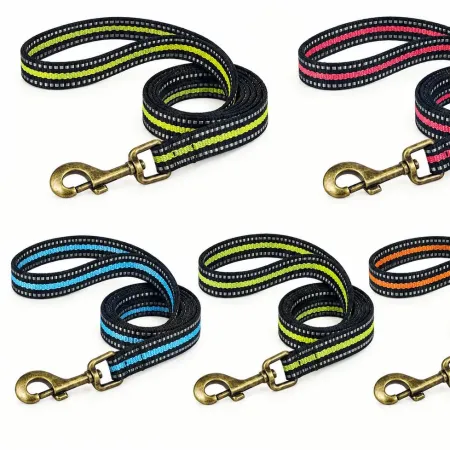
A collar sits lower than a headlight, and that single fact shapes everything else about it. Pet reflective webbing for dog collars is bought as though the band were a small version of a safety vest, and it is not: the vest is worn at the height of the light source, while a collar on a small dog rides at a quarter of that height, at an angle the beam reaches obliquely. The band works, and it works differently from the way a catalogue implies.
This guide covers the three arcs of a collar and what each one contributes, why height changes the geometry of being seen, why a collar rotates and what that costs, how much area a 25 mm band actually offers, six lines a collar brief should carry, and the two things a flat sample cannot judge.
Pet Reflective Webbing for Dog Collars: Three Arcs
A collar is not one surface. It is a ring divided into three arcs that face different directions and are seen by different observers, and a design that puts reflection on only one of them is betting on the dog facing a particular way.
| Arc | Faces | Seen by |
|---|---|---|
| Top of the neck | Upward and slightly back | A driver ahead, during the part of the stride when the head is down |
| Sides | Outward, under the ears | Traffic approaching from either side, which is the direction that matters at a kerb |
| Under the throat | Downward | Almost nobody, and it is the arc that spends most of its life pointed at the pavement |
The third row explains the rotation problem in one line. A collar turns on a neck as a dog walks, sniffs and scratches, and the arc that ends up facing the ground is often the one carrying the widest reflective stripe, because a full-face band cannot choose. The result is a product that is fully reflective and, at the moment it is needed, showing its plain side to the traffic.
A quarter of a metre of band
A collar for a medium dog is about 350 mm around by 25 mm wide, which is under a tenth of a square metre of band, and only part of that faces any given direction at once. That is the area doing the whole job. It explains why width and pattern matter so much at this size, and why the figure of 2000N that the base band clears is not the limiting factor: strength is abundant, and visible area is scarce.
Three Things That Decide a Collar's Visibility
The height of the band
A retroreflective surface returns light most efficiently when the light arrives close to perpendicular to its face, and its efficiency falls as the angle tilts. A headlight is roughly half a metre to a metre above the road; a collar on a small dog sits at a quarter of that, so the beam arrives at a noticeable angle rather than straight on. The band still works, and it works at a disadvantage that a taller product, such as a harness strap running up the chest, does not share. That is the honest reason a harness is brighter than a collar at the same grade, and it has nothing to do with the material.
The rotation of the ring
A collar has no fixed orientation, so the design has to work in every position or accept that it works in some. Three answers are used: a full-face reflective band, a double-sided construction, or a pattern repeated around the whole circumference so that no arc is entirely plain. The third is the cheapest and the most often overlooked, because a repeating stripe costs no more material than a single stripe and removes the worst case entirely.
The coat over the top
On a long-haired breed the collar disappears into the coat for part of its circumference, and the part that remains visible is the buckle side rather than the reflective stripe. This is not a defect in the band and it is worth designing around: a wider band, a stripe repeated on both edges, or a band set slightly proud of the fur all help. It is also the reason a collar sold to a breeder of coated breeds should be specified differently from one sold to owners of short-haired dogs, even though both are called the same product.
Six Lines for a Collar Brief
- The neck size range — from the smallest to the largest setting, since the band length that carries reflection changes with the adjustment.
- The band width the buckle allows — 25 mm is standard, 20 mm for small breeds, and the fitting decides before the design does.
- Full face or striped — and if striped, whether the pattern repeats around the whole circumference or only along the top arc.
- The single or double face — a double-sided band answers rotation directly and adds thickness that the buckle must accept.
- The breed and coat — long-haired dogs cover part of the band, which changes the useful width rather than the nominal one.
- The buckle and D-ring positions — hardware covers band, and where it sits decides which part of the reflective face survives assembly.
The sixth line is where a good collar is separated from a correct one. A buckle, a D-ring and a keeper occupy maybe forty millimetres of a 350 mm band, and on a small collar that is over a tenth of the circumference. If those forty millimetres land on the reflective stripe, the band is still reflective and the collar is measurably less visible, which nobody notices until the two are compared side by side. Offsetting the hardware onto a plain section is a drawing decision, and it costs nothing.
- Stripe on both edges — so that a rotated collar still shows a line whichever arc faces the road.
- A plain centre — where the buckle, the keeper and the D-ring can sit without covering optics.
- A repeat sized to the collar — a motif drawn for a lead will not divide evenly around a neck, and the join usually lands at the buckle.
- A dark base behind the stripe — which raises contrast in daylight and lowers the return at night, so the choice should be made rather than inherited.
Collar work sits inside a range that also covers harnesses and leads, so the band is the same pet reflective webbing cut to a different length, on a base from the polyester webbing line, with a hook and loop fastener where the design calls for a soft closure rather than a buckle. The assembled options are on the pet harness and pet leashes pages.
Two Things a Flat Sample Cannot Judge
How it looks as a ring
A strip of band shows a continuous reflective line. Sewn into a ring, the same strip shows a line that bends away at both sides, and the tangent point where the band turns is the part a driver sees edge-on and reads as dark. That is normal and it is worth knowing before a customer sends a photograph of a collar that looks half-lit. Bending a sample into a circle of the intended neck size, and viewing it from a metre away at knee height, is a two-minute test that reproduces the effect.
What the buckle does to the line
Hardware sits on the band and interrupts whatever pattern runs underneath it, and the interruption is at the front of the neck, which is the most-viewed arc. A sample with the buckle fitted tells the truth; a sample without one does not. Where a range uses two buckle sizes, the pattern should be checked against both, because the smaller buckle covers less band and changes which part of the stripe survives.
FAQ: Pet Reflective Webbing for Dog Collars
Why is a harness brighter than a collar?
Because of height. A harness strap runs up the chest towards the height of a headlight, so the beam meets it closer to straight on. A collar sits lower and is lit at an angle.
My collar turns around. Is that a fault?
It is normal on a loose-fitting collar. The design answer is a pattern that repeats all the way round, a double-sided band, or a closer fit.
Is 25 mm the right width for every dog?
No. Small breeds are usually 20 mm and toy breeds narrower still, because a wide band on a small neck stands away and rotates more. The buckle sets the practical maximum.
Does a long-haired dog need a different band?
It benefits from one. Fur covers part of the circumference, so a wider band or a stripe on both edges leaves more visible surface than a single central stripe.
Where should the buckle sit?
On a plain section of the pattern, not on the stripe. It covers band, and it covers it at the front of the neck where it is most seen.
Pet reflective webbing for dog collars works with very little area in a position slightly wrong for the geometry. Repeat the pattern around the neck, keep the hardware off the optics, and account for the coat.
Why Xinxiangrui for Collar Webbing
A collar is a short length of band with hardware on it, so the decisions that matter are the pattern's repeat and where the fittings land, and both are settled on the drawing. The pet reflective webbing for dog collars made here uses the same base and coating as a harness, so a range stays consistent across products. Band, coating, printing and the hardware bench share one 8,000+ m² plant in Dongguan, which is why a repeat sized to a 350 mm neck can be trialled and stitched in the same week. Share your collar details with us and we come back with a matched sample.