Polyester Webbing for Pet Leashes: Cut Length and Coil
Polyester webbing for pet leashes is a simple product with a shipping problem attached. A leash is sold by length, cut from a roll, and packed as a coil, and those three facts meet at one point: whether the length on the roll divides the length being cut. Get that wrong and a programme loses a tail off every roll, which across a container is a pallet of material nobody ordered.
This guide covers how cut length and coil length are decided, the three places a leash order loses money in handling, why winding tension matters more on a narrow band, six lines a leash brief should carry, and the two delivery faults that show up when the carton is opened.
Polyester Webbing for Pet Leashes: Three Lengths and What Each Costs
The leash length a customer chooses is a use decision. The roll length that feeds it is a handling decision, and the two have to be introduced to each other before the loom runs.
| Finished length | Where it is used | What it does to packing |
|---|---|---|
| Short, around a metre | Training, close control, small animals | Many short coils per carton, and a tail that is a large share of a piece |
| Standard, around 1.5 m | Everyday walking, the default in most catalogues | A comfortable coil that packs two or three to a bag |
| Long, three metres and above | Open ground, tracking lines, recall training | Few per carton, and a coil large enough to mark itself |
The third row is where a narrow band and a long length combine badly. Three metres of 20 mm webbing coiled tightly puts a great deal of pressure on the inner turns, and a band that is thin has nothing to resist it. The coil arrives looking correct and reveals a flat spot along one shoulder when it is unwound — the sort of fault nobody notices until a customer photographs it.
The roll length must divide the cut length
If a customer cuts 1.5 m pieces and the roll holds 50 m, each roll leaves a 0.5 m tail. At a hundred rolls that is fifty metres of waste, and it becomes a pallet that has to be stored, counted and eventually discarded. Asking for a 48 m or 51 m roll removes the tail and costs nothing at the loom, which makes it the cheapest improvement available in a leash programme.
Three Places a Leash Order Loses Money
At the tail
A tail is not just material; it is a decision at the cutting table about what to do with the last piece. Some workshops join it to the next roll, which puts a seam in the middle of a leash, and some set it aside, which creates a bin of short lengths that never quite gets used. Both are avoidable by arithmetic at the ordering stage.
At the two ends
A leash is handled at both ends every time it is used. One end takes a clip or a ring, the other a handle, and both are where a band begins to fray. A hot-cut seal stops the yarn unravelling; a folded and stitched loop is stronger and bulkier. Deciding which end gets which treatment is a per-model decision that a brief should make explicitly.
At the assembly sequence
Fitting a clip and then coiling produces a bulkier pack and a coil that will not sit flat. Coiling first and fitting afterwards is neater and slower. The sequence also decides whether the goods can be packed retail-ready, with a header card that has to be attached to a finished leash rather than to a length of band.
There is one property that leash buyers notice before any other, and it is not strength. A leash hangs from the hand and swings, so a heavy band feels wrong however strong it is, and a stiff one communicates every movement of the dog up the arm. Polyester is stiff, which is why a leash in this fibre is usually specified lighter and narrower than a load calculation would suggest. The band is chosen for the hand first and the load second.
Six Lines for a Leash Brief
- Finished length — not the cut length, because the loop and the fitting consume both.
- The roll length that divides it — stated as a multiple, so the tail is designed out rather than discovered.
- The end treatment at each end — hot cut, folded loop or a sewn eye, and which end gets which.
- The coil diameter and tie — a large coil marks less, and a paper band is gentler than an elastic one.
- Assembly before or after coiling — which decides both the pack and the packing time.
- Retail or bulk — a header card changes the carton count and the handling per unit.
The fourth line is where a cheap programme becomes an expensive one. An elastic band around a tight coil leaves a compression mark that a retailer will find before a customer does, and on a dark band it is visible in a photograph taken at an angle. A wider coil and a paper wrap cost a little handling and remove a recurring claim.
- Unwind one coil and lay it flat — the shoulder mark only appears when the coil is opened.
- Measure the finished length — with the loop closed, as it will be sold.
- Hang it with weight on — the end treatment announces itself under load.
- Weigh a filled carton — coils are bulky and the box fills before it is heavy.
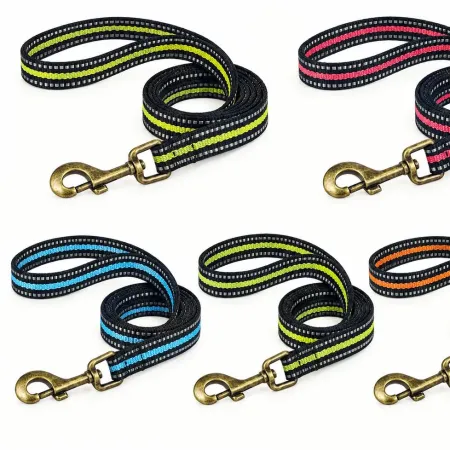
Leash lengths are cut from the same polyester webbing rolls as the rest of the range here and assembled alongside the pet leashes and pet reflective webbing lines, so a clip can be fitted and pull-tested on the actual band rather than on a stand-in. The 2000N anchor belongs to the 25 mm base; a leash is decided by its cut length and its two ends.
A last note on the handle. A leash is held for an hour at a time, and a narrow band folded into a loop makes a thin handle that cuts into a hand. A wider section at the handle end, or a padded sleeve, is usually the difference between a product that is used and one that is left in a drawer. That decision is made at the cutting table, not at the loom.
Two Delivery Faults That Show Up in the Carton
The coil has taken a set
A leash that has been coiled tightly for weeks in a warm container comes out with a memory of the coil. It will not hang straight, and the wave travels down the band for the first few uses. A larger coil, a looser tie and a cooler pack all reduce it, and none of them removes it entirely on a long sea route.
An end was cut with a blade
A blade leaves loose yarn at the end, and loose yarn in a coil wraps itself around the leash and then around everything beside it in the carton. By the time the carton is opened the contents are tangled, and the damage is read as poor packing rather than as an unsealed cut. Specifying a hot-cut end costs almost nothing and prevents the whole sequence.
FAQ: Polyester Webbing for Pet Leashes
What is the standard leash length?
About 1.5 m for everyday walking. Short training leads and long lines are the two ends of the same catalogue.
Why does the roll length matter so much?
Because a roll that does not divide the cut length leaves a tail on every roll. Over a container that tail becomes a pallet of waste nobody planned for.
Should both ends be sealed?
Yes if either might be cut on site. A sealed end does not unravel, and an unsealed one tangles a carton before anyone has used the product.
Why does my leash not hang straight?
It has kept the set of the coil. A larger coil and a looser tie reduce it, and hanging the leash with a light weight often restores it.
Can leashes be packed retail-ready?
Yes, with a header card or a sleeve, which has to be attached after the clip is fitted. That changes both the sequence and the packing time.
Polyester webbing for pet leashes is decided by two numbers that never appear in a catalogue: the roll length that divides the cut, and the coil diameter that leaves no mark. Fix both, seal the ends, and the carton that arrives matches the sample that was approved.
Why Xinxiangrui for Leash Webbing
Length and coil are the two numbers a leash is really bought on, and both are set here before the loom runs: this polyester webbing for pet leashes is cut to the length the customer sells, hot sealed at both ends, assembled with the fitting asked for and packed for retail or bulk. Give us the application and the load it must carry, and the construction follows.