Pet Accessories Leashes: Why the Set Outsells the Item
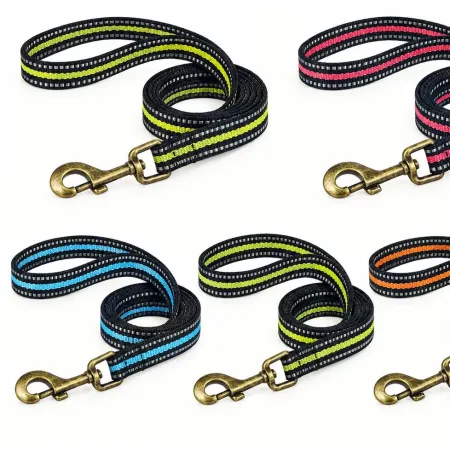
Pet accessories leashes are usually bought as one piece of a group, and the group is what a shop actually displays. A lead on its own hangs from a hook and disappears among twenty others; the same lead beside a matching collar, a harness and a waste-bag pouch becomes a fixture, and a fixture sells in three colours rather than one. That is the commercial reason to think in families rather than items, and it has a manufacturing consequence: the pieces either share a band or they do not.
This guide covers the four pieces that make up a walking set, what they share with the lead and what they cannot, why a set usually fails at its fourth item, six lines a family brief should carry, and the two decisions about how a set is packed and shipped.
Pet Accessories Leashes: Four Pieces in One Family
A walking set is built from four pieces that share a look and differ in what they must do, and the shared part is smaller than buyers assume.
- The lead — the piece that sets the colour, the width and the hardware finish for everything else.
- The collar — the same band in a narrower width, with a buckle and a D-ring whose finish must match the lead's hook.
- The harness — more band, more joints, and the piece where the geometry changes with size rather than only the length.
- The pouch — a small accessory that carries the colour and is the cheapest piece to add and the easiest to forget.
| Piece | Shares with the lead | Differs by market |
|---|---|---|
| Collar | Band, dye lot, thread and finish | Buckle versus clip, and the size range stocked |
| Harness | Band, dye lot and finish | Configuration, which follows local walking habits |
| Pouch | Band, dye lot and a small fitting | Whether it is included or sold separately |
| Packaging | The card design and the language | Language, and whether pieces are hung or boxed |
One band serves every piece in the set
A 25 mm band that clears 2000N is more than a lead needs, and the same construction cut to 20 mm serves the collar and to 15 mm serves the pouch trim. Because the band is common, a set matches on colour automatically, and the engineering question moves from each piece to the family as a whole.
Three Things That Decide a Family
The band is shared, the hardware is not
A lead uses a snap hook, a collar uses a buckle and a D-ring, a harness uses several adjusters and a pouch uses a clip. Each is a different part, and a set that matches in colour but mixes a bright hook with a dull buckle reads as assembled rather than designed. Specifying one plating finish across all the hardware is the single most effective way to make a family look deliberate.
Sets fail at the fourth piece
The lead, the collar and the harness are usually planned together, and the pouch is added late or supplied by someone else. Since the pouch is the piece a shop puts nearest the till, a mismatch there is more visible than anywhere else in the set. Either bring it into the same order or leave it out of the display entirely; a family with a gap looks like a range that has been picked over.
Market habits decide the composition
In some markets the harness is the default and the collar is a fashion item; in others the collar is standard and a harness is a specialist purchase for a strong dog. That difference changes which piece leads the set and which one carries the colour decision. Since the same band is used across 50+ markets and 200+ active partners, the composition can differ per destination while the material stays common, which is the cheapest way to serve several habits from one production plan.
A small rule keeps a family coherent: the collar is usually one width step below the lead, and the harness follows the dog's weight rather than the lead's width. A 25 mm lead beside a 25 mm collar looks heavy on a small dog, and the buckle becomes oversized for the band it sits on. Stepping down to 20 mm for the collar keeps the proportion right without changing the colour, the weave or the dye lot.
Six Lines for a Family Brief
- The pieces, listed — lead, collar, harness, pouch, and which of them must match exactly rather than merely coordinate.
- The common colours — the shades that run across every piece, and how many are shared rather than piece-specific.
- The hardware finish — one plating across the family, named once so it cannot drift between pieces.
- The size ladder — the widths and lengths per piece, and whether the harness changes geometry or only dimensions between sizes.
- The card and the language — one card for all pieces or one per piece, decided before printing.
- The pack configuration — whether a set ships assembled, in one bag or as separate units for the shop to combine.
The packing decision has more influence on sales than it looks. A set shipped as separate units lets a shop mix sizes and split a set when one piece sells out, which suits a specialist retailer; a set sealed in one bag is easier to merchandise and harder to break up, which suits a chain. Neither is universally right, and the same family can be supplied both ways from one production run if the packing is decided before the cards are printed.
The family is built on a shared nylon webbing base, with a polyester webbing version for markets where sun resistance outweighs stretch. A ready-made starting point exists in the pet harness range and the lead range, and both draw on the same constructions, so a set can be assembled rather than developed. Colour matching across the pieces is handled through the development route, and the test records for the band cover every piece cut from it.
Two Decisions About the Shipment
Whether the set is a display or an order unit
A set can exist as a merchandising idea, with each piece carrying its own code and its own place on the shelf, or as a single sellable unit with one code. The first suits a shop that wants to compose its own display and reorder pieces unevenly; the second suits a gift purchase and a chain that wants one decision at the till. Deciding which one the product is changes the card, the bag and the carton, and it is cheaper to decide before the first print than after.
Whether a sample set is one bag or four
A buyer evaluating a family needs to see the pieces together and to handle each one, and a set packed in a single sealed bag cannot be assessed without destroying the packing. Sending one assembled set plus one set loose costs almost nothing and answers both questions: how it looks on a shelf and how it feels in the hand. It also reveals whether the hardware finishes actually match under the same light.
FAQ: Pet Accessories Leashes
Which pieces should match exactly?
The lead, the collar and the harness should share band, dye lot and plating. The pouch can coordinate rather than match, but a visible difference there is noticed.
Can a set be bought piece by piece?
Yes, and most are. A family supplied as separate units lets a shop reorder the piece that sells fastest, which is usually the lead.
Does one band really serve all pieces?
In different widths, yes. A 25 mm construction that clears 2000N can be cut to 20 mm for a collar and 15 mm for a pouch without a new weave.
Should the harness be in every set?
Only where the market walks dogs in harnesses by default. In other places it is a specialist piece and adding it inflates the set without selling it.
How many colours should a family carry?
Three or four that run across every piece. More colours multiply the number of dye lots and make a full set in every shade harder to hold.
Pet accessories leashes sell best as the anchor of a family, and a family is one band, one plating finish and one card. Plan the four pieces together, and the set that reaches a shelf is the set a shop wants to display.
Why Xinxiangrui for Pet Accessories Leashes
A walking set is one band used several ways, and sets ship from here to 50+ markets with 200+ active partners behind them. Three production lines across 17 product categories and 65 items mean the band under a lead is the band under a collar, a harness and a pouch, so a family matches on colour by construction rather than by careful ordering. Tell us your lead spec and a matched construction comes back to you.