Cotton Webbing Belt with D Ring: Why Friction Decides the Fit
A cotton webbing belt with D ring has no buckle, no holes and no prong. It holds because the webbing grips itself where it doubles back through two rings, and that grip depends on four things a spec sheet rarely mentions: the surface texture of the cloth, its thickness, the diameter of the ring wire and the angle at which the tail hangs.
This guide covers how the two-ring closure actually works, how to size the belt from a waist measurement, what the ring dimensions have to be relative to the webbing, and why fitting the rings and rivets in the same plant that weaves the cloth removes a class of argument that otherwise arrives with the first bulk order.
How a Two-Ring Belt Actually Holds
The tail passes through both rings, over the top ring and under the bottom one, then back on itself. Load pulls the rings together and clamps the webbing between them. There is no mechanical lock anywhere in the system.
- Grip comes from surface, not tension — a cotton twill has a texture that bites into itself. A soft, heavily calendered finish reduces that bite, and the belt starts to slip under a coat.
- Thickness sets the clamping force — two layers of 1.8 mm webbing in a ring with a 4 mm wire create a firm clamp. Two layers of 1.2 mm in the same ring leave slack, and slack means slip.
- Ring wire diameter resists deformation — thin wire straightens under load and the clamp opens. A 4 mm wire on a 38 mm belt is a working minimum for an adult.
- Tail weight helps or hurts — a long, heavy tail hanging down adds a little tension to the clamp. A tail cut too short rides up and works the rings loose.
The practical consequence is that a two-ring belt is a system, not a strap with hardware attached. Changing the webbing finish without changing the ring size changes whether the belt holds, which is why the two decisions belong in the same conversation.
Sizing the Belt and the Ring
Two numbers are usually quoted for a webbing belt and they are not the same: the waist it fits and the length of the belt. The difference is the tail, and the tail is a design decision rather than a measurement.
| Waist range | Belt length | Tail beyond the rings |
|---|---|---|
| 70–80 cm | 95–105 cm | 20–25 cm |
| 80–95 cm | 105–120 cm | 20–25 cm |
| 95–110 cm | 120–135 cm | 25–30 cm |
The ring's inner width has to clear the webbing plus the fold, not the webbing alone. A 38 mm webbing belt needs a ring with an internal width of 42 to 45 mm so the doubled cloth passes freely when the belt is threaded but locks when it is pulled. A ring exactly 38 mm wide will jam, and a ring at 50 mm will not grip at all — the range is narrow and it is the part buyers most often get wrong.
- Ring inner width — webbing width plus 4 to 7 mm, allowing for two layers at the fold.
- Ring wire — 3 mm for a light belt at 25 mm, 4 mm for 38 mm, 4.5 to 5 mm for a wide waist belt.
- Fold allowance — ring diameter plus twice the webbing thickness, plus the seam.
- Tail length — long enough to hang, short enough not to work loose. Twenty to twenty-five centimetres is the usual band.
D-Rings, Rivets and Webbing From One Site
At Xinxiangrui's 8,000+ m² plant in Dongguan, weaving, dyeing, printing and hardware assembly run on one site, and a belt is where that shows most clearly. The webbing finish and the ring size are a single decision, and a change to either is one work order rather than a three-way negotiation.
- The finish can be adjusted for grip — a slightly firmer finish on the face gives the rings something to hold, and that adjustment is made on the same line that wove the cloth.
- Rings are tried on the actual strip — a 42 mm and a 45 mm ring behave differently on the same webbing, and the difference takes a minute to test when both are in the same building.
- Rivets and stitching are fitted in-house — the end that takes the most load is assembled by the same people who know which finish was applied to it.
- Colour is matched across cloth and hardware — a black webbing with black oxide rings is a match decision, not two orders from two suppliers.
Test the belt by wearing it, not by pulling it
A pull test on the rings tells you the hardware will not deform. It does not tell you whether the belt slips when the wearer sits down, stands up and walks for an hour. Thread the sample, wear it over the garment it will be worn with, and do the things a wearer does. Most two-ring failures appear in that half hour and nowhere else.
Three Failures the Two-Ring Closure Produces
The belt slips instead of locking
The signature complaint, and almost always a finish or thickness problem rather than a hardware problem. A soft, slick webbing in a generous ring has nothing to grip. A firmer finish, a slightly thicker cloth or a ring 3 mm smaller usually solves it without changing anything else.
The ring straightens at the fold
A 3 mm wire on a 38 mm belt takes the whole load at one point. Under a sudden pull — a wearer catching the belt on a chair — the wire opens and the belt will no longer clamp. A 4 mm wire in a plated steel is a working minimum, and the plating matters as much as the diameter.
The rivet tears out of the fold
A rivet placed too close to the cut end, or through too few layers, pulls through and leaves a hole. Hole diameter and edge distance are the two figures that prevent it, and both belong on the drawing rather than in a workshop habit.
Five Lines for a Belt Order
- Waist range and belt length, with the tail stated separately so the arithmetic is visible.
- Webbing width and thickness, because the ring is chosen against both.
- Ring inner width and wire diameter, with the plating named.
- Finish — the grip surface is a functional decision, not a cosmetic one.
- Attachment method — rivet, stitch or both, with hole distance from the end.
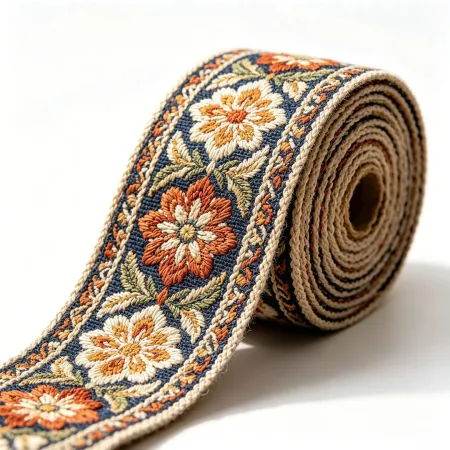
The twill construction is the one that grips best in a two-ring closure, the plain weave version is softer and needs a tighter ring, and the cotton webbing range covers the widths a belt programme usually needs.
FAQ: Cotton Webbing Belt with D Ring
Why does my two-ring belt keep slipping?
Usually because the webbing is too soft or too smooth for the ring size. A firmer finish, a thicker cloth or a ring four to seven millimetres wider than the strap — not fifteen — restores the grip. A ring much wider than the strap will never hold.
What size D ring for a 38 mm belt?
An inner width of 42 to 45 mm with a 4 mm wire. The extra width allows the doubled webbing to pass when threading, and the wire diameter is what stops the ring opening under a sudden load.
How long should a webbing belt be?
Roughly the waist plus twenty-five to thirty centimetres, which leaves a tail of twenty to twenty-five after threading. State the waist range and the intended tail rather than a single length, because a belt that fits one measurement fits a range.
Rivet or stitch at the ring end?
Both is common and neither alone is wrong. A rivet concentrates load at one point; a box-X spreads it. Used together, the stitch carries the working load and the rivet stops the fold opening if the thread fails.
Does the metal need to be nickel free?
For a belt worn against the body, nickel release is a regulated question in several markets, and a plated ring is the component most likely to raise it. Ask which plating was used and whether a release test accompanies it.
A cotton webbing belt with D ring is held by friction, and friction is a property of the cloth as much as of the hardware. Finish, thickness and ring size are one decision, and a sound cotton construction at this width clears 2000N — but the belt will slip long before it breaks.
Why Xinxiangrui for Cotton Webbing Belts with D Rings
At Xinxiangrui's 8,000+ m² plant in Dongguan, weaving, dyeing, printing and hardware assembly run on one site, so the webbing finish and the ring size are settled against each other on the real strip rather than on two drawings. Rings, rivets and stitching are fitted in-house, and the finish is adjusted for grip where the closure needs it. Tell us your cotton webbing belt with D ring spec and a matched construction comes back to you.