25mm Polyester Webbing: What 2000N Actually Measures
A 25mm polyester webbing is usually quoted at 2000N, and that number is treated as a property of the product when it is really a property of a test. Change the distance between the grips, change the speed, change the way the ends are held, and the same band gives a different figure. The number is not wrong; it is simply incomplete until the conditions are attached to it.
This guide covers what a 2000N reading describes, the three ways a tensile figure misleads a buyer, what to specify when asking for a test, and the two numbers that predict performance in use better than the peak does.
25mm Polyester Webbing: The Conditions Behind the Number
Four variables move a tensile reading on a narrow woven band, and three of them are decided by whoever writes the test rather than by whoever weaves the cloth.
| Variable | Why it moves the reading | What to state |
|---|---|---|
| Gauge length | A longer free length lets more warp extend, so the peak falls and the extension rises | The distance between grips in millimetres |
| Rate of pull | A fast pull reads higher, because the fibre has less time to rearrange | Millimetres per minute |
| Grip type | Flat jaws concentrate stress at the jaw face; a roller or bollard grip spreads it | Whether the break was accepted inside or outside the gauge |
| Conditioning | Dry and wet readings differ, and for polyester the wet reading barely moves | Which state was tested, and for how long it was conditioned |
The last row is the one worth dwelling on, because it is the reason polyester is chosen for anything that gets wet. A polyester band tested wet loses very little of its dry strength, while a polyamide band of the same construction loses noticeably more. That difference does not appear in a headline figure, and it is often the only reason the material was specified at all.
A break at the jaw is not a result
When a specimen parts at the grip rather than in the free length, what was measured is the grip, not the band. A good report says where the break occurred, how many specimens were rejected for gripping, and what the accepted readings were. A report that gives one figure and no location is a marketing document.
Three Ways a Tensile Figure Misleads
It describes the strongest point, not the useful one
The peak load is the moment before something gives way. Everything a product does happens well below it, and the property that governs behaviour in that range is extension rather than peak. Two bands can both read 2000N and behave completely differently at 400N, one holding its length and one stretching visibly.
It is a reading from one position on the roll
The outside of a roll has been exposed and tensioned differently from the inside, and the two ends of a long run can differ more than two rolls from the same lot. A single figure taken from the start of the first roll is a sample of one. A report that names how many positions were tested tells you whether the figure is typical or lucky.
It says nothing about the assembly
Almost every failure in the field happens at a stitch, a bar-tack or a buckle rather than in the middle of the band. A 2000N band sewn with the wrong needle, the wrong stitch density or too little seam allowance becomes a 600N assembly. The band passed; the product did not.
There is a further subtlety that separates polyester from the fibre it is most often compared with. Polyester is stiff, so it reaches its peak load with relatively little extension, and that stiffness is what makes a band feel secure under tension. The same stiffness means it has less capacity to absorb a shock, and a sudden load on a taut polyester band can peak higher than a slow pull would suggest. For a static application that is an advantage; for a snatch load it is a reason to add a damper rather than to widen the band.
Six Lines for a Test Request
- Gauge length — the free distance between grips, because it changes both the peak and the extension.
- Rate of pull — stated in millimetres per minute so two laboratories can produce comparable figures.
- Number of specimens and positions — how many, and taken from where along the roll.
- Dry, wet or both — the answer matters most for outdoor and pet products, where both states occur.
- Where the break is acceptable — inside the gauge, with a stated rule for specimens that slip or part at the jaw.
- The assembled strength too — the same test on a sewn loop or a bar-tacked end, which is the figure a customer experiences.
The sixth line is the one that changes decisions. A band tested flat tells you what the cloth can do; a band tested as it will be used tells you what the product can do. When the two figures are far apart, the money is better spent on the stitching than on a stronger weave.
- Ask for the raw readings — a mean without a spread hides the one specimen that failed.
- Ask where the break happened — at the jaw, at the edge or across the face are three different stories.
- Ask for the batch identity — a report that cannot be tied to a lot cannot be used in a dispute.
- Ask for extension at working load — the number that predicts how the product feels in service.
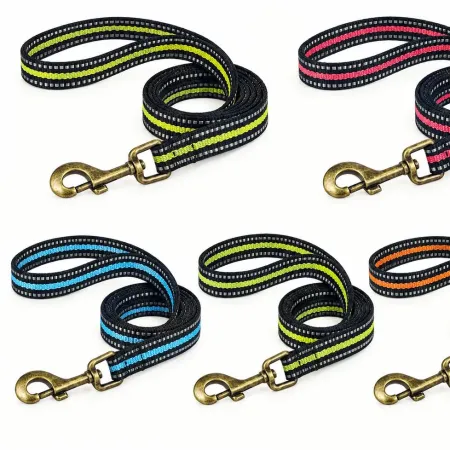
Every lot of polyester webbing that leaves here can be tested on the batch in hand rather than against a catalogue figure, and the same bench serves the pet webbing and bag programmes, where a sewn strength matters more than a flat one. A 25mm base clearing 2000N is the starting point; the reading that decides a product is the one taken after the needle has been through it.
A note on how the figure is usually quoted in trade. A band sold as 2000N is often described by the construction behind it rather than by the reading, and the two drift apart as a programme matures: a yarn supplier changes, a finish is added, a loom is reset. None of those events is a defect, and each of them can move the peak by a few percent. The reason to keep a retained specimen from every approved lot is not suspicion; it is that a physical reference answers the question a certificate cannot, which is whether the band in your hand is the band you approved.
Two Numbers That Predict More Than the Peak
Extension at working load
Measure how far the band stretches at the load it will actually see, and you learn whether a strap will need re-tensioning, whether a seam will crease, and whether an adjustable fitting will hold. This single figure explains most of the difference customers describe as quality, and it is almost never printed.
Strength retained after abrasion
A band that rubs against a buckle for a season loses more than a band that hangs free, and the loss is measurable on an abrasion tester with a tensile reading before and after. Reporting the retention rather than the initial figure describes the product at the end of its first year rather than on the day it was made.
FAQ: 25mm Polyester Webbing
Is 2000N a minimum I can rely on?
It is a reading from a defined test. Whether it is a minimum depends on the specification and on how many specimens were tested, which is why the method travels with the figure.
Why did my band break at the grip?
Flat jaws concentrate stress where the band leaves the jaw face. A roller grip, a longer gauge or a padded jaw usually moves the break into the free length where it belongs.
Does polyester lose strength when wet?
Very little. That is one of the main reasons it is chosen over polyamide for outdoor, marine and pet applications, where a wet band is normal.
Can two suppliers both quote 2000N and differ?
Yes, and often do. Gauge length, rate and grip type account for much of the gap, and thickness and pick density for the rest.
How many specimens should a report cover?
Enough to show a spread, and taken from more than one position on the roll. A number without a range cannot support a decision.
A 25mm polyester webbing is not a number, it is a construction that produces numbers under stated conditions. Ask for the conditions, the positions and the assembled figure, and the peak becomes a piece of information rather than a slogan.
Why Xinxiangrui for 25mm Polyester Webbing
The number that leaves this building is not a catalogue figure but a reading taken on the roll that is shipping, and a 25mm polyester webbing is measured for peak load, extension at working load and strength after sewing before the lot is released, and the report carries the batch identity rather than a sample number. Tell us your 25mm polyester webbing spec and a matched construction comes back to you.