
Features
Why Choose Xinxiangrui Webbing?
Source Factory
Direct wholesale production from our own plant in Dongguan, not a trading desk. Weaving, dyeing, printing, hardware assembly and packing all run in house, with no middleman margin in the price.
Full Customization
OEM and ODM work starts from your drawing: width, weave, colour, hardware and retail packaging. We match Pantone, send a physical sample before bulk, and keep every change on one work order.
Strict QA & ISO Standards
Every batch is checked for width, thickness, break strength and colour fastness before it ships, and the plant runs to ISO 9001 and ISO 14001. Test reports for your batch travel with the goods.
Proven Track Record
Fifteen years of narrow fabric since 2011, 200+ active partners and shipments to 50+ markets. Long-run programmes are what this factory is built for, which is why most customers reorder.

We Have The Best Solutions for Your Business
Xinxiangrui has made narrow fabric in Dongguan, China since 2011. Our 8,000 m² plant weaves, dyes, prints, cuts and sews under one roof, supplying 200+ active partners in 50+ markets. We produce polyester, nylon, cotton, elastic, reflective and bio-based webbing, ribbon, lanyards, pet leashes, bags and luggage components, from yarn and reflective tape to finished straps and handles.
Because every step stays in one plant, a widening range does not cost tolerance. Our laboratory tests to 2000N+ break strength, 50,000+ Martindale cycles and 1,000+ hours of UV exposure, and every batch carries its own figures rather than a catalogue sample. We work to OEKO-TEX, CPSIA, REACH, RoHS, ISO 9001, ISO 14001 and GRS. Send us your spec sheet and target quantity, and we will recommend the construction that fits.
Cosmetic Bag: The Four Constructions in Production
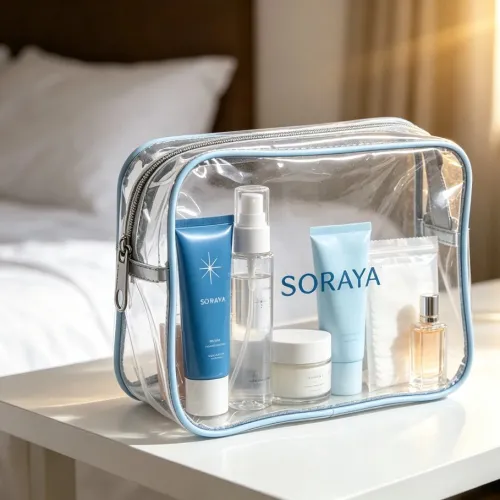
Almost every cosmetic case sold today is one of four shapes, and the choice is made by how the product is used rather than by what it looks like on a shelf.
| Construction | How it is built | What it suits | Where it fails |
|---|---|---|---|
| Flat pouch | Two panels, one zip, no base | Travel kits, gift sets, hotel amenities | Standing open while in use |
| Boxed | Side walls inserted, base panel sewn in | Countertop cases, brush storage | Corner seams under a full load |
| Brush roll | Flat panel, stitched slots, tie or elastic | Professional kits, brush protection | Slot spacing that does not match the tools |
| Hanging organiser | Panels joined by a spine, hook at the top | Home storage, bathroom doors | The spine, where every panel's weight collects |
The test that settles a construction argument: put the products the user actually carries into the sample, close it, and drop it from waist height onto a hard floor. A flat pouch lands on a corner and the zip takes the impact; a boxed case lands on a seam; a roll lands on a brush. Whichever part you hear first is the part to reinforce.
Lining: The Part the User Actually Touches
A cosmetic case is judged from the inside. The lining is what a hand reaches into, what a spill sits on, and what shows the first sign of wear. Three routes are common, and each one trades a different property.
Coated fabric, the default for a reason
A woven lining with a thin polyurethane coating wipes clean, resists a powder stain and does not fray at a seam. The coating is measured in grams per square metre and the figure matters: a light coat wipes but lets a liquid sit long enough to wick through at a stitch line, while a heavy coat is genuinely liquid-tight and becomes stiff enough to rustle. The middle of the range is where most production sits, and it is the version that survives a washable case.
Bonded film, for a case that must not leak
Where a case is expected to contain a spilled bottle rather than merely resist a mark, a separate film is bonded to the lining. The bond, not the film, is the specification: a film that lifts at a corner after a warm journey is worse than no film, because it traps liquid behind itself. Ask for a bond strength figure read after a wash rather than before one.
Uncoated cotton, for a natural claim
A plain cotton lining answers a materials story and gives up the wipe-clean property entirely. It is a legitimate choice for a case that holds dry items such as brushes and compacts, and a poor one for a case that travels with liquids. The failure is not dramatic: the lining absorbs, dries slowly, and eventually holds a smell that no amount of washing removes.
There is one more part of the case that decides how it is used rather than how it looks, and it is usually drawn last. A loop, a tab or a short handle lets a wet case hang from a hook instead of sitting in a pool of water, and it is the reason a well-made pouch outlasts a better-looking one. The loop should be a woven band rather than a strip of the shell cloth, because the shell is chosen for appearance and the loop is asked to carry weight while wet. Position matters as much as material: a loop on the back panel lets the case hang flat against a door, while a loop on the end lets it swing, and the two suit different bathrooms.
Six Lines a Cosmetic Bag Brief Should Carry
- The finished size, measured flat — with the depth stated separately, because a case quoted as a single size is ambiguous once it has walls.
- The construction — flat, boxed, roll or hanging, since each one needs a different pattern and a different seam allowance.
- The lining and its coating weight — named as a route rather than as a colour, because the coating is what a customer experiences.
- The zip type, length and pull — coil or metal, the tape colour, and whether the pull is metal or moulded, since the pull is the part a hand touches most.
- The inside layout — pockets, elastic loops or a divider, drawn rather than described, because a "small pocket" means four different things to four factories.
- The trim and hardware finish — zip pull, ring, hook and label, matched or contrasted deliberately, since a mixed finish on a small case is far more visible than on a bag.
Four Checks Before a Bulk Order
- Pour a teaspoon of water inside and wait. Ten minutes tells you whether the lining holds, wicks at a seam or passes through the stitch holes. It costs nothing and reproduces the event the product exists to survive.
- Open and close the zip fifty times. A coil zip that skips a tooth does it early, and a pull that feels loose when new will separate after a season.
- Fill it and stand it on a slope. A case that tips over when packed is a design error that no seam can fix, and it only appears under load.
- Turn it inside out and look at the seam ends. The inside is where a factory's standard shows, and where a customer looks after the first spill.
The sewn side of this product sits alongside the rest of the custom spec bags range, and small cases borrow from both worlds: a grab handle is a short band, a divider closes with a hook and loop fastener, and the carry strap on a larger travel case is specified the way a piece of high-end luggage is. The 25 mm band used on those straps clears 2000N, a figure that has nothing to do with a pouch and everything to do with the case it travels inside.
Two Mistakes That Reach a Bathroom Shelf
A lining chosen for the outside
Lining is often selected from a colour card at the same time as the shell, which makes it a visual decision. The result is a beautiful interior that behaves like a sponge for one particular shade of product. The lining should be chosen by route first — coated, bonded or plain — and coloured second, because the colour has to live inside whatever route has already been approved.
A zip that is one size too short
A zip has to be shorter than the opening it closes, because the ends need to be folded back and stitched into the seam. Specify it by the length of the opening rather than by the length of the zip, and state how much is turned back, or the first sample will arrive with the slider stopping a centimetre short of each corner. The resulting gap is the first thing a customer notices and the last thing a factory wants to rework.
A cosmetic bag is a small object with three decisions that matter: what happens to a spill, what the inside feels like, and whether the closure stays closed. Settle the lining route before the colour, the zip length before the pattern, and the construction before the sample, and the rest of the product follows without argument. The three decisions cost a morning to settle and a season to regret.
Why Xinxiangrui for Cosmetic Bags
A cosmetic bag is the smallest product in a bag programme and the one where the inside matters most, so a cosmetic bag made here is assembled in the same Dongguan plant that weaves the band for its handle and its zip tape. Cutting, lining, zips and finishing are handled under one roof, which means a lining change is a conversation with one team rather than with three. Tell us the construction and what the case has to survive, and a matched sample comes back to you.
Featured Products
Collection about Xinxiangrui Webbing

User Reviews
What users say about Xinxiangrui Webbing
Frequently Asked Question
Do you have any question?
The lining. It is what the inside of the product is: it decides whether a spill is wiped away or absorbed, whether the case smells after a season, and whether the interior still looks acceptable in year two. The shell is chosen for appearance; the lining is chosen for the event the product exists to survive.
A coated woven for general use, a bonded film when the case must genuinely contain a leak, and plain cotton only when the contents are dry. Choose the route first and the colour second, because a colour cannot rescue a route that was chosen from a shade card.
Specify it by the opening length rather than by the zip length, and state how much is turned back at each end. A zip has to be shorter than the opening because the ends fold into the seam. Get this wrong and the first sample arrives with the slider stopping short of both corners.
Because the base is narrower than the packed volume or the walls are too soft to hold a shape. A boxed construction with a sewn-in base panel keeps its footprint under load; a flat pouch spreads and leans. Fill a sample and stand it on a slight slope before approving.