Custom Pet Leashes: Who Draws the Specification First
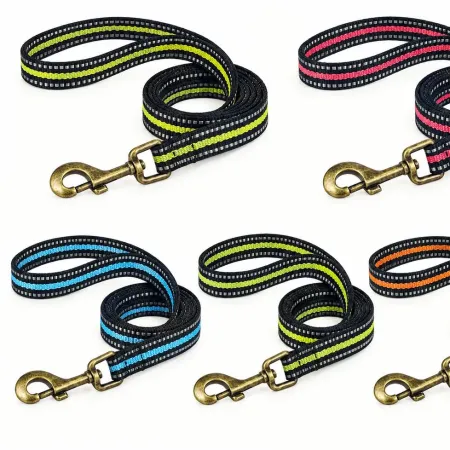
Most custom pet leashes projects begin with a photograph, and a photograph is not a specification. It shows a band, a hook and a colour, and it says nothing about width, thickness, stitch density, thread size or the internal width of the slider the band has to pass through. The first real decision in a custom lead is therefore not the design; it is who converts the picture into a set of numbers, and that answer decides how many sample rounds the project needs.
This guide covers the three decisions a sample settles, the four places a custom lead goes wrong, six lines a custom brief should carry, and the two qualities a sample can never demonstrate no matter how many rounds are run.
Custom Pet Leashes: Three Decisions a Sample Settles
A sample exists to answer questions that cannot be answered on paper. Three of them are decided by the first round, and everything after that is refinement rather than discovery.
- The hand of the band — the same width in two thicknesses feels like two products, and only a hand decides which one belongs on a shelf at a given level.
- The colour against the hardware — a colour that looks correct in a Pantone book can read dull next to a bright plated hook, and the pair has to be seen together.
- The balance in the hand — where the mass sits when the lead is held at the handle, which is a function of hardware weight and band stiffness rather than of either alone.
| Sample round | What it answers | What it cannot answer |
|---|---|---|
| Construction | Whether the band, width and weave suit the product | Whether the shade survives a summer of sun |
| Colour | Whether the dye lot matches the target under office light | How it looks under shop lighting or daylight |
| Hardware | Whether the hook suits the collar ring and the hand | Whether the gate spring lasts three winters |
| Branding | Whether a label, a print or a woven mark reads at size | Whether the mark survives washing |
The band is chosen before the fittings
A 25 mm base clearing 2000N is stronger than the joint that will be sewn into it, so the band can be chosen on hand, colour and cost without worrying about the load. That is a useful freedom in a custom project, because it means the expensive decisions are the hardware and the finishing, and those are the ones a sample round should be spent on.
Four Places a Custom Lead Goes Wrong
The reference is a finished product, not a band
A buyer often sends a competitor's lead and asks for something similar, and the request hides three separate items: the band, the stitching and the hardware. If the brief names only the look, the factory will match the closest band it stocks and choose a hook it can get, and the result will be similar in a photograph and different in the hand. Splitting the reference into three lines before the first sample is what prevents the third round.
The colour is approved under the wrong light
A dye lot is approved across a desk, under whatever lamp the office has, and then displayed under a shop light or sold outdoors. Narrow woven band has a slight sheen that shifts with angle, so two panels cut from the same roll can read differently depending on how they lie. Approving a shade on a flat swatch and then on a stitched lead, under two kinds of light, removes most of the argument that follows.
The hardware is the only part with a tooling cost
Band, dye and stitching are settings on equipment that already exists; a bespoke hook body, a custom buckle or an embossed plate is a tool, and a tool is the one item in a custom lead whose cost does not fall with order size in the same way. A project that wants a unique fitting should expect that decision to be the long lead item, and should decide it before the band colour rather than after.
Six Lines for a Custom Brief
- The dog and the walking style — weight in kilograms and whether the lead is for street, trail or training, since that changes width before it changes anything else.
- The width and the thickness — given as a pair, because a width alone does not describe a band and a supplier will otherwise pick the thickness that suits the loom.
- The colour reference — a Pantone number plus a physical target if one exists, and a note on which light the sample will be judged under.
- The fitting, named and sized — hook type, ring size, swivel or fixed, and the finish, because this is the part a customer touches first.
- The stitching — thread size, stitch density and whether the tack is single or double, described in the same terms the factory uses rather than as "strong".
- The packaging and the label — whether the lead is hung, boxed or bagged, since a hanger loop has to be built into the assembly rather than clipped on afterwards.
The packaging line is not an afterthought, because a lead sold on a display hook needs a header loop sewn into the handle end, and that loop has to be planned with the stitching. Adding it after the sample is approved means re-stitching every piece, and the cost of that is concentrated in the first order rather than spread across it.
Custom work on this product usually starts from a nylon webbing base in 20 mm or 25 mm, with a polyester webbing alternative where sun resistance matters more than stretch. Colours are matched to a supplied reference rather than to a screen, and the sampling route exists so that the first piece comes off production settings instead of a bench. The lab report that follows should name the thread and the tack, not only the band.
A brief survives a project only if a third party can read it. The person who approved the colour is rarely the person who places the reorder, and in two years neither of them will remember which light the swatch was checked under. A one-page sheet holding the width, thickness, colour reference, thread, tack and fitting, with photographs of the approved piece, turns a custom project into a repeatable product and makes a second order a confirmation instead of a negotiation.
Two Things a Sample Cannot Show
How the lead behaves on the third walk
A new lead is stiff and sits neatly in the hand. Three walks later it has taken a set from the way it was carried, the band has softened where it passes through the slider and the handle has begun to mould to a palm. A sample is judged in its first hour, when it is at its least representative, which is why walking it for a week before approving a colour is worth more than a fourth sample round.
Whether the shade reads the same on the second order
A custom colour is a dye recipe, and a recipe reproduces within a tolerance rather than exactly. Two orders placed six months apart will differ slightly, and the only defence is a retained standard: a physical piece kept from the approved lot, stored away from light, that the next run is measured against. Without one, every reorder is a fresh argument, and the second order is the one where a range starts to look inconsistent.
FAQ: Custom Pet Leashes
Can a lead be made from a photograph?
A close match is possible, but the photograph has to be broken into band, stitching and hardware first. Asking for three decisions is faster than asking for one.
How many sample rounds are normal?
Two, if the brief is written. Three or four when the colour is being found by eye rather than matched to a reference.
Is a custom hook worth the tooling?
For a range with a strong identity, yes. For a first order, a stock hook in the right finish usually sells the product just as well.
How close can a Pantone match be?
Close enough that a shade card is signed off, not close enough to be identical. The variable is the dye lot, and a retained standard is how it is controlled.
Should the collar and lead be developed together?
Yes. A set is one dye decision and one hardware decision, and developing them apart is how a range ends up with a lead in six shades and a collar in four.
A custom pet leashes project runs on three decisions and one written brief. Name the band, the colour and the fitting, say which light the shade will be judged under, and keep a physical standard from the approved lot.
Why Xinxiangrui for Custom Pet Leashes
A custom lead is settled by the sample, so the sample is where the work should happen. Free samples, Pantone colour matching and development from a drawing or a physical reference are standard routes here, and because weaving, dyeing, printing and hardware assembly share one site, the first piece is built on production settings rather than assembled by hand on a bench. Send us the drawing, the width and the target market, and we reply with a construction.