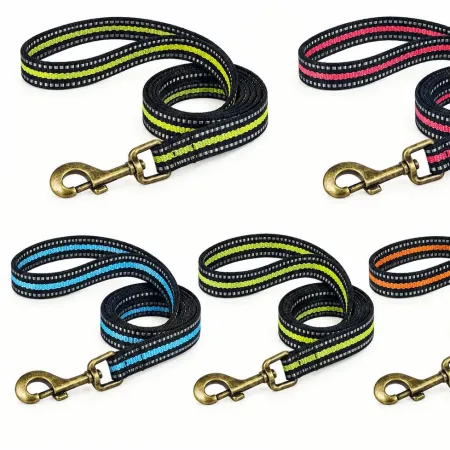
Pet Striped Dot Reflective Webbing: Coverage and Edges
A dotted band has more edge than a striped one, and edge is where a coating begins to leave. Pet striped dot reflective webbing is sold on appearance and judged on durability, and the two are linked by a quantity that never appears in a catalogue: the total length of the boundary around the reflective shapes. A stripe running the length of a band has two long edges. The same reflective area broken into dots has a perimeter many times larger, and every millimetre of that perimeter is a place where a peel can start.
This guide covers how the two patterns differ geometrically, why coverage and legibility pull in opposite directions, what happens to a dot when the band bends and washes, six lines a patterned brief should carry, and the two things that only become visible at a distance.
Pet Striped Dot Reflective Webbing: Two Geometries
Both patterns put the same optical material on the same band. What differs is how the material is divided, and division is what decides how the product ages.
| Pattern | Edge per unit of coverage | Where it suits |
|---|---|---|
| Solid stripe | The lowest, since two long sides serve the whole area | Leads and collars that will be dragged, washed and pulled |
| Wide dashes | Moderate, with a short boundary at each end of each dash | A pattern that reads as a stripe at distance and breaks up close |
| Dots | The highest, since every dot carries a full circumference | Coat trim, fashion ranges and light-use accessories |
| Fine dot lines | The highest of all, and the least forgiving to print | Presentation pieces where the pattern is the point |
The arithmetic is easy to state and rarely done. A 5 mm dot has a perimeter of about 16 mm and an area of about 20 mm², so its edge-to-area ratio is roughly four times that of a stripe 5 mm wide, which has 10 mm of edge for every 5 mm² per millimetre of length once both sides are counted. Four times the boundary for the same amount of optical material is four times the number of starting points, and that is the whole reason a dotted band ages faster than a striped one of identical grade.
The pattern does not weaken the band
A printed or transferred dot sits on the surface, and a 25 mm base band clears 2000N whether the face carries a stripe, a dot line or nothing at all. The difference between the patterns is entirely about how long the reflective face survives, not about what the band can hold. That separation matters when a range is built on one base with several faces.
Three Things a Dot Pattern Changes
Coverage is not legibility
Two patterns can cover the same share of the face and read completely differently. At a distance the eye stops resolving individual dots and averages them into a grey haze, which is dimmer than a continuous stripe of the same area because the gaps do not return light. A dense dot field can therefore be less visible than a sparse stripe at the distance where it matters, and more attractive at the distance where it is sold. Both are legitimate; only one of them is being bought for safety.
A dot deforms when the band bends
A circle printed on a flat band becomes an ellipse when the band curves around a neck, and the compression is on the inside of the curve. A stripe has no shape to distort and a dot does. On a tight radius the dots on the inside of the curve close up and the pattern appears to crowd, while on the outside they open. It is a cosmetic effect, and on a small collar it is visible enough that a buyer comparing a flat sample with a finished piece will ask about it.
Small shapes are harder to bond
On a transferred pattern the adhesive has to flow into the weave under pressure, and a small shape has less area to distribute that pressure across. The result is a dot that is fully bonded in its middle and marginal at its rim, which is invisible on inspection and shows up as a ring of lifting after a few washes. Making the dots larger, spacing them further apart or rounding them rather than using a sharp-edged shape all improve the bond at no cost to the design.
Six Lines for a Patterned Brief
- The pattern at final size — dot diameter and spacing in millimetres on the finished band, not on the artwork sheet.
- The coverage wanted — the share of the face that returns light, agreed as a number so that two patterns can be compared.
- The viewing distance — where the product is expected to be seen, since that decides whether the dots resolve or merge.
- The route — printed, transferred or woven in, because a woven-in stripe cannot make a dot at all.
- The bend radius — the tightest curve the band will follow, which sets how much the dots will deform.
- The wash condition — the cycles and temperature the pattern must survive, since a dot field fails at its rims first.
The second and third lines are the pair that resolves most arguments. A brand wants a pattern that photographs well at thirty centimetres; a safety buyer wants one that reads at thirty metres. Writing both numbers down produces a design that satisfies the first without pretending about the second, and it prevents the later discovery that a much-admired motif disappears at the distance a car approaches from.
- Fewer, larger dots — better bond, better distance reading, and a cheaper print setup than a fine field.
- A dot plus a stripe — one continuous element keeps a line at distance while the dots carry the design.
- A repeat that divides the cut length — so a collar and a lead end on the same part of the pattern.
- A plain margin at the selvedge — where a stitch line or a buckle will sit, so the pattern is not cut through twice.
A patterned band is the same pet reflective webbing construction as a plain one, printed or transferred on the face, on a base from the polyester webbing line. The assembled pieces appear on the pet leashes and pet harness pages, and the development process is where a repeat gets sized to the product.
Two Things Visible Only at a Distance
Where the dots merge
Every dot pattern has a distance at which it stops being a pattern and becomes a tone. That distance depends on the spacing and on the observer's eye, and it is the single most useful thing to know about a design. Photographing the band at five, ten and twenty metres under one lamp shows the transition and tells you whether the pattern still contributes at the range the product is used. It takes ten minutes and settles a question that otherwise returns as a complaint about a band that looked brighter in the picture.
Which dots fail first
A dot field does not wear evenly. The dots at a fold, at the selvedge and beside a seam lose their rims before the dots in the middle of a panel, and the loss reads as a pattern that has gone patchy rather than as a band that has worn. That appearance is harder to explain to a customer than uniform dulling, and it is another argument for keeping a continuous element in the design so the product still reads as reflective while the dots age.
FAQ: Pet Striped Dot Reflective Webbing
Is a striped band more durable than a dotted one?
Usually yes, because a stripe has far less edge. A dot of the same area carries several times the boundary, and boundaries are where a coating lifts.
Does more coverage always mean more visible?
No. At distance a dot field averages into a tone, and the gaps return nothing. A stripe covering less area can read stronger from far away.
Why do dots look oval on a finished collar?
Because the band curves. A circle on a flat strip becomes an ellipse around a neck, compressed on the inside of the curve and stretched on the outside.
Can the dots be woven in?
Not as dots. A woven-in reflective yarn makes straight bands along the warp, so a dotted design is a print or a transfer rather than a weave.
How small can a dot be?
Below about a millimetre the shape has more edge than face, and it is difficult to bond reliably. Above that, the limit is the print resolution rather than the material.
Pet striped dot reflective webbing is a trade between a pattern that looks good up close and a stripe that reads at a distance. Measure the edge, name the viewing distance, and keep one continuous element.
Why Xinxiangrui for Patterned Webbing
A dot pattern is a print decision on a coated band. The pet striped dot reflective webbing made here is printed and coated in the same 8,000+ m² plant in Dongguan as the loom, so a repeat that does not divide the cut length is corrected before the roll is run rather than after. Dot size is set against the distance card a buyer supplies, and one base carries a plain, striped or dotted face without a new construction. Send us the drawing, the width and the target market, and we reply with a construction.